2014-01-14

D&D Module X10: Red Arrow, Black Shield

D&D Module X10: Red Arrow, Black Shield, is, in my opinion, a true masterpiece. It was published in 1985, a seminal year for the game -- possibly the end of the "golden age" at TSR (among other things, the year when Gygax left the company). Written by Michael S. Dobson, module X10 combines high-level RPG heroics with a world-spanning military campaign, miniature wargaming, and copious connections to the prior history of published adventures.

The module package comes with a 48-page booklet detailing the adventure, a poster-sized hexmap of the entire D&D "Known World" area, 200 cardboard counters for various divisions and legions contesting for that geography, a plastic baggy for carrying the counters, and a 3-panel cover (the inside of which has statistics for all the military forces).

Basically, the situation is this: The "Master", archvillain of the X4-X5 module series, is back -- and he's leading an almost endless horde of nomads and monsters out of the desert to conquer as much of the Known World as he can. The PCs (likely having faced him before) are drafted as Ambassador Plenipotentiaries to travel to the various countries and try to hammer out an alliance that can fend off the Master's armies. Generally in each capital the PCs will be face some quest, challenge, honorable combat, or roleplaying negotiation to sway the nation's leaders -- frequently with desert emissaries present, fighting for the opposite outcome. National alliances are run on a points-based system, and as the PCs travel about, other countries may ally or declare war against them (in accordance with their prior interests and rivalries). While war boils over on a strategic scale, with luck the PCs can put together an elite fighting force to take as a vanguard against the Master -- possibly culminating in an epic man-to-man showdown against the Master and his various allies at the edge of the Known World. The whole thing pretty much rocks.

When I ran module X10, my friends and I were in high school. We'd played D&D pretty heavily on lunch breaks in late grammar school and junior high, but our interests were veering in different directions, and it had gotten pretty rare for us to get together and play D&D anymore. I scheduled a weekend together to play "one more time", planning to use X10 as a grand finale for the D&D characters they'd developed over the prior 7+ years or so. The setup was kind of perfect -- their PCs had adventured against the Master in X4, but not seen his actual defeat in X5 (my roguish players had obtained & read that module in advance, so I aborted running it). Unfortunately, it was simply too big of an adventure to play overnight or on a weekend -- we got about halfway through it, with some good successes on their parts, before our time ran out. It was indeed the last time we ever got together for D&D, and the ultimate outcome for our world was left unresolved. An itch and a curiosity that I've unfortunately never been able to scratch.

Funny aside: When I go Googling for answers to D&D-related questions it's gotten a bit silly on how often this blog by your truly pops up in the results. For example, when I went looking for an image of the X10 map, some odd inclusions were: (a) the Star Frontiers: Knight Hawks boxed set contents, (b) various scans of old Thor comics, (c) a photo of an ancient scroll, and (d) Joel Rosenberg's novel The Sleeping Dragon. As it turns out, these were all images from blog-posts here where I incidentally mentioned Module X10 in the past. (In particular, this reminded me that in my first SFKH post from one year ago, Random Wizard mentioned how much that game reminded him of X10 from the same time period. How apt!)

Anyway, Module X10 spans at least 3 scales of action (feeding into my interest in such games): man-to-man roleplaying (regular D&D), tactical wargaming with miniatures (using Battlesystem by Knight Hawks' Doug Niles), and strategic campaign conquest (using War Machine by Frank Mentzer). At the time, I ran the tactical combats (where PCs were present) using Gygax's Swords & Spells system -- now, obviously, I would use my Book of War rules which fix a lot of problems in those older rules. While I'm generally very critical of Mentzer's War Machine rules (for not giving results the same as the D&D game itself), I would agree that in a worldwide campaign of this scale something more abstract must be done to handle the many (many, many) battles where the PCs are someplace else, and so I was using that at the time.

X10 serves as a "bridge" product, intending to be an appropriate denouement to PCs who played through the Expert set (level 4-14) adventures, and introducing them to action at the level of the Companion (level 15+) set and Battlesystem rules; that is, at the scale of kingdoms and empires. X10 contains several high-level monsters from the Companion rules (at least one mega-dragon), a 6-page summary of the War Machine rules from that set, and a list of Companion-level spells usable by the 30th-level Master in personal combat. It also predates the Gazetteer series of 1987-1991, so at the time X10 sketched out the most detailed information on the various D&D Known World nations in publication. 

One of the delightful and loving things about the adventure is the multitude of connections it makes to other adventures before and after -- it might hold a record for adventure with the most references or links to other adventures. When the PCs visit the Grand Duchy of Karameikos (likely their earliest stomping ground), it is pointed out that the Duke likely knows them from their activities in any of the B-level modules: especially B1, B2, B3, B6, and BSOLO. Elsewhere connections are made to almost all of the X-modules: X3 (saving the King of Vestland), X4 and X5 (prior fights against the Master of the Desert Nomads), X6 and X9 (destinations available from the starting city of this adventure), X7 and X8 (actually sub-adventures recommended here as quests for when PCs travel as ambassadors to the Minrothad Guilds!). Even XL1 Quest for the Heartstone gets a nod (the tie-in module to action figures like Strongheart, Warduke, etc., remember them? Now the good members are the comically senile retired lords of the Kingdom of Ierendi). Finally, when the PCs attend the court of the Emperor of Thyatis, his offer is direct, simple, and rather brutal: pledge to move to Norworld -- the region of the first Companion-set module CM1 Test of the Warlords -- establish kingdoms under his sovereignty, and give him everlasting fealty. Then mighty legions of Thyatis are the PCs' to use in war against the Master; what better way to segue into the adventures of the CM-series thereafter?

Now, a few things are a bit wonky with X10. One thing is that it tries to abstract out city action into a singular flowchart with 25 circles and various connecting arrows (i.e., no city maps), and I don't think that it works as well as desired. The other strange thing is how it portrays the Master in the inside illustrations -- they make him look just like Ayatollah Khomeini, the USA's main international bogeyman of the 1980's. In fact, the image behind his henchman Alrethus is pretty much a knockoff of when he was Time Magazine's Man of the Year for 1980. I think when I was a teenager I considered this representation clever, but now the topical political connection seems dated and kind of embarrassing.

So, Module X10: I give it an "A" for ambition, setting, writing, packaging, game-balance, design of the epic war game, design of the unique political alliance negotiation system, respect and connections for prior work, and more. Even though I never played it to completion myself. You could consider structuring X10 as an entire high-level campaign unto itself, including many of the other X-modules as side quests along the way (esp.: X2, X3, X7, and X8). You'd have to make decisions about how to deal with tactical battles (I recommend Book of War), strategic battles (the included War Machine Redux is as good as anything, I suppose), and generally keeping the campaign map set up with all the divisional counters for weeks or months on end (perhaps taped to a wall with sticky material placed under the army counters). 

If you're intrigued by Module X10 (one of my favorite adventures ever), you can use the following affiliate link to get it (and help support the Wandering DMs channel at the same time):

Red Arrow, Black Shield at DriveThruRPG

Question: If you ever played module X10 through to the conclusion, what was the result in your game?

2014-01-12

Super Sunday – On Disneyfication

In 2009, Marvel Comics was bought by the Disney corporation. Generally speaking, this is just one more step in Disney's inevitable conquest of all things beloved in my childhood: Marvel Comics, Star Wars, the Muppets, what-have-you. A Borgification, if you will.

Let's talk about the Marvel cartoons produced in the last 15 years or so. My opinion is that series such as X-Men: Evolution (2000-2003), Fantastic Four: World's Greatest Heroes (2006-2007), Wolverine and the X-Men (2009), and Avengers: Earth's Mightiest Heroes (2010-2013) are very fine works of art, and I've watched them multiple times with my (non-superhero loving) girlfriend to great mutual enjoyment. However, from what I can tell more recent series have "jumped the shark" and have become barely watchable. It's not completely definitive that Disney is the one to blame, but it does match up pretty closely with series that are entirely developed and produced post-buyout.

The change seems pretty clear to me, and I can see it in both the one-season cutoff to the Wolverine show, and the distinct tonal change to the Avengers show in its second season. Wolverine and the X-Men was perhaps the zenith of Marvel TV production, having evolved a very mature sensibility and style, presenting an unrelentingly tense, and frequently terrifying look at a nigh-dystopian present and future. Avengers: Earth's Mightiest Heroes, while having a more cartoonish art style, had very  textured characterizations, and an ingenious season-long plot hook, which I found to be extremely satisfying (and I wrote about here).

More recent cartoons (Ultimate Spider-Man, Avengers Assemble, Hulk and the Agents of SMASH) suffer from a number of self-evident problems. One is that some directive has gone out to explicitly skew them towards a younger audience; gone are the tense themes from the earlier X-Men series, for example. Second, and related, is that some requirement has been put forward to make them "funny" in the most juvenile fashion possible: it seems like every episode requires one or two slapstick moments or really stupid, forced jokes. (Examples: mini-Spider-Man asides to the audience in the fashion of Family Guy, Hulk mugging for the camera in a reality-show "private cam" recording device, Iron Man announcing that he's erased Dr. Doom's video streaming queue, etc.). Third, the shows seem to have become nearly wall-to-wall mindless violent action sequences for the entirety of the episodes (some of the best scenes from the old Avengers show were the complicated evolving relationship between Clint and Natasha, or Steve trying to give Tony boxing tips; no more of that). Generally the characters seem a lot dumber, either because that's supposed to be funny or because the writers are lazier about caring for forced or holey plot points.


If you watch both of those videos above that I found at random in the last day or so, for about 2 minutes or so each, you'll notice that both of them feature giant green booger jokes. Maybe that was actually a requirement from the executive offices, I don't know.


Another problem, most evident in the Avengers Assemble show, is that the old show was terminated and the new show produced in order to align the property with the current Marvel movies being produced. Specifically: the character designs were redrawn to make the characters look exactly like they do in the movies (the cartoon Captain America now looks exactly like Chris Evans, Hawkeye like Jeremy Renner, etc.). But this is a fool's errand, because the the cartoons will constantly be playing catch-up to the movies in this regard. Consider: A cartoon series produces around 20 episodes or so per year, while a movie franchise puts out one production every two years or so; therefore the cartoon needs to present about 40 times as many heroes and villains over its run. Granted that movie producers are given free reign (and encouragement?) to totally re-design any character from the ground up, they will without exception be different from the cartoon, and thus leave the cartoon once again out-of-synch with the movie property. A great example of this is the Avengers Assemble inclusion of the Falcon as a primary team member; while all the other members look identical to their recent movie appearances, the Captain America movie coming out next year has used the Falcon character, and of course totally redesigned him, leaving the cartoon distractingly out-of-synch in this regard. But that would go for any hero or villain covered by the cartoon that a movie later opts to use. Really better to let the properties evolve naturally in their own universes, as these kind of misalignments are inevitable, and only highlighted when the other roles are freakishly duplicated.


So it seems like to me, the "golden age" of the animated Marvel TV show has come to a close, in light of Disney looking like it's forcing an attempt at a much younger audience, and requiring that the shows be an appendage to the enormous movie franchise that they currently have going. (Which is a loss in the sense that I think that the recent cartoon shows had much more satisfying writing and character development; not being allowed to truly take advantage of the longer-form medium is a real shame.)

A final, corollary point is how this development again proves the lie to late-era D&D and Star Wars apologists (etc.) over whether our vision is clouded by mere age and nostalgia. Once again we can easily perceive a compelling and exciting piece of storytelling (like Wolverine and the X-Men or Avengers: Earth's Mightiest Heroes), even when we are well into our adult years, and note the disaster that occurs when the property is taken over by marketing interests who want to change its pitch to an audience of the youngest children at all costs.

2014-01-07

Quantum Roleplaying

In quantum mechanics there's this idea of wave function collapse, in that interaction with a measuring device supposedly causes a wave function to reduce from a plurality of eigenstates to just one. My interpretation is that it's simply saying this: before you roll a die, there is a probability that it lands on any face (for d20: 5% 1, 5% 2, 5% 3, etc.), but the instant you actually roll it the possibilities collapse to just one (100% certainty about the particular result that you rolled). *

It seems to me that this is quite similar to the moment in RPG's when a designed scenario full of  possibilities switches to a narrative story, at the point in time when you actually play it. That is, "scenario becomes story" when the dice hit the table and we find out what actually happened. Prior to that moment there are endless possible outcomes -- a statistical space, really -- whereas afterward there is one known outcome which we then seek to explain as a "story". Story generally exists only after the fact, not before play, in RPG's. *

We might more broadly say that this occurs in any live performance: theatre or music, for example. Technically many possible exciting things can occur which we only know about for sure after the fact. However, this phenomenon is several orders of magnitude easier to see in RPGs, which has such an overabundance of possible outcomes (in conjunction with both player choices and random die-rolls), as opposed to theatre or music, where the script and rehearsal set a relatively narrow expectation for what should happen in the performance.

* Note: This is a heretical interpretation on my part.

New Magic Item: Arrow of Time

This very rare arrow acts as +3 to hit and damage. On the round when it is fired, probabilities for critical hits or fumbles are tripled (i.e., if normally 1 or 20, become 1-3 or 18-20) for all parties in an encounter. If hit, then the target must save vs. spells or else only achieve average results for the rest of the encounter (i.e., automatically roll a natural "10" for any to-hit roll or save, exactly average damage or spell duration, etc.). It is occasionally produced by chronomancers and best used by parties who are overwhelmed by stronger forces and expect to lose the fight without extraordinary help.


2013-12-28

SciFi Saturday – 30 Years of Star Frontiers

Last January I started posting about the 30th anniversary of the space-combat game by Doug Niles, published by TSR, Star Frontiers: Knight Hawks. At the time, I figured I'd have enough material to maybe last three or four months. But here it turns out (somewhat assisted by my getting into assembling, casting, and sculpting spaceship miniatures for the first time) that I've managed to make a post about the game every single Saturday for the entire year. That's certainly the most consistent that I've ever managed to be about any art/gaming project.

I've heard it said that one should be careful about what a boy gets into at age 13, because he'll be stuck with it as an interest for the rest of his life. For me, I turned that age in 1983, which was a pretty important year for the gaming hobby, as the D&D boom was still going strong, if tipping into the downslide at that time. Among the important releases that key year:
  1. The D&D Red Box Set by Frank Mentzer. It's not "my" version of Basic D&D, but I know that it escorted many new players into the game, so for that I have to be thankful.
  2. The Greyhawk boxed set, expanding the earlier folio with more game-able information, which I had on my wall, and set almost all of my adventures in, for many years.
  3. D&D modules X4 and X5, the Master of the Desert Nomads series, which for all its playability flaws, has among the most epic set-flavor of any wilderness modules ever. I can still remember reading it on Christmas afternoon 30 years ago this week, on the couch at my grandmother's during the big family gathering, feeling like I had been hit by a thunderbolt.
  4. Walt Simonson's legendary run on the Mighty Thor comic began, with its arcane mix of mythology, Nordic adventure, superheroism, and Kirby-esque cosmic space opera. (Some argue that this was simply the best comic series of all time.)
  5. Somewhere at TSR, the Marvel Super Heroes roleplaying game was working its way through production channels, to be released the next year.
  6. Doug Niles' Star Frontiers: Knight Hawks game was released, completing the Star Frontiers set and allowing us to roam and fight for the stars themselves. (And had sufficient legs as to be cross-referenced by other TSR games like MSH for spacefaring rules.)
All in all, an intoxicating and inter-connected brew of adventure, mythology, science, and wargaming which I was never able to shake off. I think that was also the summer that I spent almost the entirety in the basement with the TSR-80 Color Computer I'd gotten that year, working through the two books of BASIC programming projects from beginning to end on the little chicklet keyboard, and saving programs on the squawky audio tape recording system. And writing programs to let me play things like Bismark and Knight Hawks solo, for example. So that's basically the life-arc that I've been on ever since.

I think that in the mid-80's, Doug Niles may have been about the strongest actual game designer that TSR had producing work for them. His Knight Hawks game really hit all the right notes, I think, and it's taken about three decades years of tinkering with it to really see any flaws, and they still don't bother me very much. (That's high praise.) Likewise, his Battlesystem mass warfare rules were almost-but-not-quite-incredibly-good, a much-needed improvement over the Swords & Spells and Chainmail games that didn't really synch up with D&D anymore, the way it had evolved. It made a big splash, and you can tell that the guy cared deeply about the work with the revisions he made in the follow-up edition. (If not 1983, then the runner-up for most important year in gaming for me would be 1985, with the release of Battlesystem, supplements for Marvel Super Heroes, publication of Unearthed Arcana, and the departure of Gygax from TSR.)

So anyway, these 52 Saturdays are almost-but-not-quite everything that I have to say about the game at the moment. I don't plan to be posting every Saturday anymore, although there may be occasional game reports, and perhaps one last project that I didn't get to complete by the end of the calendar year. You'll see a shift back to more actual D&D-related posts (as per the name of the blog, after all) that I somewhat got away from in recent months.

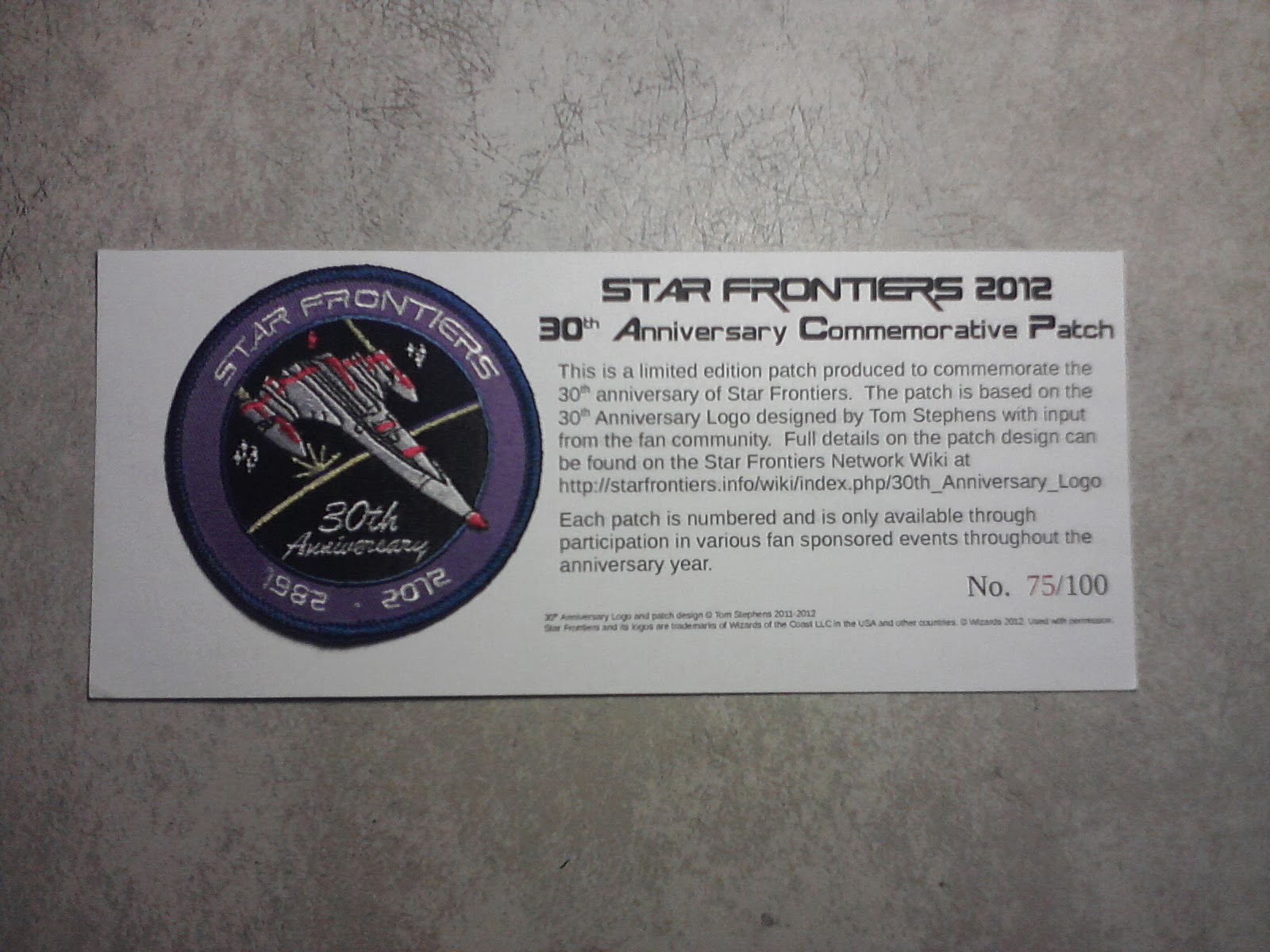
In a rather beautiful piece of serendipity, just yesterday I received in the mail the limited-edition Star Frontiers 30th Anniversary Commemorative Patch from TerlObar, which is a rather beautiful piece, featuring the Assault Scout design in which all of our PCs would fly around to adventures (and hopefully not instantly blow up in a fight). I'm immediately going to put it on my backpack that I carry to school and class every day, sweet. (There are still some available for ordering at the link above.)


And one last thing:  The 13-year old me would stand in the hobby store at the mall across the state line and stare rather longingly at the brightly-colored boxes of spaceship miniatures for the game, wishing that he had the money to purchase them. Maybe two decades after that I got those boxes on EBay, but still didn't have the gumption to actually tear them open and assemble and paint them. So when I started this year I had zero actual Star Frontiers: Knight Hawks miniatures on my shelf to play the game with. Now I'm happy to say that's been greatly rectified; below you'll see a photo of my overall combined fleet. Both the 13-year old me and the current actual me stand in agreement in saying "pretty cool"!


Thanks for reading this stuff and your thoughtful comments are always appreciated. Hope you and your loved ones are safe, happy, fulfilled, and get even better in the new year. Have some good holidays and we can plan to read each other again in 2014.

2013-12-21

SciFi Saturday – Miniature House Rules

Since I've gotten into assembling & playtesting the Star Frontiers: Knight Hawks miniatures in only the past year, I've developed a small set of house rules that I find it conducive to play by. Some of the normal SFKH rules don't work so well on an open (hexless) play space, or become too fiddly, especially for non-hardcore wargamers (i.e., casual friends and acquaintances). Therefore at the end of a year of testing this is how I run the game these days:
  1. Generally my basic boardgame rules are in effect, in regards to speeds, orbital movement, docking at stations and carriers, and assault scouts having 25 hull points.
  2. Fleets are chosen by my simple point-based method. Each side gets index cards for each ship. Protractors should have the 60° marks highlighted for turning.
  3. Defender chooses a board edge or sets up planets & satellites, as appropriate. Attacker then sets up ships on a board edge, documenting initial speed. Defender then sets up ships, on opposite edge or near planet if any. (This is rationalized by defender sensors informing them of incoming fleet configuration, and allowing them to respond intelligently.) Maximum starting speed is 10 for any ship. Attacker moves first. Roll dice if attacker/defender is not obvious.
  4. Pre-measuring is allowed before any move or fire designation. (Again, this is rationalized by advanced sensors giving full information on distances, and maintains continuity with the hex-based boardgame.)
  5. Measurement is specifically made from front-post to front-post of all ship miniatures. Round to the nearest inch for all measurements (esp. range diffusion: down if under 1/2", up if 1/2" or more). When used, line protractors up on top of ships; usually there's a key bulge that fits into the pen-hole on the protractor.
  6. On movement, player must document (write down) all current speeds first, then make actual movements on the table. No take-backs of the maneuvering are allowed once the ship has moved from its initial position. (Unlike in the hex-based game, unwinding movement to change a decision is simply too difficult.)
  7. Turning is made via my alternate movement rule: divide current speed by the MR and round down; this is the minimum number of inches the ship must travel before each 60°rotation. (This seems more realistic and makes it easier to move ships otherwise in close proximity.) Note that frequently the protractor edge is the only thing needed to measure these short steps (tape measure rarely necessary.)
  8. Defensive fire is taken only against opponent ships' final location in a move. The book rule that permits firing at any closest point on a move is not used. (Trying to mark the closest point in any move versus all opponent ships in open space is much too difficult; and this acceptably simulates constant motion throughout the turn.)
  9. Forward-firing cannons can hit targets within 30° left or right of the nose (as noted in the Conversion Booklet). The Head-On Shot rule is ignored (because it is too fiddly and prone to argumentation on the open tabletop).
  10. No ramming or collisions are allowed. Place ship miniatures as near to each other as space allows on any close movement.
So that's what works pretty well for me at the moment.  Do you have any boardgame house rules that you think are critical that I've overlooked?

2013-12-14

SciFi Saturday – Forgotten Photos

The other day I came across some hi-res photos that I took with my girlfriend's better camera while I was constructing custom Star Frontiers: Knight Hawks miniatures (mostly the fighter minis), but forgot to use in my prior posts as I was casting them. Since they give some nice detail to what I accomplished as an amateur sculptor, here they are today.

First, a close-up of a metal pour as it starts to cool:


The UPF Fighter trio figure:


The Sathar Fighter sculpture as it gets finished:


Sathar Fighter close-up:


Three Sathar Fighter casts next to a quarter for scale:


2013-12-07

SciFi Saturday – Ping Pong Planets

Here's the latest addition to my set of miniatures for playing the Star Frontiers: Knight Hawks game -- whereas action around planets and space station is an integral part of the tactical game (and essential to the one-and-only Sathar victory condition in the Campaign game), the official miniatures don't come with any representation of these features. So I thought for a while how I could make my own.

It finally dawned on me that at the game scale of 1" = 10K km, a ping-pong ball is actually very close to the size of an Earth-like planet (like all the inhabited planets in Frontier space). In particular, the current ping-pong ball is 40mm * 1 in/(25.4 mm) * 10K km/(scale in) ~ 16K km, whereas the diameter of the Earth is close to 13K km. So I bought some ping-pong balls and started painting them, as well as assembling standard SFKH stands and bases for them. Below you can see my best take on planets in the fashion of Earth, Mars, and Venus. (The Earth planet is actually the result of a simulation in Maxis' SimEarth game; the Mars one was my best freehand recreation of the real Mars).


The only problem with this, having completed the project, is that of course the SFKH ship miniatures are not at the same scale (they're at a scale of about 200,000 times larger). While this is also true for the counters that come in the boxed set, the visual effect is limited when playing on the hexmap, because the hexes themselves box the figures in to a known, limited space. When playing on the open tabletop the effect is a little more wonky:


I also made a black hole. There's a whole prior post from when I was planning this about what scale to interpret the black hole at, and how the resulting gravitational force would affect the game.


Finally, I purchased what seems to be the only small-scale space station miniature that exists on the open market and set that up on a similar stand and base. Now I think I finally have everything necessary for the very first scenario in the Knight Hawks tactical game book. :-)