In D&D, has it ever bothered you that an archer's chance to hit a target at 200 yards is only minimally reduced from that at 10 yards? Or that lumbering giants can almost unerringly strike their tiny victims at enormous range? I'd like to make a single pointed argument here: the range modifiers for man-to-man combat in D&D are far too lenient.
Rules from ChainmailInterestingly, in the Chainmail mass-combat rules, there are no range modifiers to hit whatsoever (CM, p. 11-12; although the traditional max ranges are immediately present on p. 10). In the man-to-man combat section, it is asserted that ranges should be split into increments of one-third (p. 25), and in the combat tables, these increments each make a difference of 1 pip to hit on 2d6 (p. 41). Simple, indeed -- however, I'll be forced to argue that the simplicity of 1-point per third-of-range was simply not thought through at all; in fact, it wildly misses the true difficulty of man-to-man archery fire at great range.
On D&D Range ModifiersThe 1-point per range increment rule is carried forward into the basic D&D rulesets. OD&D actually sets the "base" to-hit at
long range, with increasing bonuses for closer distance ("Missile hits will be scored by using the above tables at long range and decreasing Armor Class by 1 at medium and 2 at short range"; Vol-1, p. 20). Gygax's Swords & Spells mass combat rules does the same (S&S, p. 24). The Moldvay/Mentzer line does appreciably the same (regular chances at medium; +1 at short, -1 at long; Rules Cyclopedia p. 108).
In the AD&D line we see an admission that these modifiers are too lenient; here, the rule is regular chances at short range, -2 at medium, and -5 at long (PHB p. 38; DMG p. 74-75). But still, I don't think these are severe enough.
On Issues of RangeFirst of all, let's consider an issue that is frequently overlooked: The difference between shooting at at a massed army, and shooting at a single man. The difference in the size of the target is obviously enormous; and so it's entirely possible that the former may be practically impossible to miss, while the latter may be nigh-impossible to hit, even at the same range. It's reasonable that longbows might be an effective instrument of war at 200 yards or so (against an army); while it's almost unimaginable to think that anyone could hit a given man-sized target (even stationary) at that range. So, it seems like quite an oversight in OD&D (i.e., Chainmail man-to-man rules) to switch blithely from one to the other, using the same range categories and the same chances to hit without major modification.
(Note: In
Swords & Spells, Gygax did address this, with full damage only against large formations, reducing as the target unit's ranks decrease. When the "Target is single creature, about man-sized", then 90% of the normal damage is lost [p. 23]. However, no rule like this transfers into any form of D&D.)
Secondly, keep in mind that by the
inverse-square law, if you double distance, the visible area of the target is reduced to just one-quarter what it was originally. For example: Say you're shooting at a man-sized target at 50 yards. Moving the target to 100 yards reduces the visible area to one-quarter. Again moving the target to 200 yards reduces the visible area to just one-sixteenth what it was originally.
On a Statistical Model of ShootingNow, this doesn't necessarily mean that the
chance to hit is reduced to exactly one-quarter and one-sixteenth in the circumstances above -- that would presume chance to hit is linear with distance -- but it should intuitively imply that hitting targets at very great ranges should be very, very difficult. What should we use as a model of shooting accuracy?
The standard statistical model would be to use a normal curve (
previously developed here). For example, the article
"Analysis of Small-Bore Shooting Scores" says, "... a calculation model based on the central circular bivariate normal distribution has been used to calculate the expected distribution of the the displacement of shots from the point of aim... ", and that this model was at least "partially successful" in predicting shooting competitor's scores. [A.H. Conway-Jones,
Journal of the Royal Statistical Society, Series C, Vol. 21, No 3, pp. 282-296] The term "bivariate normal distribution" basically means a normal-curve model in two dimensions (mostly simply, independent normal distributions for both the x- and y-axis of the target;
see here for description and simulator applets).
Let's look for some real-world data. Way back in the day,
Dragon magazine published on article on broadly the same topic, "Aiming for realism in archery: Longer ranges, truer targets" (Robert Barrow,
Dragon #58, February 1982, p. 47-48). Barrow begins by compiling some interesting information about modern English archery tournaments:
English archers use a 48-inch-diameter target in tournament competition. Since a 48-inch target is about the same target area as a man’s body, these archers’ scores can be examined and compared for use in game terms. A compilation of the twelve highest tournament results during a one-year period shows that the "hit" percentages of England’s finest archers at three ranges were: 92% hits at 60 yards, 81% at 80 yards, and 54% hits at 100 yards distance. The best archers for an entire year of tournament competition still scored complete misses 46% of the time when firing at a target the size of a man at 100 yards range (Archery, p. 240). And these scores were achieved using slow, deliberate fire at a stationary target. [p. 47]
Thereafter, Barrow attempts to extrapolate these numbers into a table for all different ranges. This fundamentally fails, because Barrow is trying to force the numbers into a linear progression, when our normal-curve sense (see above) tells us this certainly won't be the case. For example, Barrow's increments veer up & down irregularly: over ranges 40-140 yards, taken at 10 yard increments, the percentage chances to hit in his table decrease in these steps: 10, 8, 6, 5, 14, 13, 6, 5, 5, 4.
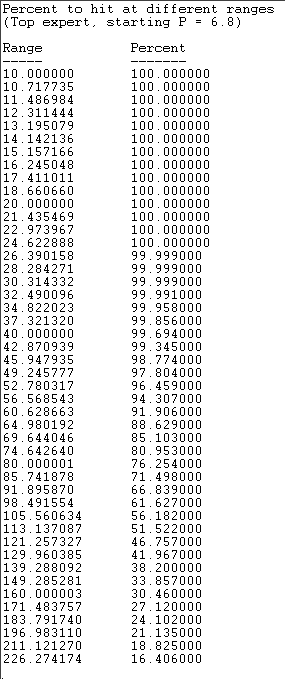
Let's try to do better with our normal-curve model (bivariate, in two dimensions). Write a computer program which simulates this, starting at 10 yards, and stepping back such that distance doubles over the course of 10 steps (or equivalently: shrink size of the target by the same amount in both dimensions). Pick a starting "precision" value that gives results similar to "England's finest archers" above; and fire 100,000 shots or so at each step and see how often they strike the target. A starting precision of P = 6.8 seems to do the job (see sidebar).

First, see how the key targets noted by Barrow basically match his percentages. In the table to the right, range 60 yards correlates with 92% chance to hit; 80 yards is 76%; and 100 yards is something like 58%. (Not a perfect match, but within 5% in each case.)
Let's see what this says about standard D&D longbow increments; we'll look at the
middle-point of each range category, i.e., 35/105/175 yards. At short range around 35 yards, the chance to hit is nearly 100%; 105 yards, 56%; and 175 yards, about 26%. We can immediately see that the chance to hit drops off much faster than any of the modifiers in D&D or AD&D. (More specifics below.)
On Our Results in D&D TermsSo, look back and see if we can model "England's finest archers" in D&D terms. At the short range of around 35 yards, who has a 100% chance to hit (0/1 on d20)? In 1E AD&D, that's like a
12th-level fighter against AC 10 [DMG p. 74] -- and hey, that's the same as in our proposed "Normalizing Resolutions" system (level 12 + AC 10 = success level 22 = to-hit 1 on d20;
see here).
Now let's derive what the range penalties "should" be for these experts. Taking the chances to-hit above (100%/56%/26%), and taking short range as the base, then the "medium" modifier could be -9 (-44% reduction), and the "long" modifier could be -15 (-74% reduction). Or alternatively we could put this in terms of our "normalized" system (probably more legitimate, granted we've used a bivariate normal curve model for our shooting) and level modifiers therein: as noted, 100% is at level 22; 56% is like level 12, i.e., -10 steps; and 26% is like level 4, i.e., -18 steps from the start.
So to make things simple again, by rounding off to convenient numbers, we see that's it's legitimate to set ranged penalties on the order of
-10 at medium range, and -20 at long range. Hitting a man-sized target at 100 or 200 yards out is really, really tough! As we saw from the Barrow article above, even "England's finest archers" should be missing in our medium range about half the time -- and that's against a totally unarmored, and motionless, target. (Any additional penalties for movement are left as an exercise for the reader; or see Len Lakofka's
Leomund's Tiny Hut column in
Dragon #45.) Clearly range modifiers on the order of -1, -2, or -5 are fundamentally very broken.
On Firing at ArmiesBarrow is typical in including a passage like this:
Many claims are made about the greatest distance an archer can accurately fire an arrow. A modern hunting bow (for use in bagging wild game) can fire an arrow almost 300 yards; however, it has an effective range of only 60 yards. The 300-yard shots require special arrows and near-ideal weather conditions. This evidence is in sharp contrast with other sources claiming that an English longbow archer could hit a man at 400 yards. [p. 48]
Perhaps, but again this collapses the issue of firing at a man, versus firing at army (which is what would be of real interest to the English longbowman). Granted that the chance of hitting an individual man at say, 200 yards is almost negligible (20% for our top expert above). But let's consider a larger target; Barrow indicates a competition by the Royal Company at 200 yards, where any arrows within 24 feet of the target count for points.
Going to our program and increasing the target size from 2-foot radius to 24-foot radius, then the "expert" shooter cannot miss at any range (100% in every category). Even switching to "novice" capacity (Fighter level 1; i.e., starting precision P = 1.9 in our model), our shooter has 100% accuracy up to 100 yards and more, and 90% accuracy even at a distance of 210 yards. So I would conclude that the original
Chainmail rule (which is to say; ignore range entirely) is a perfectly good one for the purpose of shooting at armies in mass combat -- even if anything close to that would be wildly atrocious for man-to-man combat.
Some Suggested FixesSo in short, I would actually go so far as to recommend using this derived modifier of
-10 at medium range, and -20 at long range (either as usual to the D&D to-hit numbers, or in relation to "success level" in our normalized system; it's about the same either way in the meat of the progression). Yes, this makes hitting man-to-man targets almost impossible at the longer ranges -- probably for the better, as it's (a) more realistic, (b) keeps the action within playable distance on our tabletop (say, 7" or 14" or so), and (c) leaves some room for progression by the highest-level fighters.
Of course, the preceding was all in terms of outside shots, measured in "yards", etc. What about indoors in the dungeon (where ranges are in feet, thereby closer and easier to hit in our model)? Well, you could think about giving as much as a +10 bonus to hit in that situation (to make a long story short -- literally). But, we never did take into account possible cover, low ceiling, darkness, and frantic combat movement -- so if we start adding those things up, more than likely they add up to about -10 or thereabouts, so we could probably call the whole thing a wash. (Going back to our new -10/-20 modifier.)
Probably thrown weapons -- such as spears, handaxes, and daggers -- with their much smaller range, should not be subject to these increased modifiers for great ranges. I would consider skipping any consideration of range penalties for these weapons entirely. (Or perhaps further research in axe-throwing at targets is in order...)
Open Questions- Would you consider using modifiers of -10/-20 or the like for man-to-man archery?
- Can we use the same modifiers indoors as outdoors (assuming that melee movement counteracts reduced range)?
- Should handheld missiles be without penalty?
- Should we totally forgo ranged modifiers in mass combat rules?
- How important is it to give creatures like giants separate melee and ranged attack scores?
C++ source code for the bivariate normal archery simulator (ZIP archive; GPL/LGPL license) can be
downloaded here.
 In regards to archaic values like shillings and pounds in the Middle Ages, the term of art used by experts and academics is to say that they were "moneys-of-account". But what does that mean, exactly? Let's be very clear, it indicates this: Shillings and pounds were not coins; they were not paper banknotes; they weren't anything physical that you could hold in your hand or carry around whatsoever. They were purely abstract counting units.