Back in the early 80's there were ads in Dragon magazine for an LED-lit stick that would generate random numbers, called the "Dragonbone" (link, although I wish the picture were in the original white, as opposed to that tasteless red color). This definitely caught my imagination, although I never had or saw one, and clearly the functionality was extremely limited. For example: it only did one roll at a time, so it wouldn't automatically roll 3d6 for abilities, or simulate the fistful of dice you need for mass saving throws from spells such as confusion, fireball, sleep (pre-Sup-I), etc.
So I was thinking the other day that obviously this functionality would be beyond trivial on a modern smartphone. Coincidentally, a few days later I had Allier G. contact me to point out his dice-rolling app (link; free and pay versions, Android only, no iPhone).
Does anyone use software-based dice rolling at the table? And if so, what's your favorite application for it? Or: do the benefits of tactility, visibility, security, and naturalness always favor actual dice-in-the-hand?
2014-07-10

2014-07-07
Spells Through The Ages – Confusion

Chainmail Fantasy
Confusion: By using this spell up to 20 of the enemy can be caused to react in absolutely the apposite manner. For example, if they advanced, they will be retreated instead. Duration is but one turn. The user secretly indicates which unit is to be confused, and when the spell takes effect he allows the enemy to move the troops and then when all movement is finished he changes the action of the confused unit to the apposite of what it actually did. (Complexity 4)
At 86 words, this is almost the longest spell in this ruleset (beaten only by conjuration of an elemental at 94 words). This is a fairly elegant mechanic in this context -- whatever move is made for the target unit (whether using the written-orders system or otherwise; CM p. 9), the caster gets to reverse it into its opposite. Kind of clever; it only lasts for 1 turn so there's no question about what happens afterward.
Original D&D
Confusion: This spell will immediately effect creatures with two or fewer hit-dice. For creatures above two hit dice the following formula is used to determine when the spell takes effect: score of a twelve-sided die roll less the level of the Magic-User casting the spell = delay in effect, i.e. a positive difference means a turn delay, while a zero or negative difference means immediate effect. Creatures with four or more hit dice will have saving throws against magic, and on those turns they make their saving throws they are not confused; but this check must be made each turn the spell lasts, and failure means they are confused. The spell will effect as many creatures as indicated by the score rolled on two six-sided dice with the addition of +1 for each level above the 8th that the Magic-User casting the spell has attained. Confused creatures will attack the Magic-User's party (dice score 2-5), stand around doing nothing (6-8), or attack each other (9-12). Roll each turn. Duration: 12 turns. Range: 12".
In OD&D, the spell is given a variable number of creatures affected (2d6+level over 8th), a unique variable delay onset time (d12-level in turns?), and an extended duration (12 turns). The effect itself takes the form randomly-determined actions each turn (attack PC's, do nothing, or attack each other). Apparently victims under 4HD get no save (an oddity in the LBBs); creatures over that level are still affected, but get a save to see if they're confused every turn throughout the duration (possibly quite complicated for a number of creatures all at once).
D&D Expert Rules
Confusion
Range: 120'
Duration: 12 rounds
This spell affects 3-18 creatures in a 60' diameter area. Creatures with less than 2 + 1 hit dice have no saving throw. Those with 2 + 1 or more hit dice must make a saving throw vs. Spells every round the spell lasts or the spell will affect them that round. A confused creature rolls 2d6 each round to determine its action:

Next we'll look at Dave Cook's interpretation of the spell for the Expert Rules. This is probably the shortest and sweetest version of the spell for D&D. Range, duration, and effect are the same as in OD&D (effect put in table form, like all editions after OD&D). Number affected is simplified to 3-18. The no-save HD limit is lowered from the former 4HD to just 2HD (although not removed entirely, as it will be AD&D 1E etc.). Still, this seems like a powerful spell, in that it apparently automatically affects a large number of arbitrarily-high HD creatures, and at least partially disrupts their actions over the course of spell. Keep this in mind if you're a player in a B/X game, maybe fighting giants (or other high-HD creatures appearing in numbers); it may be one of the only spells in the system that implies that cheat-y no-save advantage.
AD&D 1st Ed.
Confusion (Enchantment/Charm)
Level: 7
Range: 8"
Duration: 1 round/level
Area of Effect: Up to 4" by 4"
Explanation/Description: This spell causes confusion in one or more creatures within spell range. Confused creatures will react as follows:
The spell lasts for 1 melee round for each level of experience of the spell caster. It will affect 2 to 8 creatures, plus a possible additional number of creatures determined by subtracting the level or number of hit dice of the strongest opponent creature within the spell range and area of effect from the level of the druid who cast the spell of confusion. If a positive number results, it is added to the random die roll result for number of creatures affected; a negative number is ignored. All creatures affected will be those closest to the druid within the area of effect. Each affected creature must make a saving throw each round, unless they are caused to "wander away for 1 turn" in which case they will go as far away from the druid as is possible in one turn of normal movement, as conditions permit. All saving throws are at -2. Confused creatures act according to the table of actions shown above, but saving throws and actions are checked at the beginning of each round.
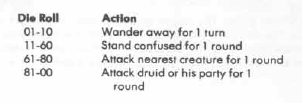
This is one of the many spells in 1E where the main text got pushed into the new druid's spell list (note 7th level above), and only back-referenced in the magic-user spell list (still at 4th level). In addition to the 3 effect options from OD&D, a new one is added in table form: "Wander away for 1 turn", which I always found inconvenient, because it puts the recipient on a different recurring check schedule than the other targets (other options last only 1 round each). Here, everyone gets a recurring save to avoid the effect each round (not just those over 4HD, as in OD&D; possibly more fair, but yet more rolling for the DM). There's a sufficiently complicated formula for number affected that I'm actually having some trouble parsing it right now -- 2d4 + max(caster level - max(target HD), 0)? There's also a -2 save modifier whose rationale eludes me.
Compared to the druid text you see above, the wizard's spell is strengthened in line with OD&D, with longer-range (12"), larger area (6×6 inches), longer duration (bonus of 2 rounds), and more creatures affected (2d8 + addition as above).
AD&D 2nd Ed.
Confusion
(Enchantment/Charm)
Range: 120 yds.
Duration: 2 rds. + 1 rd./level
Area of Effect: Up to 60-ft. cube
This spell causes confusion in one or more creatures within the area, creating indecision and the inability to take effective action. The spell affects 1d4 creatures, plus one creature per caster level. These creatures are allowed saving throws vs. spell with -2 penalties, adjusted for Wisdom. Those successfully saving are unaffected by the spell. Confused creatures react as follows:
The spell lasts for two rounds plus one round for each level of the caster. Those who fail are checked by the DM for actions each round for the duration of the spell, or until the "wander away for the duration of the spell" result occurs.
Wandering creatures move as far from the caster as possible, according to their most typical mode of movement (characters walk, fish swim, bats fly, etc.). Saving throws and actions are checked at the beginning of each round. Any confused creature that is attacked perceives the attacker as an enemy and acts according to its basic nature.
If there are many creatures involved, the DM may decide to assume average results. For example, if there are 16 orcs affected and 25% could be expected to make the saving throw, then four are assumed to have succeeded. Out of the other 12, one wanders away,
four attack the nearest creature, six stand confused, and the last acts normally but must check next round. Since the orcs are not near the party, the DM decides that two attacking the nearest creature attack each other, one attacks an orc that saved, and one attacks a confused orc, which strikes back. The next round, the base is 11 orcs, since four originally saved and one wandered off. Another one wanders off, five stand confused, four attack, and one acts normally.
The material component is a set of three nut shells.

Having almost totally skipped 2E in my playing years, I think that I'm reading this spell description for the first time ever. The level, range, duration, and area are the same as in 1E. The number affected is much simplified (d4+caster level). The "wander off" effect is admirably streamlined, since it lasts the whole duration and takes those creatures out of the recurring rolls entirely. However, the spell still seems sufficiently clunky that an extra "2E maybe" paragraph was added, outlining how the DM might average the effects over several creatures (something that maybe shouldn't need to be said in the first place, or made a more general rule elsewhere).
Also: The fact that victims save every round to avoid the effect seems easy to overlook (when to make the save is mentioned once in the third paragraph, "Saving throws and actions are checked at the beginning of each round", but it's not explicated exactly what the purpose is). Perhaps jointly with that, what used to be the "attack caster" case has turned into a wider "act normally" statement (at the end of the list).
D&D 3rd Ed.
Confusion
Enchantment (Compulsion)
[Mind-Affecting]
Level: Brd 3, Sor/Wiz 4, Trickery 4
Components: V, S, M/DF
Casting Time: 1 action
Range: Medium (100 ft. + 10 ft./level)
Targets: All creatures in a 15-ft. radius
Duration: 1 round/level
Saving Throw: Will negates
Spell Resistance: Yes
Creatures affected by this spell behave randomly, as indicated on the following table:
Except on a result of 1, roll again each round to see what the subject does that round. Wandering creatures leave the scene as if disinterested. Attackers are not at any special advantage when attacking them. Behavior is checked at the beginning of each creature’s turn. Any confused creature who is attacked automatically attacks its attackers on its next turn.

Now, in some ways I really like how this was simplified. All of the language about number affected, special save modifier, optional ways to rule on the effects, etc., were totally sliced out. (Number affected is now purely determined by the reduced area-of-effect.) Note also that the recurring save each round has disappeared (partly due to the 2E text nearly obscuring that aspect?). However, the spell weirdly backslid in one way: the "wander away" result doesn't last the whole spell (as in 2E), now it's back more like 1E (where after 10 rounds you'd have to start rolling again). I wonder why that was?
D&D 3.5 Revision
Confusion
Enchantment (Compulsion) [Mind-Affecting]
Level: Brd 3, Sor/Wiz 4, Trickery 4
Components: V, S, M/DF
Casting Time: 1 standard action
Range: Medium (100 ft. + 10 ft./level)
Targets: All creatures in a 15-ft. radius burst
Duration: 1 round/level
Saving Throw: Will negates
Spell Resistance: Yes
This spell causes the targets to become confused, making them unable to independently determine what they will do. Roll on the following table at the beginning of each subject’s turn each round to see what the subject does in that round.
A confused character who can’t carry out the indicated action does nothing but babble incoherently. Attackers are not at any special advantage when attacking a confused character. Any confused character who is attacked automatically attacks its attackers on its next turn, as long as it is still confused when its turn comes. Note that a confused character will not make attacks of opportunity against any creature that it is not already devoted to attacking (either because of its most recent action or because it has just been attacked).
Arcane Material Component: A set of three nut shells.

I don't normally check in on this edition (another one that I skipped), but here it is. In 3.5 they switched the effects table from d10 to percentile-based, even though they kept the 10% gradations, so: more dice for no reason. They now have 5 options, having re-inserted the "attack caster" option (top of list here) that appeared up through 1E but evolved out of 2E. They also added a detail to the "do nothing" option, that the person babbles incoherently (okay, big thanks for that, 3.5), and that that's the default if no other action is possible. You also have to remember who attacked last round because that trumps the normally random actions; also you need a special rule for attacks-of-opportunity, because otherwise it wouldn't be fully 3E-ified.
Did we make that clear? Which version of the confusion spell is your preference? Personally, I think my solution to the multitude-of-rolls with this spell would be to roll back to the Chainmail sensibility and have the entire affected group follow the same action (one single roll) each round.
2014-07-03
AnyDice.com

2014-06-30
Spells Through The Ages – Spell Lists in B/X
Additions and Subtractions Over Time; Whence the OD&D Sup-I Spells?
While I personally got into D&D initially with the 1979 Holmes Basic D&D Set, I had a somewhat more well-resourced friend who later got the 1981 Moldvay Basic/Cook Expert Rules sets, and actually handed them off to me, so as to DM him and other friends through higher levels of play. (I was always the DM in our community since day zero, so this just seemed like the thing to do.) We played a lot with those rules for a bunch of years, and every time I go back to them I'm really impressed by the level of reflection and tasteful editing that Moldvay & Cook put into those rules. While Holmes was very connected-at-the-hip to AD&D (with the Holmes text being edited & altered by Gygax himself before printing), the Moldvay-Cook B/X intentionally set its own traditions (like race-as-class), a separately-evolving game through the 1980's. Let's take a comprehensive look at their magic-user spell lists here.
Moldvay Basic Rules

One thing that Moldvay does here is to set a tradition of exactly 12 spells in each level of magic-user spells. That's a little bit nice, since you know you can always roll a d12 for a random spell in any level (as a scroll, spellbook, or maybe an NPC wizard's memory); although it may be a bit of a handcuff in the design space. Recall that the OD&D had no such organizing principle, different levels had different numbers (and in distinction to AD&D, there were actually more at higher levels, not less).
In the LBB's, at there were only 8 spells at 1st level, and 10 at 2nd level. Therefore, to fill out his list, Moldvay had to include some of the canonical D&D spells which first appeared in D&D Supplement-I, Greyhawk -- at 1st level, magic missile, shield, and ventriloquism; at 2nd level, mirror image and web. Now, at first level, that still doesn't fill out his d12 roster, so Moldvay also had to go to AD&D and take the floating disc spell (a.k.a. Tenser's floating disc in those rules). Note that this is the only spell in the entire B/X line that didn't appear in either the LBBs or Sup-I. On the other hand, there was an overflow of OD&D Sup-I spells that didn't make it into Moldvay at second level: namely darkness, strength, magic mouth, and pyrotechnics (several of these being pretty canonical for D&D -- I recently saw fellow players quite surprised that strength and darkness were not available playing by these rules).
Now before I go on, let's compare this to the Holmes Basic D&D list. Holmes' original manuscript had lists that were identical to Sup-I (although alphabetized and unnumbered -- 11 spells at 1st level, 16 at 2nd level). However, Gygax got in after him and added several spells that otherwise only appear in AD&D -- dancing lights, enlargement, Tenser's floating disc (by its full name), audible glamer, and ray of enfeeblement. This then brought the total number in the published Holmes work to 14 at 1st level, 18 at 2nd level (more than in the later Moldvay rules). If you want to see a complete look at that development from Holmes' unpublished manuscript, see the recent Zenopus Archives Blog (spell levels one, two).
Cook Expert Rules

In Expert D&D Rules, Cook starts by repeating the Moldvay list, and then adds the spells you see above for levels 3-6. (Asterisks represent reversible spells, also added as appropriate to the 1-2 level lists). He continues with the design pattern of exactly 12 spells at each level. But here's a wrinkle: since the OD&D LBB's already had that many spells or more at each of these levels (14 at 3rd, 12 at 4th, 14 at 5th, 12 at 6th), he didn't need to copy any Sup-I spells into the Expert rules, and in fact even a number of spells in the original LBB's got cut out (clairaudience, slow at 3rd level; growth of animals, wall of iron at 5th level). All the higher-level Sup-I spells went entirely missing from these rules; and that's probably for the best, because they tend to be wonky, confusing, or under-powered anyway.
Later Editions
The soon-revised 1983 Frank Mentzer Basic/Expert Rules keep almost the same lists as Moldvay-Cook -- except that Mentzer cuts the spells at 5th & 6th levels down to just 8 (other levels have the same 12 as in B/X); maybe for space purposes in the book?On the other hand,the 1991 Aaron Allston D&D Rules Cyclopedia makes the very strange choice of adding one spell per level to B/X, and thereby having a uniform 13 spells at each level (and thus not immediately rollable on any Platonic die). The spells he adds are, respectively by level 1-6: analyze, entangle, create air, clothform, dissolve, and stoneform. (He also has level 7-9 spells based on the Mentzer Companion/Master Sets, which I won't go into here, but likewise have 13 spells in each list).
Was there perhaps some intermediary product in the late 80's that add these "thirteenth" spells to Basic D&D along the way?
2014-06-26
Wandering Expectations
A number of weeks ago, poster DHBoggs sent me a nice analysis of setting up dungeons in OD&D, including assessment of likely monsters encountered. I've looked at Wandering Monster Levels and Tables in the past, and he and I came up with basically the same numbers for average hit dice from each of the various wandering tables in OD&D Vol-3.
One thing that he and I agree on (I think I'm more of a latecomer to this observation) is that it doesn't quite make sense to equate "monster level tables" (tables 1-6 on Vol-3 p. 10-11) with "level of the monster" for number appearing purposes (which gets compared to dungeon level on p. 11). If you were to blindly do so, then at the deeper dungeon levels (like 13+), since the "monster level tables" only go up to 6, then you'd be committed to a situation where even the top-level monsters like Dragons, Balrogs, and Purple Worms would need numbers appearing in every encounter multiplied (or exponentiated?) by at least a factor of 7 or more, which becomes totally lunatic if you think about it. It makes much more sense in OD&D, for this purpose, to treat the "level of the monster" as equivalent to its hit dice -- just like it says in the example on experience in Vol-1, p. 18 regarding "a troll (which is a 7th level monster, as it has over 6 hit dice)."
Anyway, one thing this discussion brought to mind is that while we'd both computed the average hit dice (level) of monsters at each of the 6 monster level tables, no one had thought of computing the expected hit dice of monsters at each actual dungeon level. Consider the following tables (or see the open document spreadsheet ODS file here):

As you can see in the final column of numbers, the average random encounter on the 1st level of an OD&D dungeon actually features a monster with 2 Hit Dice. In the 2nd dungeon level, the monsters average 3HD. At 3rd level the average is 5HD, at 4th-5th it's 6HD, etc.
Similar to what we've seen before, the interpretation of these results is in OD&D at the lower levels, the average wandering monster is actually higher level than the dungeon level would indicate. (Later, AD&D tables over-correct and have distinctly weaker monsters, while something like Holmes or Moldvay Basic D&D is about in the middle.)
This explains why in the margin of my copy I subtract -1 from the die-roll for monster level table, such that the monsters more generally match the dungeon level on which they're appearing. At the deepest levels you'll still be doing some multiplications of monster numbers for creatures of around 9 or 10HD, although it's rarely necessary for 12HD Hydras or Dragons, and never done at all for 15HD Purple Worms, for example (which is certainly better than treating all of these types as uniformly "6th level").
One thing that he and I agree on (I think I'm more of a latecomer to this observation) is that it doesn't quite make sense to equate "monster level tables" (tables 1-6 on Vol-3 p. 10-11) with "level of the monster" for number appearing purposes (which gets compared to dungeon level on p. 11). If you were to blindly do so, then at the deeper dungeon levels (like 13+), since the "monster level tables" only go up to 6, then you'd be committed to a situation where even the top-level monsters like Dragons, Balrogs, and Purple Worms would need numbers appearing in every encounter multiplied (or exponentiated?) by at least a factor of 7 or more, which becomes totally lunatic if you think about it. It makes much more sense in OD&D, for this purpose, to treat the "level of the monster" as equivalent to its hit dice -- just like it says in the example on experience in Vol-1, p. 18 regarding "a troll (which is a 7th level monster, as it has over 6 hit dice)."
Anyway, one thing this discussion brought to mind is that while we'd both computed the average hit dice (level) of monsters at each of the 6 monster level tables, no one had thought of computing the expected hit dice of monsters at each actual dungeon level. Consider the following tables (or see the open document spreadsheet ODS file here):
As you can see in the final column of numbers, the average random encounter on the 1st level of an OD&D dungeon actually features a monster with 2 Hit Dice. In the 2nd dungeon level, the monsters average 3HD. At 3rd level the average is 5HD, at 4th-5th it's 6HD, etc.
Similar to what we've seen before, the interpretation of these results is in OD&D at the lower levels, the average wandering monster is actually higher level than the dungeon level would indicate. (Later, AD&D tables over-correct and have distinctly weaker monsters, while something like Holmes or Moldvay Basic D&D is about in the middle.)
This explains why in the margin of my copy I subtract -1 from the die-roll for monster level table, such that the monsters more generally match the dungeon level on which they're appearing. At the deepest levels you'll still be doing some multiplications of monster numbers for creatures of around 9 or 10HD, although it's rarely necessary for 12HD Hydras or Dragons, and never done at all for 15HD Purple Worms, for example (which is certainly better than treating all of these types as uniformly "6th level").
2014-06-23
Spells Through The Ages – Spells In Sup-I

In fact, even before getting my hands on the LBBs within the last decade, I always had a gut feeling that something was "weird" about the 7th-9th level spells -- while the 6th level list has the stark "powers over life, death, and eternity" (death spell, reincarnation, disintegrate, control weather, anti-magic shell, permanent geas and invisible stalker, etc.) the higher-level spells have often fiddly and complicated powers that are hard to see why they're better. Of course, looking at Sup-I answers the mystery: the LBBs contain just levels 1-6, and it was Sup-I that introduced all of levels 7-9 as tacked-on afterthoughts.
Let me look at some of those "new" Sup-I spells, mostly the ones in levels 1-6 (the ones I potentially play with) -- asking some pointed questions about whether anyone ever found use for them, or if they're basically firing "blanks". I won't look at the entire later history of these spells; generally they didn't change very much, perhaps due to the fact that they were under-powered and no one was breaking the game with them (so, little in the need for errata or fixes). Perhaps I can observe a few categories for these Sup-I spells as follows:
- Low-Level Spells that Are Clearly Powerful. This would include the addition of shield, magic missile, darkness, strength, web, and mirror image (all 1st or 2nd level). Several of these are considered must-haves for wizards of any level, in some cases contending to push the best attack/defense spells from the LBBs out of use (sleep and charm person). These all became canonical identifiers of D&D, of course, and it's really hard to imagine the game without these key additions.
- Low-Level Spells That Aren't So Great. This would be ventriloquism, magic mouth, and pyrotechnics (again 1st-2nd level). Ventriloquism at first doesn't even seem like it should require magic; maybe a thief or entertainer skill. I've never seen magic mouth used by a player; it's more of DM plot device (waits eternally to deliver some information). And pyrotechnics starts a Sup-I'ism in not having a single clear game effect, but instead a series of "maybes" that require interpretation at the table ("A multi-purpose spell... either a great display of flashing, fiery lights and colors which resemble fireworks; or he can cause a great amount of smoke... overall effects of this spell depend on the size of the fire used to cause them", none of which have in-game definitions or effects; p. 22).
- Mid-Level Spells That Are Questionable. Namely explosive runes, rope trick, suggestion, and fear (3rd-4th level). Of these, fear seems to be the most useful (replicating the Fear Wand from LBB Vol-2, p. 34); the others seem strangely over-specific and limited. Suggestion I wrote about earlier (link); it seems deficient to charm person at 1st level. Explosive runes seems like another DM-protection element (it could just be an added one-liner in the scroll curse table); I've had players use this on a piece of paper and then parley with monsters to trick them into reading it, which seemed to cut against the grain thematically. Rope trick also seems to me an oddly over-specific representation of the (mythic?) "Indian rope trick" stage magic (link); I think I might prefer a more general "step into a small, short-term, extra-dimensional hiding spot" than the whole climb-up-a-levitating-rope business.
- The Mid-Level Filler Series. These would be monster summoning and extension series. These spells reappear at multiple levels with a Roman-numeral tag on each in the sequence. The monster summoning spells (I-VII, levels 3-9) refer the user to the random "Monster Level Tables", which is useful, and mechanically concise since the element already exists. But I find it to be rather tasteless game design since I can't wrap my head around (a) how the monsters get into the possibly-enclosed space with the PCs, (b) why it totally disregards whether monsters of that type exist in the dungeon, (c) why the monsters just wander off afterward, etc. The extension spells (I-III, levels 4-6) may be flat-out the weakest magic ever; they only extend some other lower-level spell by 50% duration, and if it didn't do the job in the first couple turns, are the next few going to make any big difference? Case studies: (a) I'd rather use a duplicate 1st-spell and double the duration than burn a 4th-6th level spell for only 50%; (b) the only thing that extension II does better than I is to add specifically 4th-level spells to the possible targets; (c) extension III, while in the spell list, doesn't even get any entry in the text descriptions (okay, fixed in the corrections insert at the back of the book). It almost seems like these spells were just filler to round out the mid-level lists to 16 entries each.
- Higher-Level Spells That Don't Get Used. Here I'm thinking legend lore and repulsion (at the 6th level; compare to other "life or death" magic above at the same level). Legend lore "seeks to gain knowledge of some legendary item, place or person", requiring DM interpretations on (a) what counts as legendary, (b) exactly what knowledge is gained, and (c) whether it even works at all (note the word "seeks"). This spell seems like a Rorschach inkblot test for the players and DM, possibly the vaguest spell I know of in D&D; and it also has randomized casting time, from 1-100 days (the only spell in OD&D, of very few in any edition, with multi-day casting time). Repulsion "enables the user to cause objects or entities to move in a course opposite from their intended course towards him", which seems like a restatement of the confusion spell as written in Chainmail (there only 4th level), and seemingly defeated as soon as enemies think to say "I move away from the caster". I've never seen this spell get used in play, ever.
- Spells Whose Power Comes from Disallowing Saves. This kind of burns my chaps, because it seems like a clunky rules hack that totally contradicts Gygax's other rants that "everyone gets a chance" (see AD&D DMG defense of saving throws). It's inelegant in that later rule sets need to start adding a stat-block line dedicated to keeping track of whether each spell is "Yes" or "No" allowing a save. Personally, I don't honor it my games. These spells include (some overlap here): sleep (by errata in Sup-I), magic missile (not explicit in Sup-I, but ruled that way in later sets), explosive runes, ice storm, and everything in the new levels 7-9 (p. 25: "Spells with no saving throw unless otherwise indicated!"). In particular, ice storm (4th level) looks deficient to fireball (less range, only 30 points max and no increase per level, whereas fireball does 42 max damage for a like-level caster and goes up from there), until you note the parenthetical point that "saving throws are not possible"; 1E added a variant sleety usage that caused no damage, but blindness and a possible slip-and-fall. Hacky!
I guess the only other thing in Sup-I at these spell levels that I'm looking at is the errata for the charm person and charm monster spells, actually the first thing in the list, which introduced the unique recurring save schedule by Intelligence or Hit Dice (and was carried forward through all later editions up to 3E). Even that seems unnecessarily complicated, table-heavy, and unfocused, wasteful design effort; the best version is in Moldvay's Basic D&D where he wisely edits it down to just three categories (day, week, or month). Lastly: detect magic is given a range and duration for the first time, but then why not also do so for read magic and read languages, that suffer the same lack at the start of the Vol-1 list?
So there's my personal rant about the Johnny-come-lately, frou-frou, fiddly magic-user spells and alterations that appeared in D&D Sup-I. While many of the spells at 1st-2nd level are must-haves, the ones at mid-levels are either vague or questionable or clearly worse than pre-existing options. And the new higher-level spells generally cheat and complicate the system by prohibiting any saving throws, so I don't like those, either.
What are your thoughts on those later-added spells; do you agree? Is there anything here that you found absolutely indispensable, to which I've been blind? Have any unusual interpretations that clearly "fixed" one of these spells for you?
2014-06-19
3d6 Variable Parameters
Nothing new here, but I find myself continually re-computing this stuff so I'm documenting it here. Consider rolling a 3d6 probability variable, as for ability scores in OD&D, or starting money if we multiply by 10.

Edit: My old website also has the 4d6-drop lowest curve.
- Curve is bell-shaped.
- Average is 10.5 (mean or median).
- Quartiles are 8, 10.5, and 13 (i.e., about one-quarter are 8 or below, etc.)
- Standard deviation is almost exactly 3 (more specifically: 2.958)
Edit: My old website also has the 4d6-drop lowest curve.
Subscribe to:
Posts (Atom)


