2020-01-13

Subterrane Surveys: Gygax's Castle Greyhawk

We're incredibly fortunate that on August 16th, 2007, Matt "Eridanis" Bogen managed to take a few photos of Gary Gygax running his Castle Greyhawk adventure (for ENWorld moderators at Gen Con), catching glimpses of at least two maps and a key. The very fuzzy first-level key was mostly decoded with a great deal of effort from people like Allan Grohe (grodog), Zenopus Archives, and others. The evidence to my eye seems to be that was likely the true, original map of Castle Greyhawk (e.g., he wrote on the Pied Pier boards in 2004: "Fact is that I have run OD&D games every year at several cons for the last five or so years. I start them at 2nd level and use the old dungeon levels"; and Ernie Gygax has also recollected these match the earliest games). Let's assess the first-level key in detail.

Design: The dungeon design is of the fully-packed, use-every-space style, similar to what we see in the early Dungeon Geomorphs product, AD&D Module S3 (Expedition to the Barrier Peaks), etc. Many rooms are entirely empty, with no key code whatsoever. The Red Baron estimates there are about 160 rooms on the map; my own estimate is that maybe 40 have a key-code in them. That would be about 25% with any content at all -- similar to the guidelines in OD&D that about 33% have content (per 2-in-6 die roll; Vol-3, p. 7), the earliest Monster & Treasure Assortment suggestion that only 20% of rooms have monsters, etc.


Characters: Gygax's brief key doesn't state an expected party size. Recall from last week that neither do the core OD&D rulebooks. If we assume standard modern convention group size, then that could be maybe 6-8 people -- but recall also that in the earliest days a group might commonly be 12 or more people at once (e.g., see Jon Peterson, Playing at the World, p. 563, re: Gygax at Origins II). The question of what might be reasonable is, in fact, the whole point of our current investigation.

Monsters: The key for the level has 18 numbered codes; several are repeated in the map in clusters of up to a half-dozen located together (e.g., the kobolds, goblins, orc entries). All 10 of the monsters from the OD&D Monster Level Table 1 appear in this key. There are 3 from the Level 2 list (hobgoblins, berserkers, gnoll), and one each from Level 3 (giant snake) and Level 4 (giant beetle). One is novel (giant bats), and the last two keys have evil NPC spellcasters (2nd level magic-user and cleric, which could arguably belong on any of the 1st-3rd level lists).

Wandering monsters are not shown here, but if Gygax used them at all, it would make sense to simply use the book tables from OD&D Vol-3, because (as noted) they inherently represent the Castle Greyhawk ecology, and are a perfect match for the monsters present in lairs (see above).

Monster lair numbers are given in ranges of 3-7 orcs, 3-12 giant rats, etc.; very similar to what was suggested in Gygax's Monster & Treasure Assortment, and Holmes Basic D&D products. Using my "Equivalent Hit Dice" (EHD) analysis, I find that the average (mean and median) danger level of these encounters is 6 EHD, i.e., a fair fight for around 6 1st-level PCs. (There are reports that Gygax adjusted numbers to match the strength of PC parties present. Did he stay in the given ranges, I wonder?) The expected total strength for all the set encounters (ignoring duplications) is about 90 EHD.

Treasure: Almost every room with a monster has a treasure listed -- only 2 of 15 do not. This contrasts with the OD&D Vol-3 rule (p. 7) that half of monsters will have treasure; but it closely matches the Monster & Treasure Assortment rule that "about 20% of the monsters should have no treasure whatsoever". There is one room with no monster and a hidden treasure -- the largest reward on the level (room 8, with about 1/3 total value on the level). Note that with some key codes being duplicated, it's questionable whether every such room has the same treasure or not (unlikely that every kobold room has the same dusty silver mirror?), which would skew the treasure-to-monster ratio lower. The objects are clearly not from the monster-keyed Treasure Type tables, because coin values here are usually in the 10's (not 1000's as on that table; with one exception in room 4). Coin treasures are in the same basic order of magnitude as the OD&D dungeon treasure table (Vol-3, 7), without being exact matches. The gem values are usually in the 100's (as per book median gem type).

Total expected treasure (again, ignoring duplicated rooms) is about 4,400 gp. Given that, there are about 50 gp of treasure per monster EHD.

Magic: Magic is also relatively abundant. There are 6 of 14 treasures that have magic items (43% rate), for a total of 7 useful magic treasures; this includes 2 potions, 2 magic weapons, a magic shield, ring, and a staff (with 6 charges left). Contrast with the book rule that says only 5% of treasures at this level should have magic included (from which we might expect there to be none at all, given the total number of treasures here) .

Experience: Reports say that Gygax indeed used something like the Greyhawk revised XP system, as shared by B/X , AD&D, etc., instead of the original Vol-1 system (or maybe something simpler, like a flat 10 XP per monster HD?). For example, a play report from January 2008 with Gygax says, regarding area 18 above, "they got '20 xp from 1 gnoll' and '30 xp for the evil cleric'" -- which would be correct values per the Greyhawk chart for a 2 HD gnoll and a 2nd level cleric with double bonus for special abilities (suggested on Sup-I, p. 13).

So let's assume Gygax used the Greyhawk table, and each of the keyed areas only appears once. Then the total monster XP is about 2,000 and the total treasure XP available is roughly 4,400, for a grand total of about 6,400. This gives a monster: treasure XP ratio of about 1:2 (31% monsters, 69% treasure). Note that the total would only be enough to graduate 3 fighters to 2nd level.

On the other hand, if we use the original Vol-1 XP system, then the total of about 90 EHD would give monster XP of 9,000 or so, treasure the same 4,400, for a grand total of 13,400. Ratio would be inverted to about 2:1 (67% monsters to 33% treasure), and this would be enough to raise 6 fighters to 2nd level -- a good match for the 6 EHD average encounter here.

A few commenters have helpfully pointed out that there's at least a question about whether we should be adding XP from picking up and keeping magic items or not. There is a short line in OD&D suggesting as much (Vol-1, p. 18: "when they obtain various forms of treasure (money, gems, jewelry, magical items, etc.), they gain 'experience'."), but there are no rules or suggestions for what values to give them. Gygax gave a few examples in The Strategic Review Vol. 1, #2 (e.g., potions 250-500 XP, scrolls at 100/level, a sword +1 at 1000 maximum, etc.). Later in the AD&D DMG Gygax gave full XP valuations for all items in the game; they broadly match the Strategic Review values for potions & scrolls, with other items  mostly devalued (on the order of about a half).

As a rough estimate, the first level of Castle Greyhawk would give about 5,000 XP for magic items under either system. This would make a very significant difference; roughly adding 2/3 more XP under the Greyhawk system (giving a proportion of 18% monsters, 39% mundane treasure, and 44% magic items; and then very nearly promoting 6 fighters to 2nd level), or about 1/3 more under the original Vol-1 system (then 27% of the total, and promoting as many as 9 fighters to 2nd level). If we look at other adventures in the Basic D&D line, then this won't be a consideration, because XP-for-magic-items was entirely dropped in those rulesets (even after Gygax personally edited the Holmes Basic D&D set).

2020-01-11

Article on OD&D at Dicebreaker

Dicebreaker is a brand-new news site dedicated to news in the tabletop gaming community. They just put up a really nice, meaty article for your weekend reading pleasure by author Steven T. Wright on, "Meet the Original Dungeons & Dragons diehards still playing by '70s rules".

In particular, both author Matt Finch and myself are quoted quite heavily throughout article. I had a really great conversation several weeks back with Mr. Wright when he was preparing this article -- he's a real fan already, knows and plays several indie/OSR games himself, and I got to learn at least a few things from him along the way. I think it's a really well-written and researched piece, and personally I'm looking forward to seeing more from Steven and Dicebreaker in the near future. Highly recommended!


And don't forget new Wandering DMs this Sunday at 1 PM ET -- we'll be chatting live with with Mr. Ian McGarty of Silver Bullette Publishing to get his thoughts on self-publishing for RPGs in 2020!


2020-01-10

The Hobbit Autopsy by Lindsay Ellis

In the last few days, I had the pleasure of watching Lindsay Ellis' Hugo-nominated video essay on the making of Peter Jackson The Hobbit trilogy (2012-2014). Watch it here.

Here's a commentary on that. Lindsay largely frames her essay as "I deeply loved the LOTR movies, but then I was a kid; the Hobbit movies leave me cold, maybe that's because I was an adult when I saw them". (She was 17 when the first LOTR movie was released, 28 for the first Hobbit movie.)

My reply is: "No, it's not you, it's them."

Here's a few examples from personal experience for comparison, which I hope gives a helpful perspective. I was turning a teenager when the original Star Wars movies came out and I was crazy for them. (I can still remember heatedly debating plot points with friends between those movie releases.) Twenty years later, the prequels start coming out, and my girlfriend got tickets on opening night to Ep. 1; I was so excited. That wound up being one of the most embarrassing disappointments of my life. I didn't see either of the follow-ups.

Now, a common argument at the time was, "Star Wars are fantasy movies are for kids; if you're not a kid then you're not the target audience; and you can't possibly appreciate them." But this was contemporaneous with Peter Jackson's LOTR movies coming out -- and I loved those to death. I saw them multiple times in the theaters. Persuaded friends I don't usually go to movies with to join me. This being when I was an adult -- and someone who hadn't read the novels, either (so not intimately pre-invested in the franchise).


Fast forward another ten years and you start getting the Hobbit movies, as a prequel trilogy to LOTR. Based on advance reviews, I skipped the whole series. I later saw most of the third movie on TV in a hotel and I was like, yuck, what a loud, empty not-much.

But in the meantime I'm also wildly fond of many of the Marvel movies, and likewise I've seen several of those multiple times in theaters, and have very fond memories of them. In particular, I think the last Thor movie, Infinity War, and Endgame are pretty much genius works. As an adult.

In June of 1999 (in the early web days) I wrote a short essay called, "Star Wars Episode I: 20 Criticisms". Among my complaints were things such as: lack of character chemistry, cannibalizing the material of the previous films, having old characters reappear for bad reasons, repeating plot structure, the climactic fight being uncompelling, etc. Those are all rather uncannily similar to Lindsay's criticism of the Hobbit movies. (And check this out: on The Wrap, by Phil Owen and Ross Lincoln, "The 23 Worst Parts of ‘Star Wars: The Rise of Skywalker’", which kind of says the same thing all over again about the 2019 film.) 

Looking up comparative critical ratings on Rotten Tomatoes, we see:
  • Original Star Wars Trilogy -- 93%, 94%, 82%.
  • Prequel Star Wars Trilogy -- 53%, 65%, 80%.
  • Original LOTR Trilogy -- 91%, 95%, 93%.
  • Prequel Hobbit Trilogy -- 64%, 74%, 59%.
  • Thor 3, Infinity War, Endgame -- 93%, 85%, 94%.

So the point is, there are pretty objectively good movies and bad movies in the world, and generally we know which is which (if we're honest about our internal experience of a thing). In my experience, I've grown surprised at how consistent my emotional perceptions of things are. I can become flush with excitement and fantasy at any age, if the work is essentially good.

Also: Prequels suck!

2020-01-06

Subterrane Surveys: Little Brown Books

Happy New Year! I think many of us are looking forward to the magical year of double-nat-20's and seeing what that will bring. I'm hoping for some interesting OD&D-type things on the blog here, as well as more livestreaming with Wandering DMs. In fact, we've got some things lined up this year that I'm pinching myself over because it seems almost too good to believe (while keeping our normal schedule of live chat Sundays at 1 PM ET). More on that later.

One of the things I've been working on lately is assessing what early writers intuitions were about monster challenge levels. The earliest game (of course) didn't have any formalized notion of "challenge ratings" or the like. One early attempt was Don Turnbull's MonsterMark system. I have my own system for OD&D I call MonsterMetrics, which uses million-fold computer simulations to generate an estimated "Equivalent Hit Dice" (EHD) value; current valuations are available in the OED Monster Database on the website here.

Whenever I prep games nowadays, such as for classic modules, I make spreadsheet listing of all the contents and assess EHD ratings as a way to gauge reasonable PC numbers and levels going in. So I'll probably be sharing some of those in the near future.

For starters, here's a refresher of what the 1974 OD&D Little Brown Books say on the matter: almost nothing at all. There aren't any guidelines for what a single expected party size should be, or how many monsters populate a normal dungeon room, or how powerful a given monster is vs. PCs, or anything like that. The entire arrangement is expected to be managed on an ad-hoc basis by referees on the fly, basically.

Here's the closest we get to any hard advice, in the section on Wandering Monsters (Vol-3, p. 11):


One of the things this highlights is that early on, there was the apparent expectation that DMs would modify the monster numbers and threat levels on the fly to balance against the party present. Some DM's intuitively do that today, but the general idea dropped out of the published rules and modules pretty quickly. For example, in the Holmes Basic D&D Zenopus dungeon you get advice to do that in the very first room, but not anywhere else. The same thing occurs in Frank Mentzer's version of the Village of Hommlet (but not in Gygax's earlier version).

In this particular case, the wandering monsters seem to be balanced (at least on average) to about one-third the total strength level of the PCs. If you have 1-3 1st level PCs, on the 1st level of the dungeon, encountering a 1st-level monster, then apparently the advice is just to have a single such monster. For 4-6 PCs, you get two monsters, For 7-9 PCs, you get three, and so forth.

I don't mind that, and I try to do roughly this in my games today. Nowadays (after the miraculous year where Gygax & Arneson had the only D&D games in the world and their basements were stuffed with 20 players 7 nights a week), it's become conventional to think of "standard" party size as something in the 4-6 player zone, so for like-level monsters, I roll a 1d3 for numbers (then multiplied by dungeon level and divided by monster EHD, if these differ from party level).

But that's for wandering monsters. How many should you expect in a set-lair situation? The rules simply don't say. As a stab I might expect to double the number of a wandering group, so: roll 1d6 for a lair or something like that. If we look at rulebooks a few years later we'll see Gygax writing a lot of 1d4+1 or 1d6+1 numbers in those situations. That comes close to equating monster encounters with the total PC power level (like: 4 players running up against 4 monsters in the average case), for which we might expect just a 50% chance of victory in either case. (This gets modified by magic and strategy, as my EHD ratings don't take those into account at this time.)

But all the OD&D books say is this (Vol-3, p. 7):


That's totally it. In future posts hopefully we'll see some more specific things as that evolved in published books and adventures in the next few years. 

Open Questions: Do you massage monster encounter numbers to your player strength on the fly during games? In my case currently I would likely say "yes" in most one-off games (convention situations, etc.), and "no" in ongoing campaign situations (where the monsters have some background ecology and existence; so if PCs don't bring enough troops they shouldn't go in there). In the past I would probably have been more likely to say "no" uniformly, but that's me. What's your current practice?


2019-12-25

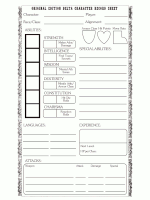
OED Character Sheet

http://www.oedgames.com/addons/houserules/
It's been a little quiet here for the last month or so, as my last academic semester teaching CS got hectic. Now I'm excited to have time to get back to some gaming projects I've had on the back-burner for a while. In particular, Wandering DMs Season 2 is on the way in a few weeks, and Paul & I have a bunch of nifty ideas I can't wait to see come to fruition (in the meantime, you can check out Season 1 in video or podcast form, and there's new patron-only videos being released each week through the holidays if you want even more).

In the meantime, here's a surprise gift: The official OED Character Sheet that we've been fine-tuning in play for the last year or so. It's a digest-sized, form-fillable PDF that automatically generates your ability scores, total encumbrance, and even movement score as you go. When I use this for pregenerated PCs, NPCs, and hirelings, I can get a character complete in about a minute. There's also a two-record form so you can print on a sheet of normal paper, cut it, and have blanks on hand at the table (always needed for emergency replacements). Get it on the OED Games website, linked below. Merry Christmas!


2019-10-25

Friday Figures: Who Keeps the Sheets?

Here's one of these 4th-wall issues that no one ever thinks to talk about, but when it finally surfaces to consciousness, suddenly everyone realizes they have a militant opinion about. On last week's Wandering DMs show discussing Dave Arneson's early play mechanics, special guest DH Boggs pointed out that Arneson kept all the character sheets for a few different reasons. At the time I thought: "Why are we even mentioning this? Or wait, has no one ever discussed this as an issue before?". So I asked the question as a poll on the Facebook 1E AD&D group; who keeps the PC character sheets between sessions?


As you can see, the "Players" vote took an overwhelming win on this poll -- by a vote of 250 to 83 to 18 at last count. (So: 71% are saying the players take their sheets home). Among the many comments on the issue include observations such as, "I will always stand by the notion that a character is the intellectual property of the player.", "I don't play with people that I don't trust enough to keep their own sheets" (I think assuming the only reason for DM to keep sheets is as an anti-cheating measure), and even, "DMs that insist on keeping their players character sheets have serious mental issues."

Now, this is somewhat surprising, because all of the play groups with which I interact actually have the DM keep the sheets. I think I usually offer players to take the sheets, but no one ever takes me up on it. Maybe our community has just all fallen into this habit unwittingly. Arguments in favor of this in the thread include, "Character sheets belong to the campaign, not the player", and predominantly, "Everyone always forgets to bring their stuff that's why the GM keeps it in a folder". I'm not seeing any comments specifically about cheating but maybe there's one or two in there (and that would have been me in junior high school). One said, "I have been really surprised by New School players who want me to hang onto the character sheets".

Other options include some form of both parties keeping copies; maybe DM gets originals and players scans, or vice-versa. Some DMs keep various summary records while players take the real sheets. Some have a "current" sheet with one party, while an "older" sheet is taken by the other. And a few use technology like D&D Beyond for 5th edition where (I think) both DM and player can access it online. (One DM keeps data in a custom spreadsheet and prints out fresh paper copies each session.)

As a special bonus, Mr. Frank Mentzer joined the conversation, sharing that his players keep their sheets, while he keeps index-card summaries (color-coded by race). And in fact has kept all those records consistently going back to 1977 (making a separate post on FB sharing some photos of those stacks of cards). Thanks, Frank!


Don't forget: New Wandering DMs live chat this Sunday -- On incorporating horror in your D&D and other RPG games. Will we wear costumes? Tune in and share you spooky suggestions. Sunday 1 PM ET.

2019-10-18

Friday Figures: Testing 5-foot Squares


A couple weeks back, a few different people (thank you!) sent me the link to the Dutch martial-arts HEMA group HVN's testing of combat with swords and daggers in current D&D-canonical 5-foot wide squares.

Very cool stuff, so glad they could share this with us. The main critique they have coming away from the test is that the squares are kind of a bit on the small side -- they find themselves standing mostly on the back end of the squares, and say that there isn't enough room to use the swords in thrusting style (so: cutting and hewing only).

And that's an interesting take, because my question for many years has mostly been whether the 5-foot size is maybe too large to be realistic. (Whenever I find myself on a tiled floor I look around and gauge whether 5 feet seems like a reasonable for combat space or not.) That's probably some bias resulting from Gygax's assertion that 3 fighting men per 10 feet should be the default (OD&D Vol-2 p. 12, AD&D 1E DMG p. 10). Really comforting to know that the 5-foot size is within the bounds of reasonability.

Videos on HVN's Imgur page here.


Don't forget: Live chat this Sunday on Wandering DMs: Paul & I have special guest D.H. Boggs, applied researcher in RPG history, on the show to discuss Blackmoor, Dave Arneson's play style, mechanics visible and hidden from players and other Twin Cities topics! 1 PM ET.