2011-11-18

Friday Night Book of War

Here's a Book of War game from earlier this summer, in which I opted to use a bunch of "giant class" monsters (orcs, ogres, and hill giants), while my opponent fielded an army of normal men. See how that worked out:


Start -- Basic Rules with Advanced Fantasy Troops; 200 points. At the top you can see my opponent's army -- she's decided to take a large number of regular crossbows, plus some horse archers on the far end. The random terrain has come up with a Stream, a Marsh, and a patch of Rough ground. At the bottom you see my army: A spearhead of 4 Ogre figures (40 ogres), 1 Hill Giant figure (10 giants), surrounded by groups of Orcish Medium Infantry (chain mail, AH 5).

Terrain was set up first, then my opponent's army (she won initiative), and then my army set up in response. My army is all-melee, my opponent's is all-missile troops, and the terrain very much favors the missiles (all of it slows me down, but none of it provides any cover, as opposed to a wood, hill, etc.) I've decided to set up my ogres as a "blocking" force, with the giants behind, and hoping that I can punch through with that group and into contact before they're all shot down.


Turn 1 -- Opponent goes first; she charges ahead with the horse archers, and shots from them and some of the crossbows have already knocked out several figures of orcs, and in fact routed two of those units. Not cool.


Turn 2 -- Here I've moved ahead, with ogres & giants trying to march through the easiest corner between the marsh & rough; while my orcs on the far right are halfway wading through the stream (and you can see the remnant of one of the groups routing off the table). My opponent has mostly remained still so she can freely shoot at my approaching monsters -- crossbows slightly repositioned so as to form a "circle of death".


Turn 3 -- Two moves later, and I've finally gotten the ogres into contact with the enemy, delivering a single hit. I've lost two ogre figures along the way, although the giants have been protected from hits so far. Meanwhile, the enemy horse archers have mostly devastated the orcs in the stream; one unit has advanced through the stream and is circling around the back of the field. I also have a unit of orcs struggling through the bad part of the marsh.


Turn 4 -- The enemy fires. Something that my opponent does regularly, which I try to avoid at all costs: Fire into melee at her own troops. Per the Book of War rules, this splits the shooting attack dice against each unit involved in a melee (anyone within 3"). So I don't like to spend half my attack against my own guys, but my opponent routinely does this and accepts the collateral damage. Here she's charged crossbows into melee, getting their attacks, and then following up with shooting (from both crossbows and horse archers), getting more hits against both me and her own forces in red. I'm down to one unit of ogres; the hill giants have taken 4 hits (out of 8); and the orcs in the marsh are all dead, too.


Turn 6 -- With the opponent's aggressive stance, every one of her figures is getting to make attacks against my remaining forces each turn. The giants go down one turn, and the ogres the next. Victory for the opponent! And disaster for me.


Postscript -- This was a fairly lopsided game, and pretty much a "perfect storm" against the monster army that I was trying to test out. My opponent: (1) made a brilliant meta-game decision to pick all missile troops, (2) received completely ideal terrain, that slowed down my movement, while giving her free range of fire, and (3) had pretty much perfect setup and tactical use of her forces (no mistakes that I could spot). End result: All my guys got mowed down pretty mercilessly. So I guess that's exactly the position you want to be in if you're leading an army of men against primitive monsters; but I can think of plenty of other situations in which things would have been more dangerous for the men. We shall see.

2011-11-16

Book of War Expansion: Giants Galore

In the published version of Book of War, in the Advanced Rules section on fantasy troop types, there is only one generic type of giant listed (i.e., hill giants). For some time I had other types of giants included there, but relatively late in the process I decided it was better for thematic and space purposes to replace them with other stuff. Below, you'll see the other giant types that appear in the OD&D Vol-2, Monsters & Treasure book. Perhaps what's really interesting here are the prices; most of the other statistics are converted directly from by-the-book D&D. (Text between the rules below is hereby indicated as Open Game Content.)


Unit Cost MV AH HD Notes
Giants, Stone 60 12 5 9 Throw stones, damage 2
Giants, Frost 65 12 5 10 Throw stones, damage 2, cold-immune
Giants, Fire 70 12 5 11 Throw stones, damage 2, fire-immune
Giants, Cloud 80 12 5 12 Throw stones, damage 3, detect invisible

Giants: Most giants throw stones at ROF 1, range 20", damage 2. Stone giants specially have damage 3 on throwing attacks. Cloud giants can detect any hidden or invisible foes within 6" with their keen sense of smell.


Keep in mind: Each type above represents a mass troop at 1:10 scale -- that is, as usual, each figure purchased represents a team of 10 giants working together. Solitary giants should cost about one-tenth as much -- and in fact, several such types do appear in the published book section on Heroes (where I felt they were a better fit for the advanced giant types of Frost, Fire, etc.; and where they play off nicely against special attack forms such as dragon breath and wizard spells). We've analyzed the giants' throwing stones ability before (here, here, and here). Also, I've used the mass Frost Giants to attack the Keep several times in my Siege on the Borderlands using these rules (here and here). And finally: Storm Giants are a special case -- they did not appear in D&D until Sup-I Greyhawk; they have special abilities beyond the scope of the ones above; and I'll leave their discussion for a later time.

2011-11-14

Book of War: Advanced Rules

The Book of War Basic Rules present a simple, complete game on their own that can be played without any advance knowledge of D&D (although it is a product of extrapolating from those rules). The Advanced Rules basically provide a mechanism to take any D&D creature type and more-or-less instantly start running it in a mass combat situation -- for example: when you are surprised by a random encounter roll with 40-400 goblins or the like. Here you'll see the kernel of those conversion rules from page 10. (Text between the rules below is hereby indicated as Open Game Content.)


One of the guiding principles of this ruleset is to make converting any creature type from the FRPG as simple as possible. Many of the most notable types are presented further below, with appropriate costs. Here are the primary guidelines for such conversions:

Movement Values and Hit Dice are the same as presented in the FRPG rules (and recall that all large creatures gain +1 to hit per 3 HD, as per the Core Rules). Armor Hit values can be converted by looking at the table in the Core Rules section and correlating AC to equivalent leather, chain, or plate types (or alternately, see Optional Rules: Exact Armor). Ranges for missile attacks are also as per the FRPG.

Monsters with extra attacks gain an equivalent number of dice when attacking. Likewise, creatures that do 2 or more dice of damage (say, giants) score that number of hits with each successful attack, but this is limited by the target's HD. For example, a 2-dice attack against a 1-HD target scores just 1 hit; that is, a normal man can't be squashed more than once by a giant's melee attack.


So I think that's pretty simple, in that the game fundamentally just uses the same stats that you'll already be looking at in places like OD&D Vol-2 (with a switch from AC→AH for the easy-to-apply-in-mass ascending target on d6). Note that for simplicity, I just ignore any incremental hit point bonuses (e.g., ogres just appear as HD4, trolls as HD6). The damage-limitation above has come to be referenced as the "no rollover minutes" rule. Also: In the book, this section presents the rule for converting cavalry, which we discussed previously.

Special abilities may require some further thought or massaging in order to elegantly play out in our wargame scale. For example, orc/goblin types have "light weakness" which indicates a -1 to morale in sunny weather (the D&D -1 to hit is negligible at our divide-by-3 scale). Regeneration such as for trolls it accounted by removing 1 hit per figure engaged in combat (at the time of the trolls' morale phase; which is sort of in exchange for them being fearless by default). And of course, the infravision possessed by all non-men/halflings can be extremely important during a night or underground engagement.

I included details for a stock variety of fantasy soldier-types -- specifically, I wanted to at least cover all the types that appear as men-at-arms options in D&D (such as OD&D Vol-3, p. 23 and other places). Divided into alignment categories, and each with a few different equipment profiles, they include: Lawful -- Halflings, elves, and dwarves; and also elite (3rd level) men, halflings, elves, and dwarves; Chaotic -- goblins, orcs, gnolls, plus (elite) bugbears, ogres, trolls, and hill giants. That's actually all I could fit in the pages devoted to fantasy types, but the primary idea is to serve as examples for the conversions you can do for any type from D&D. We do assume that larger types will be fitted with correspondingly larger, square bases (generally following what you see in Battlesystem or Warhammer or whatever you've already got them on).

Of course, while the initial creature-conversion is pretty close to being trivially easy, the correct pricing of each type is a completely different story. Special abilities may require some subjective judgements; for example, I made sure that any orc/goblin types were at least 1-point cheaper than equivalent men (in light of their special morale-weakness); and likewise elves/dwarves were required to be at least 1-point more expensive than men (respective of their special abilities). If creatures appear naturally in your campaign (such as by random encounter roll), then accurate pricing is likely a non-issue; but if you want to accurately balance combats for a standalone game, then I would again direct you to the Book of War Java pricing simulator program (or wait for me to expand to certain other types here on the blog).

2011-11-09

Review: Maze of Peril

I just got done reading Maze of Peril by John Eric Holmes, editor of the first D&D Basic Set, and a D&D aficionado who based the book on games played with his sons. The book is still available by mail from the publisher, New York-based Space & Time (here). I was impressed.

First, there's something very satisfying about the book having monochrome blue artwork for the cover -- the same as Holmes' classic "blue book" D&D rules. According to the author's biography, he also published short stories in a magazine called Bluebook, so I guess there's some sympathetic magic tied into all of his works in this way.

I would call this a very well-written book: Like the pulp short stories which I have come to prefer -- Conan, Fafhrd & the Gray Mouser, early Elric, etc. -- stuff happens rapidly, the plot barrels forward with intensity, and internal monologues and motivations are almost always left off-screen (perhaps they are deeper for being left unsaid, in a Hitchcockian sense). It's not like the bloated fantasy novels that are common today, and quite unlike, say, the Thomas Covenant novels that I more-or-less grew up on. (An aside: Shouldn't the short story format be ideal for this age of size-is-irrelevant digital readers, Twitter, and micro-messaging? Does a successful venture for that exist and I don't know about it?)

To whatever degree Holmes based this on his home game, I'd have to say that it's flat-out the best conversion from game to written story that I've ever read. Somewhat surprisingly, given the title, perhaps 1/2 or more of the story takes place outside the dungeon (with various scenes in a town, tavern, and nearby cemetery). The story follows the point-of-view of a halfling adventurer, which is much more satisfying and works better that I would have expected; the character here feels very much in the Fafhrd & Gray Mouser mold -- amusingly self-interested, jaded in a casual fashion, and like a lot of old-school D&D characters (although the name "Boinger" is really the one thing in the book I wish could be changed). Despite the back cover copy, the characters are at no point working to "... perhaps... save the world", which is actually quite preferable in my mind.


D&D Adjudications

Now I'll spend some time thinking about the rules of the D&D world as fleshed out here by Dr. Holmes (again: editor of what might possibly be the single best-selling version of D&D ever). First, the milieu is extremely well-textured, and in its way, believable (the D&D rules are interpreted with great verisimilitude). Perhaps the only thing that struck me as wrong was the "wahoo" population of the town tavern scenes, including all the usual PC races, plus centaurs, fauns, etc., apparently as standard patrons. Almost everything beside that I could at least consider using in my own games at some point. Warning: Some spoilers below.

There is an elf character (the boon companion of the protagonist after the initial chapter). Normally he is a stealthy fighter; there is just one point where he casts a spell, in the privacy of his quarters, and to do so he must strip off all of his armor and equipment. "'Can't have iron touching the body anywhere,' he explained, 'no iron, even nails in the boot heels. It drains the flow of force from the other world.'" [p. 34] Now, that's actually a really attractive (and mythologically compatible) explanation for the troublesome OD&D language on how elves "switch" between fighters and magic-users. However, on second thought, that's contradicted by the standard D&D appearance of elves in chain mail, even when casting spells (as early as OD&D Vol-2); and also by magic-users in general being customarily armed with daggers (and usually carrying spikes, lanterns, etc.) At one point, the elf succumbs to a sleep spell, so pretty clearly the AD&D-line's elven resistance to the spell is not being used here.

Other details: A lot of play is given to the sense & stealth capabilities of the halfling and elf. There are no thieves explicitly called out in the book (and the halfling is wearing chain mail), yet at one point this pair stage an infiltration and theft in town -- climbing up a tower quietly by rope-and-grapple, sneaking in a sealed window -- and at another point the halfling goes checking for pit traps with a regular pole (so obviously, this can bolster the argument of those who think that the thief class is extraneous in D&D). Significant attention is paid to the one knight character in "full armor" (the only person who appears in plate mail). Locked doors are broken open by force; serious planning takes place before a swim (all armor off and given a flotation device); and much care is given to keeping the elf's bowstring dry and unslung during travel. There are some great scenes with a group of Amazon warriors.

There are possibly some liberties taken regarding the power-level of the characters in question. Early in the book, a hard-won fight takes places with a handful of orcs; the wizard is described at one point as being second level; all of the party except one is felled by the aforementioned sleep spell; and the characters seem to have at most one or two signature magic items among them (which is actually well-focused, for storytelling purposes). Yet at the same time the group winds up engaging huge lycanthropes, a golem, a purple worm, etc.; they survive being directly blasted by a fireball spell (just barely); and the wizard casts a spell that certainly appears to be cone of cold or something very similar.

Spells end when the casting magic-user gets killed. Now, this is a pretty common feature in fantasy stories (for example, I just read the same thing last night in the Conan story by de Camp & Carter, "Red Moon of Zembabwei"), and in fact, I find that this is frequently a standard expectation of those new to the D&D fantasy game. But of course it's not a feature of any officially published version of the D&D rules, and I could imagine some problematic side-effects if this were a standard ruling (like: how it exponentially makes the PC wizard a preferred target of foes, and moreso with every spell they cast).

Something happens to a golem which is so extraordinary, I would never have thought to allow it under standard D&D rules. But it's rather brilliant in execution, and my instinct is to accept it with great amusement and salute the DM for it (from the perspective of a player-in-the-game, say). This particular bit I'll leave off for you to find elsewhere.


On Clerics

Now, here's a meditation devoted to the status clerics within Maze of Peril (knowing that D&D clerics are a super sore spot from me; deleting them is at the top of my major house rules in the right sidebar here).

First and foremost, the cleric and the knight in the story are explicitly and prominently Christian. The cleric's spells are in Latin and named as such [p. 46-47]; he says, "I must do morning mass" [p. 51] and "Lord of Hosts, aid me!" [p. 119]; his healing spell is triggered by the words, "In nomine Patrie, in spiritus sanctu, de reart invisium..." [p. 115] (a minor modification to the trinitarian formula), etc. The knight calls himself "Sir Geoffrey Haymort of the Cross" [p. 69]; he is described by the cleric as, "the flower of Christian knighthood" [p. 100]; he argues for "the finer Christian spirit of fair play" [p. 116], etc.

Now, as much as I have a problem with the D&D cleric, I find this to be totally acceptable. Obviously the original D&D cleric description is shot through entirely with Christian details (crosses, Catholic level titles, Biblical-origin spells, etc.), and this coloring-in from those details is actually a very great relief. Among my biggest problems with the D&D cleric is its sublimated "quasi-Christian or crypto-Christian" status as James Maliszewski attributes to Gygax (in his excellent post on The Implicit Christianity of Early Gaming) -- which specifically allowed it to evolve later in a direction of supposed-pantheism, and for me, compounded the problems and frustrations and nonsense, over and over again. (For example: "Cleric blunt weapon restrictions make no sense for non-Christians!" it was argued 30 years ago, and still today on Grognardia.) For me, it's a much better option to fully embrace what appears in OD&D (Christian clerics) and make those details consistent and strong (either that, or ditch the whole class -- for which there are yet more reasons -- but not to transform it into a mangled, unhinged fantasy pantheism). Holmes' success here actually made me re-think for a day or two whether I should bring clerics back to my games (Christian ones, exploring and facing off against the horrors of a more ancient world).

Now, other pagan gods are mentioned in the book, always by non-humans, at least in passing as oaths or curses. The elf utters "Crom's devils!" [p. 35] (from Conan); the halfling says, "Mithra save us!" [p. 85] (which is pretty similar to the Conan deity Mitra); an Amazon refers to "the Goddess" [p. 82]. Furthermore, the elf asserts that he can tell time underground by sensing the position of the moon above: "'I can feel the pull of the goddess once her silver orb clears the horizon line"... The cleric cleared his throat, embarrassed at the mention of his companion's pagan goddess." [p. 112] A cult of frog-men worship a huge demonic idol straight out of Lovecraft and/or Howard: "Dagon fatahgan! Ia Ia Dagon", they chant [p. 120].

And yet, none of these non-humans or their gods are described as having clerics at any point. The frog-men are described as having "priests" with magical powers -- but I keenly noted what one of these powers was: a "priest" of Dagon casts the aforementioned sleep spell, indicating that he's actually a magic-user. All of this I am also perfectly fine with. I expect to use demonic "priests" who are actually wizard/sorcerer/magic-users, myself. And I think that you could run a campaign very nicely, as Holmes suggests here, with the only functioning clerics from a human, Christian society -- other gods being ambiguous, or false, or cast down, or Crom-like in their uncaring. That's how the cleric class worked in original D&D (and the B/X line), although it was overturned as of Supplement-I (Greyhawk permitting NPC clerics to dwarves and elves).

Picture this -- The game's play takes place almost exclusively in a "Borderlands" area, in an explicitly medieval time period. Off-screen there is a civilized human empire of some size, Christian, but we don't expect to ever spend time there (after all: it's staid, settled, and boring). In this borderlands area, Christian adventurers rub shoulders with older races who maintain memories of otherwise forgotten pagan gods (and thus having no standard clerical magic). Consider the reason Holmes gives us for the adventuring cleric here: "the man started to tell a long story about his abbot, who was it seems, most unreasonable, and sent members of his order off on long quests as punishment for the most insignificant of offenses" [p. 36].

Some other details which are intriguing, if nonstandard by the D&D rules: Trapped underground, the cleric's spell-powers return after a day, without any preparation on his part, and apparently without even certain knowledge of whether or not he has them back yet (the elf says, "Brother Ambrose, a day has passed, see if you can heal the magic user" [p. 130]). Near the end, a scroll described as "resurrection" is used by the wizard (!) -- at which point the cleric removes himself, because "traffic with the dark powers offends my clerical composure" [p. 145] . And perhaps the single most sharp break with any PC cleric I've seen: the clerical party member is apparently totally unarmored at all times (e.g., he "trudged along in his leather sandals" [p. 45]) -- which is certainly a standard expectation of the non-D&D holy man that I've pointed out before (here, cleric items #10, 11, 14), and one which even the creator of "blue book" D&D could not resist in his own story-telling.

2011-11-07

A Compilation of D&D Miniature Scales

Suggested man-to-man/dungeon action board scale when using miniatures for different iterations of classic D&D:
  • Chainmail Man-to-Man Combat (1971, p. 25): Undefined.
  • Dungeons & Dragons, Vol-3 (1974, p. 8): 1" = 10 feet.
  • OD&D Sup-III, Eldritch Wizardry (1976, p. 7): 1" = 2 feet.
  • Holmes Dungeons & Dragons (1978, p. 9): 1" = 10 feet.
  • AD&D Dungeon Masters Guide (1979, p. 10): 1" = 3⅓ feet.
  • Moldvay D&D Basic Rulebook (1981, p. B61): 1" = 5 feet.
  • Mentzer D&D Players Manual (1983, p. 57): 1" = 10 feet.
Any others from this era that I missed (official D&D rulebooks only)?

2011-11-04

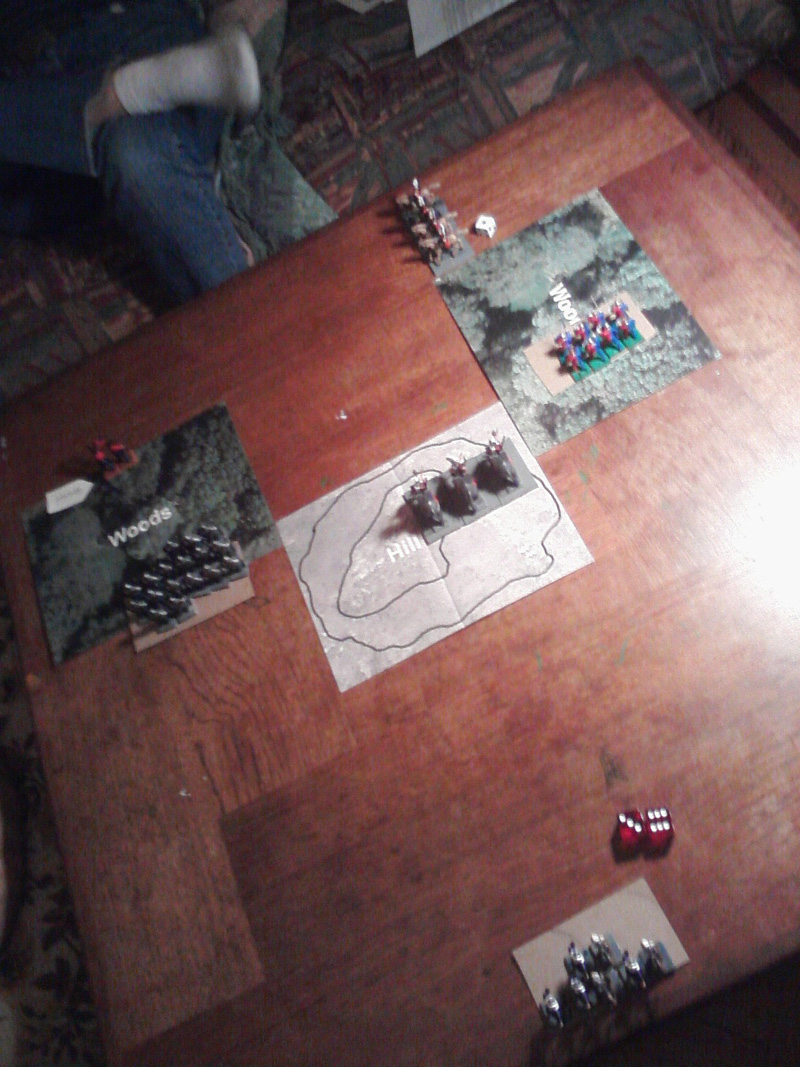
Friday Night Book of War

Here's a Book of War game from a few weeks ago, when my girlfriend decided to try using the option of war elephants with archers mounted on the back:


Start -- Basic Rules; 300 points; War elephant option. At top in red, opposition has selected crossbows, 3 figures of war elephants with archers, and medium infantry. At bottom in blue, I've chosen medium infantry, regular archers, and two groups of horse archers. I've batched my infantry & archers into two big units in the hopes of surviving morale checks; except that I placed a small unit of 3 infantry as a feint/delay tactic near my right side. Terrain are 2 areas of woods surrounding a hill in the center of the board. Red has set up first and will take the first turn.


Turn 2A -- On the first turn, opponent moved full, while I moved full on either flank (note horse archers galloping into enemy rear in top-right), and moderate half-moves in the center (no shooting because the hill crest was blocking us). Now, opposition has come through the woods, taken the top of the hill, and makes the first missile attacks of the game. Each of my lower units have lost some figures, but my horse archers there have routed. This sucks; they'll flee off the table in the next turn. (As we've seen, getting the first attack in BOW is highly desirable.)


Turn 2B -- Now I move forward and make my counterattacks. I'm trying to clear out all the supporting crossbows before taking on the elephants in the center. This goes well; infantry attack on the left, archers, in the center, and horse archers also get attacks around the woods to the rear; crossbows take heavy hits and they're all routed. I've also sent my small unit of infantry into combat in the woods on the right, and this will delay the enemy infantry there for a turn or two. Already, things look much better for me.


Turn 3 -- Well, this sucks. While enemy crossbows flee to the rear, elephant-back bowmen on the hill have shot at my archers, killing 4 figures, and the unit has now routed. Also, on the right, her infantry are finishing off my small unit there.


Turn 4 -- My big infantry continued into the woods, getting more hits on the retreating crossbows there before they could get away; also, there was another fleeing crossbow unit that got shot down by my waiting horse archers. Opponent has turned her forces around, and elephant archers have scored one hit on my horsemen. But, luck smiles on me -- my archers have managed to un-rout just before they escape from the table (scoring exactly the minimum requirement of 9 here) -- so now they'll get to turn around and harass the enemy from a direction she thought was secure.


Turn 5 -- What's happened here is that my horse archers ran into melee against fleeing crossbows at the edge of the woods, finishing them off; and my big infantry unit has done an about-face and started to wheel out of the woods (planning to charge up the hill en masse and catch the elephants on rough terrain). Before I can complete this, on opponent's turn, the elephants get just 1 figure of attacks (4 dice), because the other figures are blocked by the top-crest of the hill, and scores of 5+ are needed to hit my medium infantry in chain mail. But most grievously, all of those dice have come up 5 or 6, killing 4 of my figures, and then I've also lost the morale check. Even 1 pip higher would have succeeded; but now my whole infantry force is going to turn tail and run off the side of the board. Dammit!


Turn 8 -- Three rounds go by, and the elephants have shot at my retreating infantry to make sure they don't come back. Meanwhile, my horse archers have come forward through the woods, shooting at the elephants as they ride by (as long as they keep the target to their left-hand side, they can shoot even 180 degrees to the rear in the middle of their move). Foot archers are firing everything at the elephants in an attempt to degrade them. Here, with some good rolls, I manage to take out one of the elephant figures. Huzzah! But, with the elephants' high hit dice, that's not enough to force a morale check, and the opponent's infantry has maneuvered into position on the hill for an attack.


Turn 9 -- Opponent tried to position her infantry near the edge of the hill, out of my archers' range, but close enough to charge in the next turn. Unfortunately for her, she's miscalculated, and my archers have opted to shoot at them, with devastating results. In that infantry unit, 7 of the 8 figures have just died -- and yet they've heroically succeeded at the morale check, and on the next turn will in fact charge my archers, preventing them from firing in the next turn as they are forced to melee the lone infantry (much like how I used my rogue infantry unit back in Turn 2B). And on the next turn I actually make the same mistake, getting my horse archers too close to the elephants, after which they also get shot down. (Lesson: Trying to be fiddly and overly clever in Book of War rarely pays off.) This leaves the elephants against my foot archers.


Turn 12 -- The End. Once the elephants finish off my horse archers, they turn to my footmen with devastating results. Here, my archers are fleeing off the board -- but opponent is not letting them rest, as inflicting further hits prohibits any attempt at un-routing (a lesson she's taken to heart from Turn 4). Victory for the opponent! The war elephants have won the day.


Postscript -- We like to call this game "Killing Me Softly with Her Elephants". Turn 5 was probably the pivotal moment in this game, in which I suffered hits on every single enemy attack die, and then had my largest unit miss morale by 1 point.

One thing I did not do in advance of this game was check simulated unit matchups against elephants before selecting my army, and as it turns out -- horse archers are actually the very worst unit you can field against elephant archers. So recommendation is not to repeat that if you think you might be facing off against war elephants (even though my horse archers did a fair job in the rear of the enemy position against already-damaged crossbows). Our consensus is that the elephant archers played out a lot like tanks here -- big, hard to put down, and with a fairly crushing ranged attack. But maybe if I'd been smarter with my army selection, and a bit more dice luck, things could have turned out differently.

2011-11-02

Book of War Expansion: War Elephants

There was one obvious historical unit type that I was on the cusp of including in the Book of War Basic Rules, but ultimately I decided that they didn't fit for space, complexity, and thematic (medieval European) concerns -- War Elephants. Here are two different types that you can add to your BOW games. (Text between the rules below is hereby indicated as Open Game Content.)


Unit Cost MV AH HD Notes
War Elephants, Spears 45 12 5 6 Spearmen (2 per howdah)
War Elephants, Archers 50 12 5 6 Shortbows (2 per howdah)

War Elephants: These elephants each have a mahout (driver) and 2 men in an armored howdah (tower). They count as cavalry for most purposes. Spearmen melee as normal (total 2 dice per elephant figure), and archers shoot as normal (total ROF 4 per elephant figure), although they can fire in any direction at will. Elephants themselves melee at 2 dice, bonus 3, damage 2. All melee attacks are halved in non-open terrain or stormy weather; also, archers can still shoot in melee at half-dice (figures in contact only, i.e., at most one rank of elephants).


Design Comments: You'll see that a force like this is a little bit more complicated to handle than other stuff, which is one reason why I didn't want them in the Basic Rules (actually, the mount-with-many-riders is unique and makes them a bit more complex than pretty much anything even in the Advanced Game). The elephant stats are based on the 1E Monster Manual p. 38 (either Asiatic 10HD or African 11HD); and again I think that Gygax went overboard with the attacks there, so I've reduced them to 2 attacks for elephants here (although even that work has a "no more than two" attacks per target rule, which should arguably apply in close-ranked mass combat anyway).

There was some consideration as to exactly how the mechanics of fighting war elephants should work in D&D (can you melee the guys in the tower? does it suffice to just kill the driver?), but ultimately it seemed best to simply apply the BOW standard cavalry rule. I treat elephants as "not naturally aggressive", since there's so many reports of them being frightened off from certain historical battles. Therefore we double the sum riders hit dice (3 men × 1 die each × 2 on mount = 6HD); and this gives at least a chance of their failing a hit-dice-based morale check, as desired (even if it will be a small chance). And elephant figures are presumed to be on some larger base size; my own are 1½×2½ inches (about 40×60mm), but whatever you get yours on is probably okay, too.

The 2 men in each figure-howdah basically act as normal, with the above-noted advantages for archers (note: half-dice missiles in contact are the result of only the front 1:1 howdahs having a shot; and the tactical result, ROF2, is actually the same as they'd get in normal melee, as per spearmen). And the other thing you see here is that if the mount is entirely more powerful than the riders, then we have to track their attacks separately. For example: In a standard melee in open terrain, these figures will roll 2 attack dice each normally for the spearmen, and a further 2 dice with a bonus of +3 each for the elephants, these causing up to 2 hits damage (see MM, taking one-third hit dice for the bonus, and following the 2 dice damage indicated for attacks there as well). This extra damage is capped by the target HD, so it does not apply to enemies with only 1HD (see the BOW Advanced Rules p. 10).

The actual hard part of the design process, setting the price, came last: By adding them to the BookOfWar simulator program and hand-tuning until they were approximately balanced with other basic types, as usual (note: they've been playtested somewhat less than other core types, so pricing is possibly more tentative). Possible further options: Consider giving the elephants themselves heavy armor (total AH6; cost for that armor currently unknown); and possibly force routing elephants to flee in a straight-line-away path only, and attack any friendlies they contact there (try to avoid that at all costs!).

Therefore, if they make sense in your campaign, and you've got the money to spend, these war elephants can make a very powerful addition to your Book of War armies.


(Picture detail from "Schlacht von Zama" by Henri-Paul Motte, circa 1890.)