2011-08-31

Alternative Level of Monster Matrix

Tavis over at The Mule Abides sent me a question last week that reminded me of my OD&D monster level analysis blogs from last August (some key links below). I pointed out some oddities of the OD&D dungeon encounter tables at that time, and meant to present alternative options for them (with the usual smallest-possible changes), but never got around to it.

For example, on OD&D Vol-3, p. 10, you get the "Monster Determination and Level of Monster Matrix" (i.e., what level of monster do you encounter?). My observation from last year is that the table is tough: by the 2nd dungeon level, the average encounter is with a 3rd-level monster, with a good chance of getting a 4th or 5th level monster (and remember that the scale only goes up to 6!). That's probably too accelerated, and if you look at the AD&D DMG, Gygax would perhaps agree; he actually overcompensated in the other direction there, and made the equivalent table go up too slowly.

Here's what I currently use. It's not rocket science: simply make the progression smoothly increase. The average encounter level now increases by one for each row of the table. I also added a column on the far right called "tier" (i.e., index of the row; same as dungeon level for 1-4), which we'll use in a bit:

Alternative Level of Monster Matrix

Dungeon

Monster Level


Level

1

2

3

4

5

6

Tier

1

1-3

4-5

6

-

-

-

1

2

1-2

3-4

5

6

-

-

2

3

1

2

3-4

5

6

-

3

4-5

-

1

2

3-4

5

6

4

6-7

-

-

1

2

3-4

5-6

5

8-9

-

-

-

1

2-3

4-6

6

10-12

-

-

-

-

1-2

3-6

7

13+

-

-

-

-

-

1-6

8


Now, after you consult this table, you'll refer to one of the individual "Monster Level Tables" (which I'll leave for a later day). But the end of the process is to determine the "Number Appearing", for which OD&D gives some very loose, vague guidance. I've even previously posed this as a question to readers in the past, and gotten excellent feedback: in particular, I was tickled by "if in doubt, as a basis, roll 1d6".

So here's what I do currently:
  • If the tier is equal to the monster level, roll 1d6.
  • If there is a one-step difference, multiply or divide by 2.
  • If there is a two-step difference, multiply or divide by 4.
When multiplying you roll extra dice (i.e., when monsters are weaker than the tier); when dividing you roll one die, divide, and round up on 0.5 or more (minimum one monster; i.e., when monsters are stronger than tier). Note: You'll never have more than a two-step difference between monster level and tier level, based on the modified matrix above.

Here are some examples:
  1. We're on level 2 and generate a 1st-level monster. Since that's one step weaker than the dungeon level (tier), I'll roll double monsters: i.e., 2d6 for the number.
  2. We're on level 3 and generate a 3rd-level monster. I'll simply roll 1d6 for the number appearing.
  3. We're on level 4 and generate a 6th-level monster. Since that's two steps tougher than the dungeon level (tier), I'll roll for one-fourth as many monsters: i.e., roll 1d6 for 6, divide 6/4 = 1.5, and thus 2 monsters appear (note that any die result 1-5 would be only a single monster).
Gygax in both OD&D (Vol-3, p. 11) and AD&D (DMG, p. 175-179) tried to "naturalize" the numbers appearing (e.g., orcs in larger numbers, skeletons in smaller numbers), but personally I don't think that's sustainable. One or the other type will be over- or under-powered (all the time), so it's probably best and simplest to just use a single rule for all monster power levels. The random dice will create some nice variation in any case.

The table and rules above are indicated as Open Game Content under the terms of the Open Game License v1.0a. A copy of the table in spreadsheet form (.XLS) is available here.

2011-08-29

Spells Through the Ages – Control Weather

Have you recently wished that you could control weather? Are you aware of the notable differences between editions of this powerful spell? Does my house have any power or telecommunications at the time you read this? All excellent questions.


Original D&D

Control Weather: The Magic-User can perform any one of the following weather control operations with this spell: Rain, Stop Rain, Cold Wave, Heat Wave, Tornado, Stop Tornado, Deep Clouds, Clear Sky. [OD&D Vol-1, p. 31]
We start with OD&D. Note that Chainmail has no control weather spell -- although it does have some optional rules for random weather [CM, p. 21-22], and the options above are at least semi-compatible with the possibilities there.

Recall that OD&D spells only go up the 6th level, and this is a 6th-level spell, so it is intended to be among the most powerful magics in the game (it's actually the very last magic-user spell in the list, which is organized by some principle other than alphabetization). Notice that there is no range, and no duration specified (indefinite? one battle(field)? DM's choice?). Most of the options would require DM adjudication on the exact in-game effects (e.g., Rain, Cold Wave), although at least one could be clued-in from Chainmail (where it says: "Excess heat... Fatigue doubled, greater chance of fire in dry grass or woods if dry [p. 22]), and perhaps a "Tornado" could be simulated by the Air Elemental "Whirlwind" ability. If the spellcaster has carte blanche to instantly create and control any of these conditions, then it is a very powerful spell, indeed.


Advanced D&D (1st Edition)

Control Weather (Alteration)

Level: 7
Range: 0
Duration: 4-48 hours
Area of Effect: 4-16 square miles
Components: V, S, M
Casting Time: 1 turn
Saving Throw: None

Explanation/Description: The control weather spell allows a cleric to change the weather in the area he or she is in at the time the spell is cast. The spell will affect the weather for from 4 to 48 hours (4d12) in an area of from 4 to 16 square miles (4d4). It requires 1 turn to cast the spell, and an additional 1 to 4 (d4) turns for the effects of the weather to be felt. The control weather spell will not radically change the temperature, i.e. from below zero to a 100 degree temperature heat wave. The weather control possible depends upon the prevailing conditions:
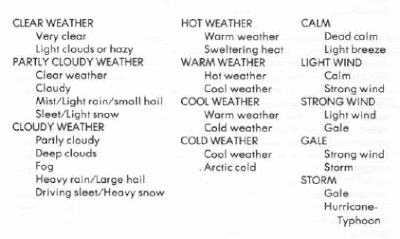
All three aspects of the weather (clouds/precipitation, temperature, and wind) can be controlled, but only as shown. For example, a day which is clear, warm, and with light wind can be controlled to become hazy, hot, and calm. Contradictions are not possible - fog and strong wind, for example. Multiple control weather spells can be used only in succession. The material components for this spell are the cleric’s religious symbol, incense, and prayer beads or similar prayer objects Obviously, this spell functions only in areas where there are appropriate climatic conditions. [AD&D 1E PHB, p. 52]
The text above is copied from the clerical spell roster; the magic-user spell references this (again at 6th level), with half the maximum duration (4-24 hours), and arcane-style material components ("burning incense, and bits of earth and wood mixed in water."). [AD&D 1E PHB, p. 83]

So at this point the spell has been fleshed out with range & duration, and they are enormous: on an entirely different scale (days and miles) than almost any other spell in D&D. Other than that, however, a decision has been made to dramatically reign in the power of the spell through a multifaceted series of restrictions. (1) The spell's power has been switched from a blank-check to a "one step adjustment" effect, among several fine-grained categories. For example: You can't just pick "Tornado" at any time now; the natural weather already has to be a "Storm" before you can change it to "Hurricane-Typhoon" (if you wanted such a thing, for argument's sake). (2) There is a very long time-to-effect after casting of 1-4 turns (10-40 minutes by the book in AD&D), which really makes it totally useless in the context of any standard D&D combat. (3) There is the "no contradictions" rule, and also the "only... appropriate climatic conditions" language, which allows the DM to nerf the spell in many ways that it might be used. And finally there is the rule (4) "Multiple control weather spells can be used only in succession", which is to say, "no stacking" (as I read it) -- a key support to #1, that weather will never be altered more than one step from the natural conditions.

The DMG provides its usual errata-like detail:

Control Weather: To find the prevailing conditions at the time the spell is cast, you must know the clime and the season, of course. Sky conditions (cloudy, foggy, partly cloudy, clear), precipitation, wind speed and direction, and temperature must be determined according to the area. Knowing this, you should have no great problem informing the would-be spell caster as to what sort of weather exists. [AD&D 1E DMG, p. 42]

Advanced D&D (2nd Edition)

Control Weather (Alteration)

Range: 0
Duration: 4d6 hrs.
Area of Effect: 4d4 sq. mi.
Components: V, S, M
Casting Time: 1 turn
Saving Throw: None

The control weather spell enables a wizard to change the weather in the local area. The spell affects the weather for 4d6 hours in an area of 4d4 square miles. It requires one turn to cast the spell, and an additional 1d4 turns for the weather conditions to occur. The current weather conditions are decided by the DM, depending on the climate and season. Weather conditions have three components: precipitation, temperature, and wind. The spell can change these conditions according to the following chart.

The upper-cased headings represent the existing weather conditions. The small headings beneath each large heading are the new conditions to which the caster can change the existing conditions. Furthermore, the caster can control the direction of the wind. For example, a day that is clear and warm with moderate wind can be controlled to become hazy, hot, and calm. Contradictions are not possible--fog and strong wind, for example. Multiple control weather spells can be used only in succession.

The material components for this spell are burning incense and bits of earth and wood mixed in water. Obviously, this spell functions only in areas where there are appropriate climatic conditions... [AD&D 2E PHB]
As is most often the case, the 2E spell is just a copy-and-paste of the 1E spell, will some minor reformatting to some of the text. What follows (after the ellipses) is the same table of possible conditions, as seen in 1E. I don't see any changes to the effect of the spell whatsoever.


Rules Cyclopedia

Weather Control
Range: 0 (magic-user only)
Duration: Concentration
Effect: All weather within 240 yards

This spell allows the magic-user to create one special weather condition in the surrounding area (within a 240 yard radius). The spellcaster may select the weather condition. The spell only works outdoors, and the weather will affect all creatures in the area (including the caster). The effects last as long as the spellcaster concentrates, without moving; if the caster is being moved (for example, aboard a ship), the effect moves also. The spell's effects vary, but the following results are typical:

Rain: -2 penalty to attack rolls applies to all missile fire. After three turns. the ground becomes muddy, reducing movement to half the normal rare.

Snow: Visibility (the distance a creature can see) is reduced to 20’; movement is reduced to half the normal rate. Rivers and streams may freeze over. Mud remains after the snow thaws, for the same movement penalty.

Fog: 20' visibility, half normal movement. Those within the fog might become lost, moving in the wrong direction.

Clear: This cancels bad weather (rain, snow, fog) but not secondary effects (such as mud).

Intense Heat: Movement reduced to half normal. Excess water (from rain. snow. mud transmuted from rock. etc.) dries up.

High Winds: No missile fire or flying is possible. Movement reduced to half normal. At sea, ships sailing with the wind move 50% faster. In the desert. high winds create a sandstorm, for half normal movement and 20' visibility.

Tornado: This creates a whirlwind under the magic-user's control, attacking and moving as if it was a 12 HD air elemental. At sea, treat the tornado as a storm or gale. [RC, p. 54]
At this point, as usual, I like to check in on the Aaron Allston Rules Cyclopedia from 1991, which represents the results of divergent evolution of the game along the BXCMI line. The rules above are fundamentally the same as those first laid down in the Expert Rulebook by Dave Cook and Steve Marsh in 1981 (same area, weather categories etc.; although most of the sentence-structures have been rewritten; p. X17). Oddly, the spell does not appear in Frank Mentzer's Expert Rulebook of 1983 (possibly appearing in the Companion rules?) While the earlier Cook text still called it control weather, the name now (in Allston) has for some reason been switched around to weather control (like most of the constituent sentences, actually) .

So: The BXCMI spell is very different from AD&D's spell. It has a much smaller area: 240 yards instead of some number of square miles (although perhaps that's an academic difference in a standard D&D fight). It lacks the multi-turn "transition" delay, but it does require that the caster be still and concentrate throughout the duration (a restriction that does not appear in AD&D). The suggested effects are actually more reminiscent of the OD&D options, with specific in-game mechanics attached to each, and apparently the caster can switch between any of them instantly and at will (no alternate AD&D "move one step" mechanic). There also isn't any "appropriate climatic conditions" restriction, as was added in AD&D.

Finally, the spell has the cracked-open-door line that says, "The spell's effects vary, but the following results are typical...", implying that the list of effects is not exhaustive, and if the DM/players are so willing, others might be added.


d20 System D&D (3rd Edition)

Control Weather
Transmutation
Level: Air 7, Brd 6, Clr 7, Drd 7, Sor/Wiz 6
Components: V, S
Casting Time: 10 minutes (see text)
Range: Two miles
Area: Two-mile-radius circle, centered on the character (see text)
Duration: 4d12 hours (see text)
Saving Throw: None
Spell Resistance: No

The character changes the weather in the local area. It takes 10 minutes to cast the spell and an additional 10 minutes for the effects to manifest. The current, natural weather conditions are determined by the DM. The character can call forth weather appropriate to the climate and season of the area the character is in.

Season Possible Weather
------ ----------------
Spring Tornado, thunderstorm, sleet storm, or hot weather
Summer Torrential rain, heat wave, or hailstorm
Autumn Hot or cold weather, fog, or sleet
Winter Frigid cold, blizzard, or thaw

The character controls the general tendencies of the weather, such as the direction and intensity of the wind. The character cannot control specific applications of the weather. When the character selects a certain weather condition to occur, the weather assumes that condition 10 minutes later (changing gradually). The weather continues as the character left it for the duration, or until the character uses a standard action to designate a new kind of weather (which fully manifests itself 10 minutes later). Contradictory conditions are not possible simultaneously.

Control weather can do away with atmospheric phenomena (naturally occurring or otherwise) as well as create them.

Druids casting this spell double the duration and affect a circle with a three-mile radius. [D&D 3E SRD]
In many respects this follows from the AD&D version of control weather. It has the same "10 minute warmup delay" and "no contradictions" language. A similar miles-and-days range & duration are maintained. It's explicit that no concentration is required (as opposed to the BXCMI version).

The list of effects, however, has switched backed to a fairly small number of options (in this case, keyed off the current season) which are once again reminiscent of those found in OD&D, with no "move one step" mechanic involved. In some sense, then, this may be looked at as a re-merging of the divergent AD&D and BXCMI lines; it doesn't have any direct mechanical effects listed here, but in many cases those can by synched up with appropriate listings in the 3E DMG.

Edit: At a slightly later date, I realized that the descriptions for the available weather conditions by season were actually taken from the alternate weather spell for AD&D (both 1E and 2E), the druidic weather summoning (6th-level spell). "Thus, in spring a tornado, thunderstorm, cold, sleet storm, or hot weather could be summoned," etc. [AD&D 1E PHB, p. 63]


Conclusions

Control weather is an interesting and imagination-grabbing spell that didn't have a chance to be playtested in Chainmail, first appearing in brief form in OD&D, and requiring significant refinements afterward. The approach to that refinement was very different between the AD&D and BXCMI lines (the former, by Gygax, being notably more liberal with its alterations/revisions; the latter remaining closer to the OD&D source, but with much heavier restrictions to duration, area, and ongoing caster activity).

I had the opportunity to think closely about control weather when I had to deal with its effects in the course of designing my upcoming Book of War D&D-based wargame. Obviously, the spell seemed like a natural fit for inclusion, being a high-level spell with outdoor usage, large area-of-effect, and a natural tie-in to battlefield weather conditions. But it also became obvious that the OD&D effect as written was simply too powerful -- under almost any interpretation, you could instantly summon a heavy storm or "high winds" and shut down all of an opponent's missile troops, for example. The AD&D modification provides a very nice and praiseworthy fix to this situation, I think; giving a "one step adjustment" to natural weather conditions means that it's possible to sway the weather a bit, and the "no stacking" ("only in succession") rule reinforces that there isn't any "cheat" to work around that and completely break the game. That said, control weather will still be an extremely important tactic in your D&D mass combat simulation.

(Illustration by AZRainman under CC2.)

2011-08-26

Backstory Rewards

Some folks like and encourage (sometimes with rules & benefits) extensive backstory as part of their RPG character-creation. I don't think it's any secret: I don't. Personally, I find it to be a hassle, a burden, a bondage, and generally a waste of time -- particularly in the context of an old-school RPG where we expect a fairly high body count/turnover. As a player, I'm very happy to experience my PC's "story" unfold in its entirety at the gaming table, to have it be organically anchored to other players and the milieu, and to be surprised and have to improvise as the character-arc unfolds (whether briefly or at length).

But let's think for a moment at the possibility for "backstory rewards", that is the inverse, awards for keeping your backstory shorter rather than longer (perhaps even a cap or a rules-based prohibition on long backstory). Say that at 1st level, you get to add one item of backstory to the campaign -- maybe as simple as your character's name. If you tell me anything more than that you get penalized in equipment (ha!; semi-joking). If that seems limiting, recall that in classic old-school play even naming the PC at 1st level was commonly avoided; some folks didn't bother to pick name until survival to a later level was proven. (And, sadly, this has a reflection in reality: once upon a time, it was common practice to forgo naming newborn babies for some time. I'm only a single generation removed from that myself.) At 2nd level, you get to add one more item of backstory -- like making up the town where you're from. Maybe at 3rd level you get to make up/specify a cult, ally, or magical school that gave you training in the past. And so on and so forth. Perhaps around name level (9th-12th or whatever) you earn the right to establish descent from a particular royal line or something.

So, in theory, this would accomplish a few things: (1) it would limit the initial backstory which can be seen as wasteful; (2) it provides yet another benefit to "leveling up"; (3) it allows limited player input to the campaign as a reward for superior play (but not carte blanche for any new entrant to mess it up); (4) it models many sources of literature where the protagonist's "special birth" or "chosen one" status unfolds as a mystery over time, only being revealed in full near the end of the character arc; and likewise (5) it plays with the idea of "fate", normally extremely hard to simulate in RPGs, as a function of re-interpreting history after-the-fact, as it were.


2011-08-24

More on Choose Your Own Adventures

We've praised Choose Your Own Adventure books in the past. Having again looked at some of TSR's equivalent Endless Quest books recently, a few other things occurred to me:

Unpredictable Timing

One of the nice things about these books is that you can't predict how close you are to the ending based on your position within the pages of the book. Lots of media you can't say that for -- A normal novel, a standard TV show, a movie whose run-time you have a general sense for. All of these things allow you to glance at your page position, or a clock, and know that you aren't in any real danger of the story ending soon based on that placement compared to that end-time. But Choose Your Own Adventure-style books raise the stakes because they could always legitimately end in catastrophe (or otherwise) with the next page-flip. The drama is not sabotaged by the physical structure of the media itself. (The only other things I can think of like this are video games, or maybe short-story collections.)

Sense of Phatasmagoria

What I mean by this is: The very act of flipping through the book on various "turn to page X" directions causes you to, unavoidably, see little snatches of text from other possible branches, and also glances at illustrations of things that may-or-may-not happen. Personally, I'm pretty scrupulous about my page-flipping, trying as best I can to only scrape open the page numbers themselves (kind of like professional poker players' extraordinary care in flipping up the tiniest possible bit of a card to identify what it is). Nonetheless, I wind up subconsciously picking up new bits of text and illustrations. Are they things in the past, or the future, or possible-futures? It's almost like having vague shamanic visions of alternate timelines. The overall effect, to me, deepens the fantasy world, making me feel surrounded by nearby alternate spirit-worlds (which is certainly not something I actually feel in reality). Consider this excellent link noted by commenter Matthew W. Schmeer, and (at the end) the example of an entirely disconnected branch whose only clue is an enticing two-page splash page of a paradisaic city.

Example of Evolution

This final item, not so much complimentary, but perhaps sympathetic to the troubles we've seen in our other interactive entertainments and the big business of producing them. With Choose Your Own Adventure books you see, early on, a cornucopia of different possible branches and alternate endings; as time and the business progressed, fewer branches and fewer different endings; and in its place (necessarily) much longer narrative chunks of text in which the author gets to tell their "story" (again, see link above for the documentation of this). Gee, what does that sound like?

I would say that it sounds like D&D and the evolution through 2E when the call for "more story", and less player capacity for affecting plot structure, became prominent and irresistible. I would also say that this resembles video games tendency to develop away from "sandbox" or "digital toy" type games in the early years, or layouts with many branches and side-corridors, to more linear story structures in later years. Or more generally, Richard Garfield's seminal (to me) observation in a Game Developer magazine essay (November 2006) that "Historically, games usually evolved in such a way as to reduce the amount of luck in them." Can the same possibly be said about plays, opera, or epic poems (possibly more responsive to a live audience in an earlier era, and becoming fossilized over time)? Maybe even social network websites?

At least with our more modern gaming forms, you can see a number of pressures that would lead to reduced player choice over time: (1) the desire for the creator to be more of an auteur, or at least an honored expert (see Garfield's essay); (2) the promotion of cross-merchandising brands into other properties, via fixed and canonical characters and backstory; and (3) the business efficiency case for having a maximum amount of content generation actually consumed by the audience (and not wasted in undiscovered branches, especially as production values and costs accelerate greatly over time; e.g. see recent New Yorker article on Mass Effect creators grappling with alternate FemShep and BroShep character development). Perhaps every "wild west" ultimately gets its taming, but nevertheless, as we've written here before, we can still regret the loss of freedom that comes with it. Perhaps more of a "devolution", really.

2011-08-22

Endless Quest Flowchart — Dragon of Doom

I was visiting my folks' house this past weekend, and took this as an opportunity to dig up some of my old Endless Quest books (D&D's answer to the popular Choose Your Own Adventure books of the era).

It occurred to me that a nice analytic tool would be to see one of these adventures mapped out completely in flowchart form; a quick Google search turned up nothing, so I figured I'd do one myself. Above you'll see my flowchart for Endless Quest Book #13: Dragon of Doom by Rose Estes. Likely not the best example of the series, but it's the first one that I grabbed. (If you can't read my handwriting, hopefully at least the overall shape of the adventure is apparent.)

SPOILERS FOLLOW.

The first thing we see here is that this adventure has two distinct and totally separate paths based on the first decision point (broadly left-vs-right in the image above). There is no way to switch back from one to the other after the initial decision is made. You trigger one of two incompatible plot designs based on that decision (in one, the evil wizard & dragon plan to meet at the Edge of the World; in the other, the meeting point is Dragon Castle).

The paths are fairly linear; in general there's a pretty obvious "throughline" from the top to one of the two bottom victory points, with several danger zones along the way which might result in premature endings. This is more true on the left branch; less true on the right branch (which has a few crossover/back points, and actually two different successful endings).

My overall sense of this adventure (#13 in the line) is that it's more juvenile and rather "gentler" than some of the adventures that came earlier. The protagonist is a child-wizard with an intelligent and cuddly pet pseudo-dragon; most of the failure endings avoid directly saying that he's killed, usually leaving it ambiguous and off-screen. This impression is reinforced by the flowchart structure; there are numerous seeming hazard points where the decisions turn out to not be at-risk at all, with most or all of the options being success, or at worst returning back to the decision point (see prime examples on the lower left branch, like "53 shambler attack" and "22-24 over lava").

Edit: One other thing that strikes me as a bit odd is the very-long narrative endings for 2 of the 3 possible victories, after the last decision point has been passed. For example, at the bottom of the left branch you have "79-86 victory!", that is, an 8-page stretch of narration (including 2-page splash illustration) to conclude the adventure. On the right branch, one ending features "148-152 feed room & pearl", followed automatically by "102-107 dragon throne victory!", constituting an 11-page block of text without any decision point (the entire book being only 157 pages total). Hypothesis: I bet earlier books didn't have such long, author-centric, narrative "climaxes" like this very much.

Total number of variant endings: 13. Failure endings: 10. Victory endings: 3.

2011-08-19

More on Catapults & Giants

In the past few weeks I was looking closely at the mechanics for OD&D catapults, giant stone-throwing, and fireball spells, which really all share the same single mechanic originating in Chainmail. If you recall how catapult-like-attacks function in Chainmail, they land at some declared range by the attacker, killing everything within an area-of-effect diameter of 2" or 3.5" (depending on light/heavy category; some survival allowed for heroic-type targets; but otherwise ignoring any armor considerations). Particularly with catapults, you then get into questions of what scale this is intended to be -- I argued that they're best understood at Siege/Man-to-Man scale, and somewhat accidentally shoved into the mass combat section.

As usual, Gygax's Swords & Spells book (which counts as being in the OD&D line) gives some nice additional perspective if you hunt around in it enough. In these 1:10 mass-combat rules, catapults are explicitly said to be 1:1 scale, which I think bolsters my previous argument:
Artillery: As the various artillery pieces represent but a single scale engine, only a single figure is needed to represent crew for each... [S&S, p. 10]
Catapults (both light & heavy) have decreased rate-of-fire from 1/2 or 1/3 [CM, p. 12] to 1/4 here [S&S, p. 9]. Meanwhile, bow archery has increased rate-of-fire from 2 per turn [CM, p. 11] to 3 per turn [S&S, p. 9]. And as far as giants go:
Giants act as 20" range -- light catapults with a fire arc of 45% [sic] left or right, but they must stand one-half move to fire. [S&S, p. 10]
That's an oddball rate-of-fire: sort of between the allowances for ROF 1 or 2 [S&S, p. 9], now much more potent than a mundane light catapult (by a factor of 4), similar to the description in Chainmail but without following the Swords & Spells reduction to catapult speed. This is backed up by the Example of Game Play at the back of the book which features giants throwing rocks on each of subsequent turns [S&S, p. 38].

Now, the thing I thought particularly interesting is that the result of catapult/giant fire is already no longer an area-of-effect. And I think this is particularly reasonable if we're interfacing between scale 1:1 throwers and 1:10 targets. The effect is now simply an application of a certain number of hit points damage to the target unit [S&S, p. 26]:

STONE CASTERS Target About Man-sized Larger
Small Catapult 30 15
Large Catapult 40 20
Trebuchet 50 25

Consider: The effect of the small catapult (i.e., giants) in these rules is to kill 30/4.5 = 6.7 normal men. That's actually very close to the number of men you'd kill if the Chainmail/OD&D area-of-effect was applied over man-to-man figure bases areas: Pi*r^2/Fig^2 = 3.14*1^2/(0.75)^2 = 3.14/0.5625 = 5.6 normal men. The large catapult kills 40/4.5 = 8.9 normal men, compared to Chainmail's heavy catapult which at man-to-man scale would kill at most Pi*r^2/Fig^2 = 3.14*1.75^2/(0.75)^2 = 9.62/0.5625 = 17.1 normal men (i.e., about twice as many).

2011-08-17

Haste Effect Poll Results

Here are the results from another past poll (embarrassingly, from last year). This follows from my pointing out how much the effect of the haste spell has changed over time, with a distinctly different (increasingly powerful) mechanic in every edition. The question asked was, "What would be a reasonably balanced effect for the haste spell as a 3rd-level wizard (magic-user) spell?" Here the far-away favorite was for the well-known version of the spell basically shared between AD&D 1E, 2E, and B/X -- double move and melee/missile attacks. Honestly, left to my own devices, I would have picked something different -- namely the second option, with double movement, but no attack benefit (explicitly matching the OD&D description for a potion of speed in Vol-2, p. 31). That said, I've accepted this poll result into my own OD&D games, and I'm comfortable with it so long as the duration is interpreted as only a certain number of rounds (i.e., one combat only, as per the previous poll's finding; and as explicit in AD&D, with the modified spell duration given there in rounds). If the duration was interpreted in terms of 1 turn = 10 minutes, then I'd say this is demonstrably broken unless you at least remove the double-attacks effect (it pretty much single-handedly broke my G1 giants game last year).