Classic D&D (OD&D, AD&D, B/X, etc.... everything prior to 3E in 2000) had as a core rule the fact that the Charisma score correlated with a particular number of maximum loyal hires. (Called variously "hirelings" in 0E, "henchmen" in AD&D, "retainers" in B/X, etc.). This number is 4 for the average Charisma score of 10-11, and varies for higher or lower Charisma, edition specifics, etc. Of course, this is the primary function of the Charisma ability in the first place, and without that mechanic in action, Charisma quickly becomes "the dump stat".
But I'll confess that I've found it a bit burdensome to run games by the letter of the book and have PC parties start to swell towards 4 henchmen per PC. (And related: I've wrestled and run some surveys on how much direct information/control to hand to the player in question, which bears on some recent discussions of "immersion" in the game.)
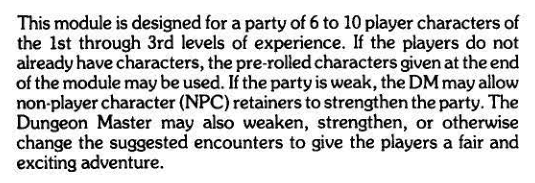
Random thought for today: In spite of the core rule being without any constraints (other than possibly cost and negotiations to hire the henchmen), the early adventure modules specify a narrower place for the hiring of loyal henchmen: namely, when the number of PCs does not match the design of the given adventure.
Here's the text in Mike Carr's Module B1, In Search of the Unknown (p. 3, 1979):

Here it is in Gary Gygax's Module B2, The Keep on the Borderlands (p. 2, 1980):

And Tom Moldvay's Module B4, The Lost City (p. 2, 1982):
Now arguably, these products starting in 1979 may not count as "early": at least half a decade after the publication of Original D&D. And I don't find similar text in other adventures of the same era (the earlier GDQ series, T1, either version of B3, etc.). But I do find an interesting take at the end of Gygax's Module S1, The Tomb of Horrors, from one year earlier. Here a list of 20 different high-level characters is given, and then a complicated matrix is given for exactly which ones are put in play depending on the number of players, which can range widely from 2 to 10 (from p. 12, 1978):

Following that rule, the associated table indeed gives two characters per player if the players number 2-4, and only one character each if the players number 5-10. This stock advice is then repeated at the end of Gygax's next adventure, Module S3, Expedition to the Barrier Peaks (p. 30, 1980).
So: What happens if we follow that sensibility -- found only in certain O/AD&D adventure module publications -- that a player shouldn't be controlling more than two characters at a time in a dungeon adventure? As I think it now, the high Charisma allowance for many henchmen has the flavor of one of those rules that works better in high-level solo play, possibly by mail or phone, than it does in live, large-party dungeon crawls (which is part of a more general thesis that's been evolving for me of late).
I wonder: What mechanic could we institute to formalize this in the open-play campaign situation? (That is: give PCs the full benefit from a high Charisma score of many henchmen, but restrict the number in a dungeon crawl to perhaps one at most.) Possibly NPCs decline to take part in adventures when their proportional share of the rewards would be too low? Some logistical problem in spelunking with a large group of people? Something else? Maybe you have some creative ideas of which I wouldn't think...


