Let's do a Spells Through the Ages! Here's one we haven't surveilled yet: the magic-user's all-purpose lookabout spell,
wizard eye -- or, in later editions,
arcane eye. How has this 4th-level divination spell evolved?
Original D&D
Wizard Eye: A spell which allows the user to send a visual sensor up to 24" away in order to observe the scene without himself moving. The "eye" is invisible. It moves 12"/turn. Duration: 6 turns.
This is a spell that never appeared on the battlefield in Chainmail Fantasy, so we begin with Original D&D Vol-1. Unsurprisingly, the spell text is less than 3 lines long in this book.
As we'll see, the one or two constants for the spell are laid down thus: The eye is invisible, and the caster can see through it. Here the eye is pretty zippy in its movement (as fast a normal man can move), but has a limited maximum range -- these details will change later on.
Recall the general custom at this time, per Chainmail, is that "In order to cast and maintain any spell, a Wizard must be both stationary and undisturbed by attack upon his person". So arguably the "without himself moving" language is a slightly-redundant reminder of that fact (which will get more formal phrasing later).
Expert D&D
Wizard Eye
Range: 240'
Duration: 6 turns
This spell creates an invisible eye through which the caster can see. It is the size of a real eye and has infravision to 60'. The wizard eye will float through the air up to 120' per turn, but will not go through solid objects or move more than 240' away from the caster. The caster must concentrate to look through the eye.
Cook's Expert rules keep the same effective speed and range as in OD&D. That said, this is the first place where the rules for the spell use the phrase "concentrate" (presumably a formalization of the "without himself moving" clause in OD&D).
Also, there are two additions made which are also echoed in 1E AD&D around the same time (possibly from coordination with Gygax): (1) the spell is given infravision, and (2) it can't go through solid objects, neither of which were dictated in OD&D.
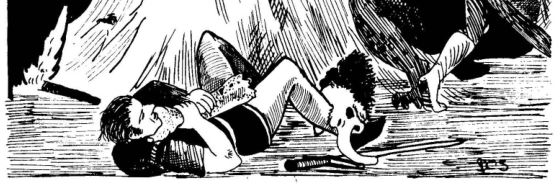
Note that the spell is depicted in this book with a nifty piece of art by Jeff Dee (at top of this article). It's careful to show the eye going through a cracked-open door to spy on the villain on the other side. The eye there looks as big as a man's torso, even though the text says it's the size of a normal eye (perhaps a trick of perspective).
1st Ed. AD&D
Wizard Eye (Alteration)
Level: 4
Range: 0
Duration: 1 round/level
Area of Effect: Special
Components: V, S, M
Casting Time: 1 turn
Saving Throw: None
Explanation/Description: When this spell is employed, the magic-user creates an invisible sensory organ which sends visual information to him or her. The wizard eye travels at 3" per round, viewing an area ahead as a human would or 1" per round examining the ceiling and walls as well as the floor ahead and casually viewing the walls ahead. The wizard eye can "see" with infravision at 10', or it "sees" up to 60' distant in brightly lit areas. The wizard eye can travel in any direction as long as the spell lasts. The material component of the spell is a bit of bat fur.
In Gygax's 1E AD&D, wizard eye keeps the standard invisibility and sight -- and as seen in the Expert rules, it gains infravision. However, that infravision is of very limited range (only 10'),
A number of other key changes are made here: First, the maximum range seen in OD&D/Expert is removed; but on the other hand, the speed is much reduced to a very slow 3" (like a super-encumbered man), or even less when carefully scanning surfaces. If an 8th-level magic-user casts the spell (one more than the minimum level to cast it), and it last 8 rounds, then the maximum distance is 24" -- the same as it was in OD&D (but increasing for higher-level wizards, of course).
The next year, the DMG added its customary errata:
Wizard Eye: The ocular device magically formed has substance and it has form which might be detected (cf. INVISIBILITY). Solid objects prevent the passage of a wizard eye, although it can pass through a space no larger than a small mouse hole (about one-half inch diameter).
So here we have the clarification that solid objects block the eye, and that a small "mouse hole" is needed for passage. Interestingly, one can have a debate about exactly what constitutes a "mouse hole", because mice are flexible and can pass through very small holes. So should that be the size of a pencil, a dime, a ping-pong ball? (We actually had a small debate about this years ago in the comments on this article.)
Consider also the reference to the "INVISIBILITY" rules in that book. As a standard rule at the time, high-level (hit dice 7+) and intelligent creatures had a percentage chance to automatically detect invisible entities -- including the wizard eye, presumably.
2nd Ed. D&D
Wizard Eye
(Alteration)
Range: 0
Duration: 1 rd./level
Area of Effect: Special
Components: V, S, M
Casting Time: 1 turn
Saving Throw: None
When this spell is employed, the wizard creates an invisible sensory organ that sends him visual information. The wizard eye travels at 30 feet per round if viewing an area ahead as a human would (i.e., primarily looking at the floor), or 10 feet per round if examining the ceiling and walls as well as the floor ahead. The wizard eye can see with infravision up to 10 feet, and with normal vision up to 60 feet away in brightly lit areas. The wizard eye can travel in any direction as long as the spell lasts. It has substance and a form that can be detected (by a detect invisibility spell, for instance). Solid barriers prevent the passage of a wizard eye, although it can pass through a space no smaller than a small mouse hole (1 inch in diameter).
Using the eye requires the wizard to concentrate. However, if his concentration is broken, the spell does not end--the eye merely becomes inert until the wizard again concentrates, subject to the duration of the spell. The powers of the eye cannot be enhanced by other spells or items. The caster is subject to any gaze attack met by the eye. A successful dispel cast on the wizard or eye ends the spell. With respect to blindness, magical darkness, and so on, the wizard eye is considered an independent sensory organ of the caster.
The material component of the spell is a bit of bat fur.
As is customary, Cook's 2E AD&D revision sticks very closely to the 1E rules text, and incorporates the extra language previously seen in the DMG. He again uses the word "concentrate", like he used back in the Expert D&D rules (but was not used in Gygax's 1E). The movement and infravision range are still very low. The necessary "mouse hole" size has doubled from a half-inch to a full inch (roughly the size of an actual human eyeball -- did Gygax previously assume the wizard eye was squishy and could squeeze through a hole smaller than itself? Think of me kindly when you reflect on that this week.)
The 2nd paragraph here adds more details to handle various exceptional cases: Gaze attacks can pass detrimentally through the eye. The eye itself can't be buffed or blinded by other spells (except via dispelling). And it looks like a wizard can use this to get around themselves being blinded, because it is stipulated as being an "independent sensory organ".
3rd Ed. D&D
Arcane Eye
Divination
Level: Sor/Wiz 4
Components: V, S, M
Casting Time: 10 minutes
Range: Unlimited
Effect: Magical sensor
Duration: 1 minute/level
Saving Throw: None
Spell Resistance: No
The character creates an invisible magical sensor that sends the character visual information. The arcane eye travels at 30 feet per round (300 feet per minute) if viewing an area ahead as a human would (primarily looking at the floor) or 10 feet per round (100 feet per minute) if examining the ceiling and walls as well as the floor ahead. The arcane eye sees exactly as the character would see if the character were there. The arcane eye can travel in any direction as long as the spell lasts. Solid barriers prevent the passage of an arcane eye, although it can pass through a space no smaller than a small mouse hole (1 inch in diameter).
The character must concentrate to use the eye. If the character does not concentrate, the eye is inert until the character again concentrates. The powers of the eye cannot be enhanced by other spells or items (though the character can use magic to improve the character's own eyesight). The character is subject to any gaze attack met by the eye. A successful dispel magic cast on the character or the eye ends the spell. With respect to blindness, magical darkness, and other phenomena that affect vision, the arcane eye is considered an independent sensory organ of the character's.
Any creature with Intelligence 12 or higher can sense the arcane eye by making a Scry check or an Intelligence check (DC 20). Spells such as detect scrying can also detect the eye.
A major change in 3E is that wizard eye gets renamed arcane eye -- at the same time that the class previously known as "Magic-User" is renamed "Wizard", and other classes are given access to the same spells, such as the new "Sorcerer". (So: the spell isn't just for wizards anymore.)
Otherwise, the language of the spell is largely the same as in 2E: it retains basically the same sight, invisibility, low speed, no range limit, concentration requirement, vulnerability to gaze attacks, etc. Even the "small mouse hole (1 inch in diameter)" requirement is identical.
One thing that you don't see here (unless I've been blinded) -- the infravision (now, darkvision) has been removed from the spell description for the first time since OD&D. Isn't that maybe highly limiting in a dark dungeon? Perhaps it's expected that the caster can magically give themselves darkvision to get around this issue -- re: "the character can use magic to improve the character's own eyesight" -- and yet doesn't that permission itself contradict the "independent sensory organ clause" retained from 2E?
Finally, note the last paragraph on highly-intelligent creatures getting an Intelligence (or Scry skill) check to detect the sensor. This mechanic is a replacement for the prior general rule that high-level and intelligent creatures can sense any invisible objects.
This spell doesn't appear at all in 4th Edition D&D (so far as I can tell), so we proceed to the 5th.
5th Ed. D&D
Arcane Eye
4th-level divination
Casting Time: 1 action
Range: 30 feet
Components: V, S, M (a bit of bat fur)
Duration: Concentration, up to 1 hour
You create an invisible, magical eye within range that hovers in the air for the duration.
You mentally receive visual information from the eye, which has normal vision and darkvision out to 30 feet. The eye can look in every direction.
As an action, you can move the eye up to 30 feet in any direction. There is no limit to how far away from you the eye can move, but it can’t enter another plane of existence. A solid barrier blocks the eye’s movement, but the eye can pass through an opening as small as 1 inch in diameter.
Commendably, 5th edition edits back the spell text a bit, in contrast to the bloat it received in editions 1-3. It's still invisible, slow, no maximum range, and has the exact same "1 inch diameter" requirement first seen in 2E. It returns the darkvision capacity that 3E removed. The extra corner-case language around independent-organ status, gaze attacks, etc., etc., has been removed, and left for adjudication by the individual and empowered DM.
Conclusions
Wizard eye is a spell that had its biggest shakeup in Gygax's 1E AD&D rules (changing speed, removing range, adding infravision, setting the "mouse hole" requirement, etc.) The extra bloated corner-case language circa 2E has come and gone. For me, I'm not fond of the 3E name change to arcane eye -- that kind of increased abstraction loses a lot of visceral feeling for me (here, replacing the imagination-catching "wizard" that anyone would recognize, for an in-game keyword "arcane" that only IP-trained players would fully understand).
Given the notable shift between Original and Advanced D&D, what are your preferences for wizard/arcane eye?
- Fast or slow movement?
- Limit to range or not?
- Magical darkvision or not?
- And how big is a "mouse hole", anyway?