Showing posts with label poll. Show all posts

2021-07-19

Surveys & Samples: Charm Person Redux

A few weeks ago, I shared the poll on charm person that I posed to the big 1E AD&D group on Facebook. Shortly after I did that, I also thought to ask the exact same question on the ODD74 forum ("What can a charm person force on an enemy fighter?", i.e., when ensorcelling an enemy in combat), thinking that the opinions might be very different. This actually got more responses there than any of my prior polls, I think (N = 32) -- and more importantly a really valuable ongoing discussion. (Link; account required.)

The results are given in the table above. Given that respondents could pick multiple options, the percentages shown aren't exactly right. Here are the corrected numbers, showing what percent of voters approved each option: 

  1. Attack former allies: 10 votes; 31% approval
  2. Defend the caster: 25 votes; 78% approval
  3. Surrender and disarm: 17 votes; 53% approval
  4. Flee the encounter: 16 votes; 50% approval
  5. Nothing: charm fails in combat: 2 votes; 6% approval

Now, the first thing that occurs to me is how surprisingly similar these results are the poll of AD&D players. Again in that case: there was clear majority support (around 80%) for "defend the caster"; around 50% support for fleeing or surrendering; just a minority (20-30%) that support "attack former allies"; and almost no support (6-8%) for the "nothing" option. 

That said, it's a bit awkward that the fleeing/surrender options consistently get around 50% support -- making that an issue of ongoing contention and no clear consensus. Personally, when I first created those options, I assumed that those were clearly weaker possibilities than "defend the caster" (participating in combat at all seems like more power to the spell, and seemingly more risk to the victim), and that therefore anyone picking the latter option would surely also pick the other two. Clearly I was incorrect. (Thanks to the Discord advance comments that coached me not to make the assumption that the options are all well-ordered.) 

On a personal note, it's fascinating to find out that I've been well off the reservation for most of my gaming career, because the option to "Attack former allies" was something I always enforced, reading the O/AD&D language as clearly permitting that (as well as almost any other direct control desire). But simultaneously, it did always bug me a bit as making for overly swingy combats. This is a case where I'm very happy to hear the voice of community experience. 

Also, one of the great parts of the ODD74 conversation was the observation of a fine distinction in the OD&D magic items of control. To wit: the potions of human, giant, and dragon control each refer back to the charm person/monster spells for their effect. But on the facing page, the ring of mammal control does something different: it says, "Control is complete, even to having the controlled mammals attack the others with it which are not controlled." See it seems like a compelling argument that the latter capacity ("complete control") is not included in the basic charm spells, or else it would not be so called out in this one case. (Big thanks to SebastianDM for picking up on that detail!)

So the next time I edit my custom Book of Spells, I'm pretty likely to edit in the limit against attacking former allies when charmed (or at least, you know, add a footnote on the issue). That would certainly have helped me on numerous occasions over the years in the past.

What's your justification for why fleeing/surrendering are considered by many to be less achievable than the "defend the caster" option?

2021-06-07

Surveys & Samples: Charm Person

I've struggled with the D&D charm person spell for some time (c.f.: Charm Person Through the Ages). Partly that's due to what appears to be one of the most radical de-powerings of any spell in the first 3 editions or so. In OD&D it started out with the stated effect of:

... come completely under the influence of the Magic-User until such time as the "charm" is dispelled (Dispell Magic)... (Vol-1, p. 23)

But this "complete" control and infinite duration was rapidly nerfed with recurrent saving throws (Supplent I: Greyhawk), language that the victim merely considered the caster a "trusted friend and ally" (AD&D PHB), bonuses to saves in combat and other restrictions (AD&D DMG), etc. By the time of the 3.5 edition revision, it merely lasts 1 hour/level, and requires an additional Charisma check to convince the victim to do anything they wouldn't normally do anyway. 

Now, some claim that this is broadly the way it always was intended (but boy, that seems like a huge shift in the language to me). E.g., Mike Mornard, who played in both original campaigns by Gygax & Arneson, recalls:

"Charmed" means "Charmed, I'm sure." The person is now your new best friend. They are NOT your mindless slave. That's how Dave and Gary both played it. (ODD74; account required)

On the other hand: In the section on hiring NPCs, it is written: "... or they can be Charmed and thus ordered to serve" (Vol-1, p. 12); and charm person was also ability ascribed to monsters such as Vampires, Dryads, etc., who could dominate and, indeed, "enslave" a victim (see: Vol-2, Nixie) for a year or more each. In the AD&D DMG Gygax tried to carve a distinction between those abilities and the spell of the same name, saying they were very different; which seems more like a retcon than consistent intent. 

Related to this wide variation in power of the spell over the years, one of the things that really bugs me about charm person is how often it turns into a debate at the table over what its effect should be -- and how often players are surprised or disappointed at an effect they didn't expect. For a 1st-level spell, I dare say this is unique. Other low-level spells generally have a very clearly qualified effect that the caster will be aware of in advance. But here we have charm person at 1st level -- frequently the very first offensive spell that a new magic-user will take -- and it usually turns into a dispute or a "gotcha" upon casting it. 

For the brand-new D&D player, it seems likely that their first impression of magic is that it's all based purely on fiat rulings by the DM and how much you can sway them through argument. 

Facebook Poll

Wondering what the majority opinion was, I thought to ask a poll on the sizable Facebook AD&D group. Questions were first reviewed & edited by Patrons on the Wandering DMs Discord channel (thanks!). Here's the result:


There were a total of 158 different voters (note participants were directed to pick "all that apply", so generally multiple selections). Of the options presented, the vote totals were as follows:

  • Defend the caster -- 126 (80%)
  • Flee the encounter -- 80 (51%)
  • Surrender and disarm -- 68 (43%)
  • Attack former allies -- 35 (22%)
  • Nothing: charm fails in combat -- 12 (8%)

So only two of the given options received majority approval: Defending the caster seems clearly to be allowed, and fleeing the encounter gets the nod from a hairs-breadth over half of the respondents. Other options like surrender or go on the offensive for the caster got the thumbs-down.

I must say I actually am quite heartened by the interpretation that an enemy charmed in combat doesn't immediately start fighting on the magic-user's side -- even though that's how I always ruled it by default historically. That seemed to me to be following the letter of the rule, but it felt incredibly swingy. Losing any party member to a spell is one thing, but then the other side gaining the same figure, of course, makes for an immediate 2-person swing which can be quite brutal (esp., again, to a 1st-level spell; and moreso with modern small party sizes). 

(Contrast, though, to an example like the magic-user in J. Eric Holmes' Basic D&D sample dungeon: he has a fighter he holds under a charm person spell, and the first thing he does in an encounter is "(a) direct the fighter to attack", albeit probably not former allies. Or likewise the one in Frank Mentzer's Basic D&D dungeon; when the player misses a save vs. charm person, they immediately abandon the cleric with whom they were adventuring -- and who earlier referred to the effect as, "He has probably cast a spell on the goblin to force it to serve him".)

Other Suggestions

As is common, a large number of other intriguing suggestions were added in the discussion, as well as some objections to the premise of the poll in the first place. The most common redirection is that the effect of charm person is indeed entirely context-dependent, and will only be known after the result of role-playing interactions between the player and DM. (Which if you recall is part of my grief earlier). Some examples:

John D.
None of the above! The magic-user can't force the fighter to do anything. They can only make suggestions and the fighter will respond as if they viewed the caster as favorably as possible. All of these would depend on the context.

Keith W.
Can't force anything....but with some good roleplaying, I'd allow some of those. Nothing that causes harm to him or his allies, but I could see him trying to talk them out of killing the caster as they now view you as a friend.

Drew B.
This is where the magic user has to come up with some strong role playing for the spell to work.

Troy O.
Great opportunity to let player role play dialogue and the more convincing the “story” the better chance it will work to charm but not force. For example go kill dragon now vs spun story of why fighter needs to go kill dragon might work. Of course DM final say...

Adam V.
I think it depends on the charisma of the mage

And so forth. A few other interesting takes:

Chris T.
The big problem is how does the charmed fighter square the circle that his best friend and allies want harm / kill each other?

Daniel N.
Since the spell says you could convince someone to hold off a dragon (and surely die) I’d say it’s pretty powerful, level one or not.

Alan S.
How good is group communication and how noisy is the fight?...

Mark B.
Just bc he regards the caster as a dear friend doesn't mean he stopped regarding his former allies as they were. He wouldn't likely attack them for any reason

Jay G.
Mark B. you’re assuming the charmee likes and trusted his former allies. Why is that necessarily true, especially for evil opponents? And even if they do...when the charmee trusts the caster totally, if he tells him “your comrades are really evil doppelgangers! We need to kill them!”, why wouldn’t he believe him?

Conclusions

As noted earlier, I'm quite uncomfortable with the "depends on roleplay" interpretation, because ultimately it depends far more on DM attitude or mood that any comparable, frequently-used, low-level spell. My instinct is that lower-levels spells should be clearly defined and known quantities to the player. Higher-level spells I'm a lot more comfortable transitioning to murky effects that may surprise the player or have an effect unique to a particular DM's game world. Charm person at 1st level with a hugely slippery and unpredictable effect stands out as "proud nail" unlike anything around it.

I actually feel very prone to write explicitly into my effect for charm person, following the poll results, that it can definitely make a victim play defense/shield-man for the caster, or withdraw from the encounter -- but not throw down their arms, or attack former allies. The items on the far ends I'm most comfortable with; the ones near the 50% I'm just somewhat more sketchy about, but not unhappy to follow a consensus on those.

What do you think about those results?

2021-05-31

Maim is the Name of the Game

Last week we looked at the status of "cleaving" type attacks through the ages of D&D editions -- and were somewhat surprised to find it listed in the core rule books (maybe as an optional rule) of every edition to date! Okay, except the 80's Basic line, but everything else.

A side-point we've made there, and in the Wandering DMs chat on the subject, is that since the core books from Original, 1st, and 2nd editions never gave any identifying label to the ability (fighters getting multifold attacks vs. very-low-level enemies), a crazy kaleidoscope of different names sprang up in supplements, video games, 3rd-party works, the OSR, etc. My recent work made me pursue what the most recognizable name would be among those many options. 

Here's the poll I ultimately asked to the big Facebook 1st Edition AD&D group:

Poll for sweep attacks name

A total of 146 votes were cast here. As you can see, by far the most popular option there was simply Multiple Attacks with 94 votes cast (64% of the total). However, I am incredibly not fond of that as an option, because it explicitly gets used in the rulebooks multiple times for other types of abilities in both OD&D and AD&D. For example, monks are described as getting multiple attacks in their first appearance in OD&D (Supplement II, Blackmoor, p. 1):

... monks of higher levels may make multiple attacks during a melee round (see STATISTICS REGARDING CLASSES)
And more definitively, here for creatures hostile and benign in the 1st Edition AD&D Monster Manual (p. 5):

Multiple attacks usually indicate the use of several members such as multiple hea[ds] or two paws raking with claws and a bite from the monster's jaws.

Clearly, none of these are what we're talking about in regards to the fighters-versus-mooks mode of combat, so using the term for that would only cause confusion, I think. 

That aside, the next most-favored choice by a large margin is Sweep Attacks, garnering 30 votes (21% of the total), noted in last week's blog as recognizable to anyone who played the very popular AD&D Gold Box video games circa 1990. This is what I plan to call the ability myself in my classic-D&D materials in the future.

Other options, like Cleave Attacks, Heroic Fray, Fighting the Unskilled, and Combat Dominance only garnered between 1 and 5 votes each. (Note that there's a possibility of bias in the poll, since Facebook only shows the top 4 options at any time, and participants need to see and click on a "Show More" button to access the rest.) 

As part of our research, I think we compiled a pretty interesting list of names used in a variety of video games and OSR materials, for this or closely related abilities:

  • Heroic Fray (2nd Ed. AD&D Combat & Tactics supplement)
  • Heroic Fighting (Hyperborea)
  • Fighting the Unskilled (OSRIC)
  • Combat Machine (Swords & Wizardry; previously "multiple attacks")
  • Combat Dominance (Castles & Crusades)
  • The Cuisinart (Wizardry video game)

Furthermore, the Facebook AD&D group poll has the option for "something else" which generated yet a larger and growing list of options -- some serious, some in jest, and some in a range of good taste. A selection the examples include (generally just a single mention each):

  • The Cuisinart (gaining 4 mentions)
  • La Machine (French analog to the Cuisinart)
  • Meat Grinder
  • Lawnmower Mode
  • Mowing the Grass (despite "Mowing" being unvoted in poll)
  • Weed Whacking
  • Snicker-Snack
  • The Aragorn
  • Minion Attacks
  • Rabble Attacks
  • Fight the Horde
  • Shredding Mode
  • Pest Control
  • Zero Level Attack
  • Cutting the Chaff
  • Spartan Attack
  • Full Auto Attack
  • The Mouli
  • Cinematic Attacks
  • Hackmastery

Notably, eminent D&D author Frank Mentzer (creator of the entire BECMI line, which is the only edition to expunge the rule) offered "Slice & Dice" as his term of art for the ability which he explicitly disliked so much (see prior post for details).

Frank Mentzer: slice & dice

Are there any other prominent names that I still haven't discovered? What's your favorite?

2021-03-12

Friday Figures: Fighter Multiattacks

Do hero-types get multiple attacks vs. 1 HD creatures? 16 Yes, 1 No.

Here's another poll I ran on the ODD74 boards a while back. This dovetails with our article Monday on running mass fights in classic D&D -- we highlighted there how critical for balance purposes the original rule was in which fighters got a number of attacks equal to their level against normal (circa 1 HD) opponents. 

That's not a rule that appears anywhere in the Holmes Basic/B-X/BECMI line, or editions of D&D from 3E on. It's not even explicitly stated for fighters in the OD&D books themselves. It's not a rule that I really like design-wise. So at the time I was myself rather skeptical, and asked the community if they really played by that rule. (On the other hand, it is explicit in Chainmail Fantasy and 1E AD&D, so I wouldn't bother to ask this question in a forum for those rulesets.)

Many of these poll-presentations are meant to spotlight the fact that many pretty basic mechanics in Original D&D have wildly varying interpretations -- that there is no one true OD&D game (even for essential things like initiative, the action sequence, morale, etc.). But this is not one of those things. Somewhat to my surprise at the time, the response here was very lopsided: Almost everyone agreed that was a core rule. We got 16 "yes" votes, only 1 "no", and 0 "other". So I spent a bit of time re-evaluating the evidence, and why I was so far out in left field on the issue.

Briefly, here's where the evidence led me to think maybe "no":

  • The multiattacks rule is explicit in the Chainmail Fantasy rules (prior to OD&D); it's the essential way in which heroes & superheroes operate.
  • The rule is also explicit in the AD&D 1E PHB (after OD&D); it's given as a key ability for the fighter class and its sub-classes.
  • Some people point to a paragraph in OD&D Vol-2 (the Monsters book), p. 5, that says everything gets a number of attacks according to their hit dice vs. normal men. I don't find that to be persuasive, because (a) it's in the monster book and not explicit for PC fighters, and (b) no one I know has ever run D&D combat that way for monsters. 

But on closer inspection, there's two places where Gary wrote about OD&D that imply the intended answer was "yes":

  • The Strategic Review #2 has an OD&D FAQ, with an example of combat in which a 4th-level fighter gets 4 attacks per round against orcs (strangely doing so unarmed, but moving on...)
  • Swords & Spells p. 1, paragraph 2, notes that a solo 12th level fighter will do 1.2 times the damage given normally for a 1:10 scale figure, which works out to be the same thing. 

So in total: The fighter-multiattacks rule is written into Gary's rules before OD&D, after OD&D, in the FAQ for OD&D, and in the mass-combat rules for OD&D. So in total: yeah, it's pretty clearly a consistent intent there (and another example of his tendency to "implicitly assume rules from the prior edition").

After that is when I realized that in addition, all the monsters in OD&D that appear in numbers of hundreds are precisely the ones that fighters get multiattacks against (excepting gnolls, but then they too were 1 HD in the pre-D&D draft).

A few other interesting tidbits on this topic:

  • The one place in OD&D where this rule is arguably given (the Vol-2 passage), says, "Attack/Defense capabilities versus normal men are simply a matter of allowing one roll as a man-type for every hit die...". There are a small number of players who attest that they apply the "roll as a man-type" strictly, so that the multiattacks themselves are all rolled as if the attacker was 1st level. I've never done this, but: it is compatible with the Chainmail mechanic, and it would solve my problem with the discontinuity/double-dipping effect of the rule.
  • Some commenters on Monday were worried about how much play might slow down because of all the rolling for the multiattacks -- and I share that concern. Interestingly, the ODD74 forum has reports that at a later date Gygax -- and maybe Arneson, too -- boiled the whole thing down to a single die-roll in this way: if your fighter is level N, then roll a dN, and that's how many normal men you put down. (E.g.: At 8th-level, roll a d8 for total casualties this round.) I think that's fascinating. I still don't want to see your damn d7, though, so don't start with me on that.
  • Even though I posted that poll a year ago in February (and the poll itself is long closed), interestingly, the conversation is still going on even as I write this!

There are several other interesting takes or modifications to this rule. If you have an account, see here for the discussion thread on the ODD74 forums

Do you normally use the fighter multiattacks rule? Do you import it to a ruleset that normally doesn't have it on the books (Holmes, B/X, BECMI, 3E+, etc.)? What other novel modifications do you make to it?

2021-02-26

Friday Figures: XP for Magic Items?


Here's another poll asked on the ODD74 forums for experienced Original D&D players. It's easy to miss but the OD&D rules do say, ever so curtly and parenthetically, that PCs should get XP for acquisitions of magic items (Vol-1, p. 18, emphasis mine):

As characters meet monsters in mortal combat and defeat them, and when they obtain various forms of treasure (money, gems, jewelry, magical items, etc.), they gain "experience".

No further information is given (e.g., parameters or values for specific items). This is one of the fairly big differences between the two branches of D&D in the 1980's: The Basic-B/X-BECMI line ignored this, and never spoke of it again. On the other hand, the AD&D line dug into this deeply and more formally -- first a very few example values are suggested in The Strategic Review #2 (p. 4), and then complete XP (and gold) values were given in magic charts for every item in the game, in the 1E AD&D DMG (p. 121-125). 

So given that major bifurcation, I thought to ask OD&D players on which side of the divide their sensibilities lay? In this case (not the first time), it's an almost even split with no clear consensus. Of 21 votes cast, 11 said "yes" (they do award XP for magic), and 10 said "no".

For me, I'm pretty much still likewise split. Needing to decide, look up, and compute the values seems very burdensome and I've been avoiding it for years. Plus there's an argument that the value of the items should come from use (to get more treasure), and giving inherent XP is double-dipping. On the other hand, I fear that a major component of the OD&D XP economy depended on this factor (e.g., see in Subterrane Survey: Gygax's Castle Greyhawk, under the "Experience" section and related reader comments). What's your take currently?

2021-02-19

Friday Figures: How Much Info on Henchmen?

Poll: How much information do you give to players about their hirelings?

Another poll asked previously on the ODD74 forums, and related to our question on Monday -- "How much information do you give players about their hirelings?" (And here OD&D uses the term "hirelings" for what B/X called "retainers", 1E "henchmen", etc.)

You could go in several directions on this, and over the years I've wrestled with them all. For full "immersion" you might consider giving the players no game information at all, keeping the NPCs entirely masked behind the DM's screen and interactive portrayal. On the other end of the dial, the DM might simply see it as a huge hassle to shuffle possibly dozens of sheets and personalities like that (in addition to every other person or monster in the campaign world), and so for logistical efficiency, just turn over the whole henchman PC sheet to the controlling player. Or something in the middle.

When I asked on ODD74, each of the options got at least some votes, but it's that "something in the middle" option that took first place. Specifically, "Index-card size" took 10 votes (66%). Second-place went to"None" with 3 votes (20%). "Full character sheet" and "Something else" each got 1 vote (7%). 

I don't mind that top choice, and I sympathize with the rationale for it. Most recently, I was giving players a full PC sheet for their henchmen after the first adventuring session -- I'm definitely now re-thinking this. Among the things I'm not thrilled about is the need for a different recording document for henchmen (the player-facing index card) -- and then need to keep that synched with the DM document, track XP, shuffle the paper in-game, etc. (Sounds like a violation of the DRY principle.)

So at the moment I'm a bit on the edge for that. What's your preference?
Poll Discussion at ODD74 Forums
(Account Required)


2021-02-12

Friday Figures: Are Hobgoblins and Gnolls Normal?

 Poll: Are hobgoblins/gnolls normal man-types? 

Here's another poll I asked on the ODD74 forums: Do Hobgoblins and Gnolls count as normal man-types?

What does that even mean?, you might possibly say. In OD&D circles, there are frequent rules debates on whether something counts as "normal" or "fantastic" (that is, not-normal) or not. This springs from the Chainmail Fantasy Supplement, where some types just borrowed the combat dice mechanic from the mass-combat game (e.g., hobbits, dwarves, elves, goblins, orcs), and others did not, appearing with special custom rules on the "Fantasy Combat Table" (e.g., heroes, wizards, dragons, trolls, giants). Sometimes those latter "fantastic" creatures were immune to "normal" attacks and sometimes not; sometimes they also had parallel values for the normal mass-combat mechanics, and others did not. 

So there's a hazy border area about what monsters are "normal" and what are not. And this distinction flows directly into the Original D&D rules, where some spells and magic items (e.g., charm person, hold person, potion/ring of human control) implicitly work just on the "normal" types. Furthermore, fighters throughout the Chainmail-0E-1E-2E rulesets are given a cleave-ability of attacks per round equal to their level, but only against "normal" types (the definition of which varied slightly over the editions). 

Therefore, in the hazy state of OD&D, the Hobgoblin/Gnoll types jumped out at me as existing right on the boundary of the normal/fantastic parameters, and I was wondering which side of the fence most OD&D players placed them on. Hobgoblins don't appear on the Chainmail Fantasy Combat Table; Gnolls don't appear in those rules at all. In OD&D they appear jointly on a single line of the monster roster. Hobgoblins have hit dice 1+1, Gnolls have 2, which in some definitions ("base 1 hit die or less", Gygax's FAQ in The Strategic Review #2) would put them on opposite sides of the divide, which could seem odd. On the other hand, the OD&D charm person spell is said to affect all these types up to Gnolls explicitly, and critically on the monster list, hobgoblins/gnolls are the highest type to appear in mass numbers into the hundreds (implying that the fighters' cleave-ability was meant to work against them)? 

Monster reference table, including hobgoblins/gnolls

As you can see in results at the top, the majority of respondents on the ODD74 forums said, "yes", Hobgoblins and Gnolls should count as "normal men" for these kinds of purposes (even though they both have more than 1 single hit die). Twelve people (80%) voted "yes", and only three people (20%) voted "no". As usual here: a small sample size, but a lopsided majority for "yes". 

I agree that does seem to make the best regression between various signals in different parts of the rules (charm person inclusion, mass numbers appearing, formation status in Swords & Spells, etc.). However, in my own house rules, I lean towards saying "no". It seems much more elegant to say "man-size is anything up to 1 hit die". That complies with the stated fighter-cleave requirements, restricts to actual man-sized figures (gnolls in AD&D are said to be 7+ feet tall!), and generally gives a nice easy-to-remember cutoff.

Here's the real kicker, though. As part of the discussion on ODD74, user retrorob pointed out a detail that all the rest of us missed: in the Beyond This Point Be Dragons document (BTPBD), presumed to be a copy of a pre-publication original D&D draft -- get this -- even Gnolls did have a single hit die! In this work, there is absolutely no mechanical distinction between the two types, except for either +1 or +2 morale bonus given in the descriptive text. Thanks immensely for that, retrorob!

BTPBD Monster Roster: including hobgoblins/gnolls

So that sort of comes back full circle. Assuming the BTPBD is an accurate reflection of the original design, the "normal" monster types affected by charm person, hold person, fighter cleaving, mass numbers appearing, etc. really did top out at base 1 hit die (including hobgoblins/gnolls at 1+1 hit dice). Having observed that, the elegance of such a system attracts me so much that I kind of want to declare that the true rule for my games. If we keep Gnolls at 2 hit dice for variety, then presumably we'd want to keep them off the fighter-cleave list, reduce their large Numbers Appearing, and cut them off the charm/hold person effect lists, etc. Suddenly that looks really nice to me. (And by implication, later 2 hit die creatures like Lizard Men and Troglodytes would be in the same category.)

How would you have voted there?

Poll on Hobgoblin/Gnolls at ODD74 (account required)

2021-02-05

Friday Figures: Favorite Basic D&D


Survey: Favorite Basic D&D set?

A few months ago on Twitter, user @LeroyD20 (thanks greatly, Leroy!) asked what I thought was a nifty question: what was people's favorite version of Basic D&D ruleset released in the 1977-1986 period? He got almost 80 votes which is fairly good sample size.

As you can see above, the results were -- Moldvay 57%, Mentzer 23%, Holmes 20%. 

Broadly speaking, I think those are fairly reasonable opinions. As someone who started with Holmes myself, of course I have a warm spot in my heart that. Holmes, of course, was trying very hard to mostly re-organize OD&D source material, frequently using the exact same language (and also getting a revision  pass by Gygax himself). On the other hand, Moldvay (which I did run for several years) has a certain spark of editorial design genius, refining, tightening, and improving rules in many, many places. Mentzer mostly follows Moldvay's core rules, but in my opinion is burdened down with the decision to make the player's book mostly a keyed choose-your-own-adventure (which takes a lot of space, and makes the book not very useful as a reference work after initial reading). 

So I might pick Moldvay as the best of the lot myself. That said: He also introduced race-as-class which almost single-handedly causes me to turn away from those rules anytime I think about announcing that my games are based on his work.

Also, how much of this is correlated with marketing pushes at the time, hitting the moment of the explosive fad years, etc.? Obviously, we'll never entirely disentangle that. But Moldvay stands above as the strong editor that many of us wish Gygax had throughout his D&D writing. 

Poll on Favorite Basic D&D at Twitter

2021-01-29

Friday Figures: Phased Turns

Phased turn poll (10 yes, 13 no)

Each of the next few Fridays, I'll present one of several polls I've asked in prior months -- usually either to the ODD74 web forum or the 1E AD&D Facebook group. (ODD74 is better for OD&D-specific questions, obviously, but much smaller membership and sample size; the 1E FB group gets much larger responses, but somewhat less focused opinions). 

For today, on the ODD74 forums, I asked: Do you use a phased turn structure? Now, this is of interest, because the OD&D little brown books famously lacked any turn sequence or initiative rules. One option is to look back at Chainmail, which had two different options for phased turn structures (e.g.: both sides move, then both sides shoot, then both sides melee). Swords & Spells maintains roughly that same structure, and some argue that should be taken as canonical for OD&D. 

That of course is quite different from the modern conceit where a particular character does all their moves, actions, and attacks, then proceed to another character for the same. At least by the 1E DMG Gygax had (on a per-side basis) one party does all its actions, then another party, and so forth. Moldvay in B/X asserts a system where one party goes through phases of morale-move-shoot-spells-melee, then the next party.

So for those playing OD&D "by the book" who need to fill in that gap, I wondered, is there a consensus? Which way do more people lean: look back to Chainmail, or forward to AD&D-style resolution? 

As you can see in the chart above -- surprisingly -- players on ODD74 are roughly evenly split. Ten people (43%) said, "yes", they use a phased turn structure similar to Chainmail or Swords & Spells. Thirteen people (57%) said, "no", they do not, and presumably use a per-party or per-character system like AD&D and later. That's a narrow lean towards the "no" side, and a break from what's in Chainmail. Also it's a small sample size, but judging from this -- it looks like there's no solid consensus. 

Which highlights that for classic D&D there's almost no "by the book" way to run the game; there are specific gaps that must be filled to personal taste by every judge and table of players. If you have an account at ODD74, see the link below for discussion that resulted from that poll (and of course continue it here if you like).

Phased Turn Pool at ODD74 (account required)

2019-10-25

Friday Figures: Who Keeps the Sheets?

Here's one of these 4th-wall issues that no one ever thinks to talk about, but when it finally surfaces to consciousness, suddenly everyone realizes they have a militant opinion about. On last week's Wandering DMs show discussing Dave Arneson's early play mechanics, special guest DH Boggs pointed out that Arneson kept all the character sheets for a few different reasons. At the time I thought: "Why are we even mentioning this? Or wait, has no one ever discussed this as an issue before?". So I asked the question as a poll on the Facebook 1E AD&D group; who keeps the PC character sheets between sessions?


As you can see, the "Players" vote took an overwhelming win on this poll -- by a vote of 250 to 83 to 18 at last count. (So: 71% are saying the players take their sheets home). Among the many comments on the issue include observations such as, "I will always stand by the notion that a character is the intellectual property of the player.", "I don't play with people that I don't trust enough to keep their own sheets" (I think assuming the only reason for DM to keep sheets is as an anti-cheating measure), and even, "DMs that insist on keeping their players character sheets have serious mental issues."

Now, this is somewhat surprising, because all of the play groups with which I interact actually have the DM keep the sheets. I think I usually offer players to take the sheets, but no one ever takes me up on it. Maybe our community has just all fallen into this habit unwittingly. Arguments in favor of this in the thread include, "Character sheets belong to the campaign, not the player", and predominantly, "Everyone always forgets to bring their stuff that's why the GM keeps it in a folder". I'm not seeing any comments specifically about cheating but maybe there's one or two in there (and that would have been me in junior high school). One said, "I have been really surprised by New School players who want me to hang onto the character sheets".

Other options include some form of both parties keeping copies; maybe DM gets originals and players scans, or vice-versa. Some DMs keep various summary records while players take the real sheets. Some have a "current" sheet with one party, while an "older" sheet is taken by the other. And a few use technology like D&D Beyond for 5th edition where (I think) both DM and player can access it online. (One DM keeps data in a custom spreadsheet and prints out fresh paper copies each session.)

As a special bonus, Mr. Frank Mentzer joined the conversation, sharing that his players keep their sheets, while he keeps index-card summaries (color-coded by race). And in fact has kept all those records consistently going back to 1977 (making a separate post on FB sharing some photos of those stacks of cards). Thanks, Frank!


Don't forget: New Wandering DMs live chat this Sunday -- On incorporating horror in your D&D and other RPG games. Will we wear costumes? Tune in and share you spooky suggestions. Sunday 1 PM ET.

2019-09-06

Friday Figures: Infravision in OD&D


Infravision survey on ODD74 Discussion forum.

Pretty much every edition of D&D gives see-in-the-dark powers to dwarves and elves; variously called "infravision" in older editions and "darkvision" in newer ones, with some tinkering around the edges about the exact effect.
  • Chainmail: Dwarves and elves have "The ability to see in normal darkness as if it were light" (Fantasy Reference Table, p. 43, note B). 
  • D&D Supplement I: Greyhawk: Dwarves and elves both "have infravision and can see monsters up to 60’ away in the dark." (p. 5). 
  • B/X: Both have 60' infravision (p. B9).
  • 1E AD&D: Both have 60' infravision. They "are able to see radiation in the infra-red spectrum, so they can see up to 60' in the dark noting varying degrees of heat radiation.  This ability is  known as 'infravision'." (PHB p. 15-16). The images are noted as being in black-and-white on PHB p. 102 (same in later editions).
  • 2E AD&D: Both again have 60' infravision (Ch. 1).
  • 3E D&D: Here the ability is renamed to "darkvision". "Darkvision: Dwarves can see in the dark up to 60 feet. Darkvision is black and white only but it is otherwise like normal sight, and dwarves can function fine with no light at all" (PHB p. 14); elves instead get "Low-light Vision: Elves can see twice as far as a human in starlight, moonlight, torchlight, and similar conditions of poor illumination."
  • 4E D&D: Dwarves and elves in this edition both get "low-light vision" (Quick Start Rules).
  • 5E D&D: In this edition, dwarves & elves are back to having 60' darkvision: "You can see in dim light within 60 feet of you as if it were bright light, and in darkness as if it were dim light. You can’t discern color in darkness, only shades of gray."
Okay, so that's every edition except for one: namely, Original D&D as published in the LBBs. OD&D never explicitly says anywhere that dwarves or elves get infravision. In some ways it appears very restrictive about PCs having sight in darkness (e.g., "any monster or man can see in total darkness as far as the dungeons are concerned except player characters", Vol-2, p. 5). But on the other hand, it does include the prior work by reference ("Special Ability functions are generally as indicated in CHAINMAIL", same page) which gave them darkvision, and the first supplement within the year (Sup-I: Greyhawk) again explicitly gave them infravision.

So I asked about this on the ODD74 Discussion forums, and got what I thought was a surprising result; a distinct lack of consensus, with a majority declining to give dwarves & elves infravision as in any other version of the game (see image at top of post). As someone working from OD&D as a basis for my game, this makes me rather uncomfortable about veering off in an unexpected direction, compared to what players of any other edition would be used to. A few weeks ago we tried to hammer this out on Wandering DMs. In this case, I'm still leaning pretty strongly towards the interpretation that they should have infravision, both for custom and the fact that the referenced versions immediately before and after both included it. Thoughts?


On that note: Tune in to Wandering DMs this Sunday 1 PM ET for the live chat, "Basic dice probability" with yours truly -- we'd love to include your comments in the discussion.


2019-08-12

Sunday Survey: Best Module Poll

Not a poll by me, but a gentleman named Jon Payton on the Facebook 1E AD&D group. And not just a single poll: Jon ran a whole series of round robin polls throughout May to determine a popular ranking for all of the published 1E modules (95 modules in all!). Here's an excerpt of his Top 10:


Now, in the run-up to the final bracket, I felt that the results were about as I would have guessed, and then right at the end it turned surprising. Namely the winner, S3: The Lost Caverns of Tsojcanth is not a module I normally hear as people's favorite (I've never run it, but it's an attractive work in some ways). Likewise, I know everybody loves module S2, but I was a little surprised to see it as high as 2nd place. For me, the G1-3 modules come out on top, always.

Related to this: In the final few rounds Jon was providing short supplementary commentary to each of the modules, that I thought was top-notch, refined, and observant. Right up until the end when he playfully spazzed out on his personal favorite, U1: The Sinister Secret of Saltmarsh, not taking the top spot; Jon is apparently a big fan of all the UK-sourced modules (for me, the U1 Scooby-Doo plot is nigh-unforgivable). I'd highly recommend taking a look at the full rankings on his Musings from the Moathouse blog, as well his reviews there for other modules. And I wish that all of his Facebook blurbs were made public there, as well!


2019-08-04

Sunday Survey: Wizard Spell Failure

Related to last week's survey on permitted armor, I asked another poll on the Facebook 1E AD&D group as follows:


This is even more surprising than last week, because the concept of a chance of "spell failure" for magic-users in armor is absolutely not a concept anywhere in either the 1E or 2E AD&D rulebooks. Nor does it appear in OD&D, Holmes, B/X, etc. (In those rules, multiclass magic-users are either permitted to use certain types of armor or they're not, end of story.)

But it is a core rule that appeared in the later 3E D&D ruleset (PHB, Ch. 7: Equipment). As a result, it also appears in the popular Pathfinder rules. However, it doesn't seem to be part of the 4E or 5E rules from the introductory materials that I have for those editions.

Spell failure for multiclass wizards in armor is not a thing that I assess in my games. That said, I do prohibit even multiclass fighter/wizards from casting in plate in my OED/OD&D game (as noted last week, a very common rule among AD&D players).


2019-07-28

Sunday Survey: Wizard Armor

A while back on the Facebook 1E AD&D group, a discussion occurred that had me quite surprised by the direction it was going. Intrigued, I asked the following poll question:


This was surprising to me, because given the context, the top result ("elven chain only") is clearly counter to the 1E AD&D rules text. Of course, when we say multiclass fighter/magic-users in 1E, we're just talking about elves and half-elves (the only races allowed for that multiclass). Under Elves on PHB p. 16, it says that they can "operate freely with the benefits of armor, weapons, and magical items available to the classes the character is operating in", with the exception being if thief activities are occurring (so: plate mail and anything else is clearly on the menu for fighter/magic-users). Note that this contrasts with gnomes on the same page who are restricted to leather for any multiclass combination. Furthermore, as of the 1E AD&D PHB, "elven chain" wasn't even a thing yet named or defined; it didn't appear until the later DMG (p. 27, as "Chain, Elfin") which says merely that it's thin and light, with no special notes about spellcasting.

I think partly, the result of this poll can be explained by later edition's rules "bleeding" into the memory banks of the many gamers who played mix-and-match a lot with different edition products. It was the 2E AD&D PHB that established elven chain as a sufficient and necessary requirement for multiclass wizards to cast in armor: "A multi-classed wizard can freely combine the powers of the wizard with any other class allowed, although the wearing of armor is restricted. Elves wearing elven chain can cast spells in armor, as magic is part of the nature of elves." (Ch. 3).

Moreover, we can look at 1E adventure products by Gary Gygax and possibly detect an "implied ruling" in the same direction on this issue. Looking at the many drow fighter/magic-users throughout the D1-3 series, all of them are equipped with fine chain mail (not a single one in plate, to my knowledge). The 1983 World of Greyhawk boxed set's Glossography has wandering encounter listings for that world, including "Elves, Patrol"; these are led by high-level elven fighter/magic-users with base AC 4 or 5 (chain, with or without shield). On the same page, "Elves, Knights" (p. 4) are principally fighter/clerics with better AC, but they have fighter/magic-user assistants again with AC 4 (chain & shield). So the consistency of this pattern may be another telling point.

Not initially knowing about the 2E AD&D rule or the apparent AD&D player consensus, I've done a similar thing in my OED house rules for OD&D for about a decade now; without reference to any special elven manufacture, multiclass fighter-wizards can cast spells in chain but not plate (also must have one hand free, no shield). Actually for quite some time I thought that was a semi-unique ruling; my surprise is that I've unintentionally matched how a lot of people elsewhere also play things.

2019-07-21

Sunday Survey: Blind Spellcasting

Recently on the Facebook 1E AD&D I group I asked this question:


Before I asked the question, I scoured the OD&D and AD&D books for a ruling on the subject, and was surprised when I couldn't find any whatsoever. To my knowledge, there's not even any statement that a caster needs to see their target in general! Consider the idiom from Chainmail Fantasy, referenced in text for OD&D spell like fireball and lightning bolt, that attack spells must have "range being called before the hit pattern is placed" (that is, casters specify a distance, not a target). AD&D DMG p. 65 has an example of a caster of fireball needing sight to the area of effect, but no general rule to that effect.

However, all later editions do dictate that casters must have sight of their target. This first appears in the 2E AD&D PHB (Ch. 7): "If the spell is targeted on a person, place, or thing, the caster must be able to see the target. It is not enough to cast a fireball 150 feet ahead into the darkness; the caster must be able to see the point of explosion and the intervening distance." (Note the distinct change from Chainmail/OD&D, with 1E being silent/ambiguous on the issue.) The 3E D&D PHB (Ch. 10) says likewise: "The character must be able to see or touch the target, and the character must specifically choose that target." So this is all very consistent in any edition post-1E, and by their wording would seem to definitively shut the door on a blinded spellcaster being able to get their spells off (excepting a target in touch-contact).

Frank Mentzer actually chimed in on this discussion, saying, "btb if you can't detect/sense/see a target, AND a target is Required, then you can only hit it accidentally. (If you insist, you roll to hit, basically.)" Now, I don't think his recollection of "btb" (by-the-book) is correct, because I can't find anything in 1E materials requiring sight or detection; I can't even find it in his Red Box rules after a brief search. But, again, if it was a common house-ruling and a constant throughout all later editions, then we should be too surprised at some of it bleeding back into our earlier memory banks.

That said, the consensus in the poll that most DMs would give some kind of probabilistic chance of a successful spell seems eminently reasonable as a ruling. It hasn't come up when I've been running a game, but if it did, I think I'd probably lean in the same direction.

Related, today on WanderingDMs live chat (1 PM ET): How do you like your Infravision to work?

2019-06-10

Prep Time Poll Results

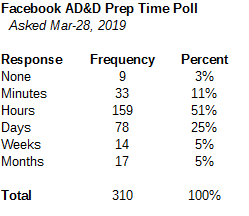
On March 28 of this year, I asked on the Facebook AD&D group the following poll question: "As DM, how much preparation time do you take before a single game session?". Over the next few weeks I got 310 responses. As you can see below, a bit more than 50% answered in the range of "Hours".


In the comments/discussion attached to that poll, there were a small number of people who answered with "years", or "my whole life", which are very interesting ways to look at it, I think. :-)


Edit: In Dragon #28 (August 1979), as part of the AD&D DMG rollout/promotional campaign, Gygax gave an interview in which he asserted, "For the amount of work that a DM has to put in — probably two hours for every hour of play — you’re going to get some real returns... "

2018-06-25

Expected Backstory Poll Results

Back in February, on the Facebook AD&D group, I asked a poll on the following question: "About how many pages of backstory is expected for a new AD&D 1st-level character in games you play?"

To be clear, this is not a question I would ever think to ask on my own. (Another poster previously asked, "How can I write the required 8 pages of backstory for my new character", or something like that, which generated a lot of interest.) As it turns out, this seems to be the most controversial/viral thing I've ever asked there: it generated 493 votes and 128 follow-up comments to date, with fiery opinions in all directions. Here's the original as it appeared on Facebook (out-of-order, and with vote totals of 100+ not visible):


Here's a possibly more useful version, with a table and chart in numerical order:


As you can see, the most popular choice by far was "zero pages" (by default, what I would have answered, the thought never even naturally occurring to me) with about 60% of the votes cast; but "one page" was also popular, with about 20% of the votes -- even more popular than a "half page", with 13% of the votes. On the other hand, while almost no one picked options in the range of 5 or 10 pages, ten people picked either "20 pages" or "More" (2% of the total voters), and were likely to post a comment justifying this stance (and so triggering counter-comments from the no-backstory camp).

Disclosure: There is a possibility that a few people picked "More" (i.e., more than 20 pages expected) accidentally, as by default Facebook only shows the top 5 options in a poll until one clicks "More Options...", that is, the options for 5-10-20 pages would be initially not visible.


In statistical practice, it is sometimes said that bimodal (or multi-modal) results like these indicate that one is measuring at least two disparate populations that perhaps should be separated apart in future analysis. The difference between "zero pages" and "twenty or more pages" of expected starting backstory is so startling that it does indeed seem like at least two different games are being played.

2018-06-02

Target 20 at OD&D Discussion

Over at the OD&D Discussion Proboard, user Piper started a poll on people's preferred AC/combat mechanic, specifically: OD&D RAW Tables, Swords & Wizardry Ascending AC Conversions, or OED Target 20. I'm intrigued by the results so far. Thanks to Piper for thinking to survey that!

2018-01-01

Halfling Weapons Through the Ages

Here's a "small" issue that gives me fits any time I try to analyze it. Halfling preferred weapons varied wildly across different editions of D&D. Let's look at that. (Also: Happy birthday to J.R.R. Tolkien, who was born on Jan-3.)

Tolkien

Nonetheless, ease and peace had left this people still curiously tough. They were, if it came to it, difficult to daunt or to kill; and they were, perhaps, so unwearyingly fond of good things not least because they could, when put to it, do without them, and could survive rough handling by grief, foe, or weather in a way that astonished those who did not know them well and looked no further than their bellies and their well-fed faces. Though slow to quarrel, and for sport killing nothing that lived, they were doughty at bay, and at need could still handle arms. They shot well with the bow, for they were keen-eyed and sure at the mark. Not only with bows and arrows. If any Hobbit stooped for a stone, it was well to get quickly under cover, as all trespassing beasts knew very well.
This is the key paragraph on Hobbit martial prowess from the Prologue to the Lord of the Rings ("Concerning Hobbits", 18th paragraph). Interestingly, what takes priority here is first and foremost the bow (and only secondarily stone-throwing). And this is underscored elsewhere, too: the only assertion of historical Hobbit military action outside the Shire emphasizes the same thing (3 paragraphs prior): "To the last battle at Fornost with the Witch-lord of Angmar they sent some bowmen to the aid of the king, or so they maintained, though no tales of Men record it."

In the Lord of the Rings, we see Hobbit archers in action only at the very end. Perhaps more memorable for most readers is the major combat in Chapter 8 of The Hobbit, in which Bilbo, alone and invisible, holds off at least 50 giant spiders by throwing stones at them (one-shot killing at least the first two he targets). Tolkien writes:
Bilbo was a pretty fair shot with a stone, and it did not take him long to find a nice smooth egg-shaped one that fitted his hand cosily. As a boy he used to practise throwing stones at things, until rabbits and squirrels, and even birds, got out of his way as quick as lightning if they saw him stoop; and even grownup he had still spent a deal of his time at quoits, dart-throwing, shooting at the wand, bowls, ninepins and other quiet games of the aiming and throwing sort—indeed he could do lots of things...
So we can forgive most readers if foremost in their minds are the scenes of Hobbit stone-throwing, instead of archery. If you search online, you'll find quite a bit of confusion and debate as to the source, context, and meaning of these passages (e.g., here and here). But if we read carefully in each case, Tolkien indicates that stone-throwing is but one instance of a broad family of similar skills. In the Prologue to Lord of the Rings, it is clear this is due to their being "keen-eyed and sure at the mark". Likewise in The Hobbit it is emphasized at many points that Bilbo has significantly better eyesight than any of the dwarves, e.g., even in the darkness of the Mirkwood ("for by now they knew Bilbo had the sharpest eyes among them", Ch. 8).

We might think that the halflings should therefore get some bonus to finding secret doors or traps or somesuch, but they do not in any edition of D&D; in contrast to elves with their secret-door detection, and dwarves with their stonework traps detection, etc.

Chainmail Fantasy

They can fire a stone as far as an archer shoots, and because of their well known accuracy, for every two halflings firing count three on the Missile Fire table.
Unfortunately, in Chainmail (hobbits/halflings being the very first entry in the list of fantasy creatures), the weapon being described is ambiguous: "fire a stone". This is might be throwing (although "fire" is a slightly unusual verb for that; Tolkien does not use it). Or it could be slings (but there is no reference, statistics, or fire rate given for slings anywhere else in Chainmail). Or it could possibly be crossbows (some crossbows fired stones instead of quarrels). It seems like the only thing it couldn't be is the self-bows highlighted by Tolkien. The three-for-two attack rule means that halflings get a boost on the normally mass-attack Missile Fire table, with any group likely scoring an extra hit as a result.

Original D&D

In Vol-1 (Men & Magic) we see this:
... they will have deadly accuracy with missiles as detailed in CHAINMAIL.
This shares the ambiguity of Chainmail itself. Is this meant to be throwing, slinging, and/or crossbows, as it might be in Chainmail? Could it be a blanket bonus to all things that count as "missiles"? Furthermore, handling the numerical bonus gets murkier as we shift from mass combat to man-to-man. (This was written, presumably, shortly before the "Alternative" combat system using d20's.)

On that point, after Sup-I (Greyhawk), we get a Corrections sheet that says this:
Hobbits:  All hobbits add +3 to hit probabilities when using the sling.
Now we have the first clear specification, giving the preference to slings (and only to slings). The bonus of +3 is both odd and surprisingly hefty (equivalent to the melee attack bonus from 18/75 Strength in these same rules, say). But consider this: Against an opponent in chain mail (AC 5, e.g., most humanoid types), a 1st-level fighter hits on a 14 or more (that is, 7 in 20, or 35%). The chance to get at least one hit from n such attacks is given by P(n) = 1 − (1 − 0.35)^n. For 2 attacks we have P(2) = 0.58, whereas for 3 attacks we have P(3) = 0.73. The difference between these chances is 0.15 = 15%, or precisely 3 pips out of 20; so the +3 attack bonus is a reasonable translation of the advantage given in Chainmail.

AD&D 1st Edition

We will see that across AD&D, different books in the same edition always expressed contradictory ideas about the halfling attack bonus. (Perhaps as one was updated and the other lagged one edition behind?) In the 1E PHB, we see no reference whatsoever to any attack bonus in the section on Halflings (9 across paragraphs on p. 17). But the 1E MM says this in the monster entry for Halflings:
SPECIAL ATTACKS: +3 with bow or sling
This is in the statistical summary block (p. 50), with no further explanation in the text. This seems to be a retention of the +3 bonus from the Greyhawk correction, expanded by Gygax to be more in line with Tolkien's original depiction. The illustration of halflings in this book features one in action with a bow (see top of this article); their weapon frequency table shows 20% with short bows, and 20% with slings. However: we will see that this is effectively the one and only time that a D&D editor thought to call out halfling specialization with the bow. (Side note: at this time Thieves cannot use bows, but in the later Unearthed Arcana they will be given permission to use short bows.)

AD&D 2nd Edition

The 2E PHB says this:
Halflings have a natural talent with slings and thrown weapons. Rock pitching is a favorite sport of many a halfling child. All halflings gain a +1 bonus to their attack rolls when using thrown weapons and slings.
Notice that the preference here is different from the 1E MM, shifting from slings/bows to slings/thrown (emphasizing the final line from Tolkien about stones, and overlooking his thoughts on archery). The bonus is dropped from the hefty +3 to a measly +1 (but see also the B/X rules, which the author Dave Cook worked on previously -- this may be from whence his numerical sensibility for the issue comes from). On the other hand, the 2E MM still says this:
They are very skilled with both the sling and the bow (receiving a +3 bonus on all attack rolls) and use these weapons to great advantage in battle.
Note that the weapons and bonus value both contradict the 2E PHB, but are still in line with the 1E MM (likely a copy-paste mistake from that prior edition).

D&D 3rd Edition

3rd Edition can be credited with somewhat better organization, finally synchronizing the rule between PHB and MM. The 3E PHB says this, and the MM agrees:
+1 racial attack bonus with a thrown weapon: Throwing stones is a universal sport among halflings, and they develop especially good aim.
This is different from the 2E PHB rule, and is the most restrictive version seen in any edition (thrown only, no slings or bows). It's also the most likely interpretation to come from someone who primarily remembers the combat between Bilbo and the Spiders in The Hobbit, say.

D&D 3.5 Edition

From the 3.5 PHB and MM:
+1 racial bonus on attack rolls with thrown weapons and slings.
This backs off the hyper-restrictive rule in 3E, and returns the skill with the sling (so: exactly matches the rule from the 2E PHB).

Basic D&D

Here we check in with the Basic D&D line, which branches off temporally after OD&D, but has its own distinct rule. Holmes Basic says this (p. 7):
Halflings are extremely accurate with missiles and fire any missile at +1.
According to Zenopus Archives, this bonus is exactly what Holmes put in his original manuscript (before an editing pass by Gygax; link), which is totally different from any other ruleset. Compared to the prior OD&D Greyhawk, it seems to massively expand the preferred weapons (from only slings to all missiles), while severely reducing the bonus (from +3 to +1).

What was the motivation for this? Well, let's imagine for a moment that Holmes was looking only at OD&D Vol-1, and didn't have the Greyhawk Correction sheet in sight when he wrote this rule. As we saw above, Vol-1 fails to explicate either the exact weapons or bonus applicable for the present ruleset ("they will have deadly accuracy with missiles as detailed in CHAINMAIL"); even if you looked back in Chainmail the weapons are ambiguous, and the bonus is totally not in terms of the present ruleset. So you might very well interpret "missiles" as "all missiles", and some kind of undefined bonus as +1, in all probability. But perhaps more importantly: if you have expert familiarity with the writings of Tolkien, re: Hobbits being "keen-eyed and sure at the mark" with bows and other weapons, then this might be the most faithful expression of that conceit.

This "any missile at +1" was kept unchanged through all later editions of Basic D&D: it is the same in Moldvay-Cook B/X, Mentzer BXCMI, the Allston Cyclopedia, etc.

Conclusions

Below is a table summarizing the always-changing status of the halfling attack bonus across different editions of D&D:


I also asked the question as a poll on the Facebook 1E AD&D group. Interestingly and unusually, the 1E rule (neither of them) did not come out on top, with a strong preference for the 2E/3.5-style rule highlighting slings and thrown items:


Recall once more that Tolkien himself emphasized use of bows, and secondarily thrown items. In the history of D&D, this latter item seemed to get the focus of attention: an ambiguous rule in Chainmail/Vol-1, with the Sup-I correction translating it to slings, around which the rule orbited from then on (and reflected in the poll results above). Yet amusingly, in some sense the sling was the only missile weapon that Tolkien didn't call out by name as favorable for Hobbits.

At this point in my OED house rules I have the benefit to halflings listed as +2 to all missile attacks (the least-popular option in the poll above, but one). It would seem that if we want to be in any way faithful to Tolkien, we must give the bonus to at least bows and thrown weapons; and then the most concise rule is to just wrap in slings on the side and make it "all missiles". Moreover, if Tolkien attributes this to being "keen-eyed and sure at the mark", then by all rights it should benefit all types of ranged attacks. The value I set at +2 as the mean between the +1 and +3 bonuses seen in various editions above (also: I have a rule-of-thumb that I don't want to deal with any situational modifiers less than +2). However: I've juggled that benefit around in OED I-don't-know-how-many-times, so based on that, it might get adjusted again in the future.

What is your preference for the Halfling attack bonus, in terms of both numerical value and preferred weapon(s)?

2017-10-30

Mummies Through the Ages

Halloween is this week -- time for a spooky undead-themed reflection. Let's mind-wipe ourselves of the movie that came out this year. Think that energy level drain is horrifying? You ain't read up on old-school mummies lately!

Popular Culture

The golden era for mummy mythology seems to be at the start of the 20th century, coincident with the golden age of Egyptology, especially after the tomb of Tutankhamen was opened in 1922. Within the next two years, a half-dozen members of the archaeology team (out of a group of about 60) had died from various weird causes, and this fueled the popular imagination that there was some "curse" from disturbing the tomb. In particular, Lord Carnavon, the financial backer of the effort, died about 4 months after from a confounding combination of mosquito bite/ shaving accident/ blood poisoning. Others died from fever, malaria, more blood poisoning, assassinations, and being shot by one's angry wife.

Now, apparently real-life curse-inscription texts in Egyptian tombs are pretty rare; but at least one was found that actually reads, "Cursed be those who disturb the rest of a Pharaoh. They that shall break the seal of this tomb shall meet death by a disease that no doctor can diagnose." Read more at the Wikipdia article on Curse of the pharaohs.

A decade later in 1932, Universal Studios made The Mummy starring Boris Karloff (and then a bunch of sequels). Almost 30 years after that, Hammer Film Productions did a revival of The Mummy starring Peter Cushing and Christopher Lee (and then a bunch of sequels). This latter film was often shown in a double-feature with the vampire/Western film Curse of the Undead. In each of these films, the titular character is brought back to life by a magic scroll, and then dark deeds ensue.

Original D&D

MUMMIES: Mummies do not drain life energy as Wights and Wraiths do, but instead their touch causes a rotting disease which makes wounds take ten times the usual time for healing. A Cleric can reduce this to only twice as long with a Cure Disease spell if administered within an hour. Only magic weaponry will hit Mummies, and all hits and bonuses are at one-half value against them. Note, however, that Mummies are vulnerable to fire, including the ordinary kind such as a torch.
In OD&D Vol-2, Monsters & Treasure, Mummies have AC 3, MV 6, and HD 5+1; the above is the entirety of their explanatory text. Even with magic weapons you can only score half-damage on them.

Now, let's look at the rotting disease. It appears that the only effect is to reduce healing rates. But this effect is inescapably permanent. Even if you treat it with a cure disease spell (and it must be within the hour!), your healing rate is still half-normal, apparently forever -- failing that, the healing rate is ten times slower. That makes every combat you ever engage in for the future noticeably more dangerous. Ironically, OD&D doesn't actual set any "normal" rate for healing, so perhaps this really only affects magical curing, which is not called out explicitly; on the other hand, almost all future texts prohibit any magical healing whatsoever to subjects of the disease.

But wait, there's more. In the last few pages of OD&D Supplement II, Blackmoor, Dave Arneson expanded upon the subject of diseases of various types in D&D. And on the subject of mummy disease, the preceding wasn't nearly fearsome enough, and this author felt it needed to be made it much, much worse. He writes:
Advanced Leprosy: The social disease afflicting all mummies, this is what causes wounds to take longer to heal. It is automatically contracted on contact with a mummy. If not cured within three days, there is a 95% chance of fatality, with a 2% decrease each successive day. Any character that succumbs to this dread disease may NOT be raised from the dead; they are permanently dead.

So, apparently on top of the forever-reduced-healing from Vol-2, Arneson gives mummy rot a 95% chance of death per day, and only marginally decreasing over time. The overall chance of surviving such a regime is less than 10−18 (that is: if there was an entire galaxy of Earth populations, and all of them were infected with Advanced Leprosy, then only around 1,000 people would survive to the end). Plus anyone who dies is un-raiseable (perhaps somewhat analogous to those slain by energy draining rising as similar undead).

There's an associated table that says for Advanced Leprosy, "% to Catch: 100%... Fatal %: 60% spec.". that 60% is a bit hard to parse... perhaps there's a 60% chance to die before one even gets to to 3-day mark? And it's also just slightly unclear how the magical curing works in conjunction with the core rule (Vol-1 says "within an hour", Sup-II says "within three days"). In any case, that seems like overkill upon overkill.

Finally: Note that "social disease" is an old-school way of implying "sexually transmitted disease", which I'm not entirely sure what that is meant to imply here in Sup-II. 

1E AD&D

Mummies are undead humans with existence on both the normal and the positive material planes... The scabrous touch of a mummy inflicts a rotting disease on any hit. The disease will be fatal in 1-6  months, and each month it progresses the diseased creature loses 2 points of charisma, permanently. It can be cured only by a magic spell, cure disease. The disease negates all cure wound spells. Infected creatures heal wounds at 10% of the normal rate.
 

The mere sight of a mummy within  6"  will cause such fear and revulsion in any creature, that unless a saving versus magic is successful, the victim will be paralyzed with fright for 1-4 melee rounds. Note that numbers will give courage, and for each creature above 6 to 1 mummy, the creatures add  + 1  to their saving throw...  

Mummies can be harmed only by magical weapons, and even those do only one-half normal damage... Magical fires are at  +1 per die of damage...  Any creature killed by a mummy rots and cannot be raised from death unless a cure disease and raise dead spell are used within 6 turns.

In the 1977 AD&D Monster Manual, Gygax keeps the essence of mummy rot -- one-tenth normal healing; plus the negation of all curative magic (which will be in all editions from now on). And he at least borrows the overall intention of Arneson's supplement; the disease now also deadly, over a period of some months, with Charisma melting off in an apparently leprosy-like fashion. The resistance to even magical weapon blows is retained. He also adds a special fear ability, shown above. Hits have been increased by one die (to 6+3), just like all the undead except for the Ghoul.

But in this case the disease can apparently be entirely removed by application of the clerical cure disease spell -- at any time, in some sense trivial for standard PC parties of a certain level. Unlike Arneson, a raise dead is possible, but with cure disease, it must be applied within 6 turns of death of anyone slain by a mummy (only slightly less harsh). Fire attacks are specified as advantageous (+1 per die).

2E AD&D

The 2E mummy is, for all practical concerns, a copy-paste of the 1E mummy. One thing stands out to me at the end of the combat block: the time frame to cure/raise victims of a mummy has been reduced from 6 turns to 6 rounds.

Also, there is a new separate entry for a certain "Mummy, Greater", which runs about 5 pages in my digital copy. These mummies are ranked by age (less than 100 to more than 500 years), with hit dice from 8 to 13, AC from 2 down to -3, increasing rates of disease progression, and all with spellcasting powers of an evil priest from 16th to 20th level.

This Greater Mummy is perhaps reflective of the overall inflation to monster abilities that occurred in 2E (esp.: dragons and giants), and perhaps borrowing something from Anne Rice's vampire novels which first appeared in 1976 and grew in popularity through the 80's.

3E D&D

Despair (Su): At the mere sight of a mummy, the viewer must succeed at a Will save (DC 15) or be paralyzed with fear for 1d4 rounds. Whether or not the save is successful, that creature cannot be affected again by that mummy’s despair ability for one day.

Mummy Rot (Su): Supernatural disease [slam, Fortitude save (DC 20), incubation period 1 day; damage 1d6 temporary Constitution.] Unlike normal diseases, mummy rot continues until the victim reaches Constitution 0 (and dies) or receives a remove disease spell or similar magic. An afflicted creature that dies shrivels away into sand and dust that blow away into nothing at the first wind unless both a remove disease and raise dead are cast on the remains within 6 rounds...


Resistant to Blows (Ex): Physical attacks deal only half damage to mummies. Apply this effect before damage reduction.


Fire Vulnerability (Ex): A mummy takes double damage from fire attacks unless a save is allowed for half damage. A successful save halves the damage and a failure doubles it.

In many ways 3E D&D "safety bumpered" PCs against the most harmful effects (for example: negative energy drains became temporary with a saving throw). Here, the mummy keeps its fear and resistance to attacks. But by wrapping the mummy rot in the standard 3E disease mechanic, it actually gets somewhat more dangerous; a victim can lose 1d6 Constitution every day, if a daily save is failed -- so likely dying in a few days instead of months as in 1E-2E.

However: The original reduced-healing effect, for both natural and magical means, appears to be removed here (and it might as well be, being effectively negligible compared to the likely death from ability damage in a few days). And fire is made even more advantageous, doing double damage instead of just +1 per die.

The "Greater Mummy" is not included, but a brief line in the stat block indicates "Advancement: 7-12 HD (Medium-size); 13-18 HD (Large)", broadly in line for the extra hit dice allowed in the 2E associated monster.

3.5 D&D

Despair (Su): At the mere sight of a mummy, the viewer must succeed on a DC 16 Will save or be paralyzed with fear for 1d4 rounds. Whether or not the save is successful, that creature cannot be affected again by the same mummy’s despair ability for 24 hours. The save DC is Charisma-based.

Mummy Rot (Su): Supernatural disease—slam, Fortitude DC 16, incubation period 1 minute; damage 1d6 Con and 1d6 Cha. The save DC is Charisma-based.


Unlike normal diseases, mummy rot continues until the victim reaches Constitution 0 (and dies) or is cured as described below.


Mummy rot is a powerful curse, not a natural disease. A character attempting to cast any conjuration (healing) spell on a creature afflicted with mummy rot must succeed on a DC 20 caster level check, or the spell has no effect on the afflicted character.


To eliminate mummy rot, the curse must first be broken with break enchantment or remove curse (requiring a DC 20 caster level check for either spell), after which a caster level check is no longer necessary to cast healing spells on the victim, and the mummy rot can be magically cured as any normal disease.


An afflicted creature who dies of mummy rot shrivels away into sand and dust that blow away into nothing at the first wind.

I'm unaccustomed to the 3.5 edition making things more dangerous than 3E, but it does so here (well, a little bit). First, the mummy hit dice are increased from 6 to 8 (with the possible advanced types running from 9-24). The fear effect is about the same. But the mummy rot doubles up the 1d6 daily Constitution loss with a 1d6 Charisma loss (hearkening back to 1E/2E). Normal healing appears unaffected, but unlike 3E, magical healing (perhaps the type PCs are most interested in) may possibly fail if a caster check does. And the window for raising (6 turns in 1E; 6 rounds in 2E) appears to be entirely eliminated, with a dead victim apparently blowing away as sand instantaneously.

Cure disease no longer has any effect on the victim of mummy rot, as it is now qualified as a curse instead; so something like remove curse is instead required. There is a certain charm to this, inasmuch as the pop-culture conceit is one of the "Pharaoh's curse" (see top), not the "Pharaoh's disease"; although this makes a cure somewhat easier to access, because remove curse is on both the cleric's and wizard's spell lists. Also: the half-damage from blows is gone, although it uses a "damage reduction" ability that shaves 5 points off any attack (so: even nonmagical attacks of sufficient strength can damage it, something not possible in any prior edition).

Holmes D&D

Mummies are also members of the undead. They do not drain life levels, but their touch (if they make a hit) causes the dreaded rotting mummy disease which makes wounds take ten times the usual rate of healing. A cleric can reduce this healing time to only twice normal with a cure disease spell if it is administered within an hour. 

Only magic weapons can hit mummies, and they take only half damage from a hit. Note, however, that mummies are vulnerable to fire, including the ordinary kinds such as a torch, although it only does half-damage to them.

When a mummy is first seen a saving throw vs. a spell must be made or the individual is paralyzed with fear and cannot move until the mummy strikes him or another member of the party. If the party numbers above 5 each member gains a +2 on his saving throw, as their numbers help dispel fear. 

Here's where we check in on the D&D Basic line, starting with Holmes in 1979. The primary project of Holmes was to closely duplicate the rules in OD&D with some of its supplements, with better organizational editing, and only rarely filling in a few gaps with extra rules; and this set the tone for most of the Basic D&D line(s) in the 80's and 90's.

This is almost entirely true for this case of the mummy. Hit dice are the same as in OD&D (5); that is, without the inflation seen in AD&D (and this will remain fixed throughout Basic D&D). The half-damage from hits is the same. The rotting disease is old-school awful as in OD&D; a permanent healing reduction, not fully removable even with cure disease. As in Vol-2, it does not mention magical healing in any way. More importantly, it entirely ignores Arneson's escalation of the disease in Sup-II -- so that while distressing, it is not automatically fatal within a few days of catching it. It does not address or prohibit raising the dead victim in any way (not that raise dead is part of the Holmes level 1-3 basic ruleset).

Now, Zenopus Archives tells us, looking at an early pre-publication manuscript, that "Holmes follows the description in OD&D closely, with no conceptual changes. The two paragraphs in the manuscript are retained in the published rulebook, which adds an entirely new third paragraph describing the fear induced by a mummy."

I think it's been well established at this point that it was Gygax who took Holmes' manuscript and did an editorial pass on it, adding various rules to make it more aligned with his AD&D work. So in this case: The first two paragraphs are really from Holmes, encapsulating the OD&D mummy; and the third paragraph is Gygax, adding in the new fear power from AD&D. Gygax has a bit softer touch here, making the paralysis end as soon as any member of the PC's party is struck by the mummy (instead of a fixed 1-4 rounds).

On the other hand, what Gygax missed in the second paragraph is that Holmes gave mummies only half-damage from fire, whereas in AD&D Gygax gives a bonus to fire damage, so in that respect the two game lines are now running in opposite directions.

Basic D&D

Mummies are undead who lurk near deserted ruins and tombs. On seeing a mummy, each character must save vs. paralysis or be paralyzed with fear until the mummy attacks someone or goes out of sight. In melee, a hit by a mummy does 1-12 points of damage and infects the creature hit with a hideous rotting disease. This disease prevents magical healing and makes all wounds take 10 times as long to heal. The disease lasts until it is magically cured. 

Mummies can only be damaged by spells, fire, or magic weapons, all of which will only do half damage. They are immune to sleep, charm, and hold spells.

The text above is from Cook's Expert D&D (p. X36, 1980). Note that the disease now includes the prohibition on magical healing (not in the prior OD&D or Holmes; first seen in 1E AD&D); however, it is more generous in apparently allowing the magical cure to completely remove the ailment. It retains Holmes' half-damage from fire, in opposition to the AD&D line. Also following Holmes, it is silent on the issue of raising the dead (even that that spell is in this volume). It keeps the paralysis-fear, and ends it if either a PC is attacked, or the mummy moves out of sight; and Cook edits out Gygax's fiddly save modifier depending on number of people in the party.

Mentzer's Red/Blue Box rules (1983) keeps almost the exact same rules text as in Cook. I can see only one change; the sentence about mummy fear does not end the paralysis on a PC being struck -- now, only if the mummy moves out of sight. Allston's Rules Cyclopedia (1991) mummy is word-for-word identical to Mentzer's, except for an added flavor-text paragraph. The half-damage from all blows is retained throughout all Basic editions.

Poll Results

I asked about mummy rot on the Facebook 1st Edition AD&D group. In one of the more lopsided results that I've seen, almost everyone there did seem to prefer the 1E long-acting version of the disease.


Summary


Looking at OD&D, we must admit that there are two separate, really incompatible takes on the mummy's curse of disease. Gygax in Vol-1 plans on the disease being a long-term degradation in recovery ability, over the course of months, perhaps. Arneson in Sup-II expects the disease to very quickly be fatal, within just a few days -- such that the slow-healing effect becomes a forgettable non-issue for practical purposes. Gygax's view held sway in 1E/2E AD&D and the Basic D&D line. But later editions from 3E on recast the disease as did Arneson, fatal in some days if not cured.

Gygax's long-term disease is more in line with the classic pop-culture understanding of the Pharaoh's curse, in which tomb-intruders die horribly months or years later. But Arneson's quick-acting leprosy may possibly be more urgently, dramatically gameable. Which is your preference?