It's been a little quiet here for the last month or so, as my last academic semester teaching CS got hectic. Now I'm excited to have time to get back to some gaming projects I've had on the back-burner for a while. In particular, Wandering DMs Season 2 is on the way in a few weeks, and Paul & I have a bunch of nifty ideas I can't wait to see come to fruition (in the meantime, you can check out Season 1 in video or podcast form, and there's new patron-only videos being released each week through the holidays if you want even more).
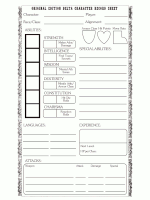
In the meantime, here's a surprise gift: The official OED Character Sheet that we've been fine-tuning in play for the last year or so. It's a digest-sized, form-fillable PDF that automatically generates your ability scores, total encumbrance, and even movement score as you go. When I use this for pregenerated PCs, NPCs, and hirelings, I can get a character complete in about a minute. There's also a two-record form so you can print on a sheet of normal paper, cut it, and have blanks on hand at the table (always needed for emergency replacements). Get it on the OED Games website, linked below. Merry Christmas!
2019-12-25
2019-10-25
Friday Figures: Who Keeps the Sheets?
Here's one of these 4th-wall issues that no one ever thinks to talk about, but when it finally surfaces to consciousness, suddenly everyone realizes they have a militant opinion about. On last week's Wandering DMs show discussing Dave Arneson's early play mechanics, special guest DH Boggs pointed out that Arneson kept all the character sheets for a few different reasons. At the time I thought: "Why are we even mentioning this? Or wait, has no one ever discussed this as an issue before?". So I asked the question as a poll on the Facebook 1E AD&D group; who keeps the PC character sheets between sessions?
As you can see, the "Players" vote took an overwhelming win on this poll -- by a vote of 250 to 83 to 18 at last count. (So: 71% are saying the players take their sheets home). Among the many comments on the issue include observations such as, "I will always stand by the notion that a character is the intellectual property of the player.", "I don't play with people that I don't trust enough to keep their own sheets" (I think assuming the only reason for DM to keep sheets is as an anti-cheating measure), and even, "DMs that insist on keeping their players character sheets have serious mental issues."
Now, this is somewhat surprising, because all of the play groups with which I interact actually have the DM keep the sheets. I think I usually offer players to take the sheets, but no one ever takes me up on it. Maybe our community has just all fallen into this habit unwittingly. Arguments in favor of this in the thread include, "Character sheets belong to the campaign, not the player", and predominantly, "Everyone always forgets to bring their stuff that's why the GM keeps it in a folder". I'm not seeing any comments specifically about cheating but maybe there's one or two in there (and that would have been me in junior high school). One said, "I have been really surprised by New School players who want me to hang onto the character sheets".
Other options include some form of both parties keeping copies; maybe DM gets originals and players scans, or vice-versa. Some DMs keep various summary records while players take the real sheets. Some have a "current" sheet with one party, while an "older" sheet is taken by the other. And a few use technology like D&D Beyond for 5th edition where (I think) both DM and player can access it online. (One DM keeps data in a custom spreadsheet and prints out fresh paper copies each session.)
As a special bonus, Mr. Frank Mentzer joined the conversation, sharing that his players keep their sheets, while he keeps index-card summaries (color-coded by race). And in fact has kept all those records consistently going back to 1977 (making a separate post on FB sharing some photos of those stacks of cards). Thanks, Frank!
Don't forget: New Wandering DMs live chat this Sunday -- On incorporating horror in your D&D and other RPG games. Will we wear costumes? Tune in and share you spooky suggestions. Sunday 1 PM ET.
As you can see, the "Players" vote took an overwhelming win on this poll -- by a vote of 250 to 83 to 18 at last count. (So: 71% are saying the players take their sheets home). Among the many comments on the issue include observations such as, "I will always stand by the notion that a character is the intellectual property of the player.", "I don't play with people that I don't trust enough to keep their own sheets" (I think assuming the only reason for DM to keep sheets is as an anti-cheating measure), and even, "DMs that insist on keeping their players character sheets have serious mental issues."
Now, this is somewhat surprising, because all of the play groups with which I interact actually have the DM keep the sheets. I think I usually offer players to take the sheets, but no one ever takes me up on it. Maybe our community has just all fallen into this habit unwittingly. Arguments in favor of this in the thread include, "Character sheets belong to the campaign, not the player", and predominantly, "Everyone always forgets to bring their stuff that's why the GM keeps it in a folder". I'm not seeing any comments specifically about cheating but maybe there's one or two in there (and that would have been me in junior high school). One said, "I have been really surprised by New School players who want me to hang onto the character sheets".
Other options include some form of both parties keeping copies; maybe DM gets originals and players scans, or vice-versa. Some DMs keep various summary records while players take the real sheets. Some have a "current" sheet with one party, while an "older" sheet is taken by the other. And a few use technology like D&D Beyond for 5th edition where (I think) both DM and player can access it online. (One DM keeps data in a custom spreadsheet and prints out fresh paper copies each session.)
As a special bonus, Mr. Frank Mentzer joined the conversation, sharing that his players keep their sheets, while he keeps index-card summaries (color-coded by race). And in fact has kept all those records consistently going back to 1977 (making a separate post on FB sharing some photos of those stacks of cards). Thanks, Frank!
Don't forget: New Wandering DMs live chat this Sunday -- On incorporating horror in your D&D and other RPG games. Will we wear costumes? Tune in and share you spooky suggestions. Sunday 1 PM ET.
2019-10-18
Friday Figures: Testing 5-foot Squares
A couple weeks back, a few different people (thank you!) sent me the link to the Dutch martial-arts HEMA group HVN's testing of combat with swords and daggers in current D&D-canonical 5-foot wide squares.
Very cool stuff, so glad they could share this with us. The main critique they have coming away from the test is that the squares are kind of a bit on the small side -- they find themselves standing mostly on the back end of the squares, and say that there isn't enough room to use the swords in thrusting style (so: cutting and hewing only).
And that's an interesting take, because my question for many years has mostly been whether the 5-foot size is maybe too large to be realistic. (Whenever I find myself on a tiled floor I look around and gauge whether 5 feet seems like a reasonable for combat space or not.) That's probably some bias resulting from Gygax's assertion that 3 fighting men per 10 feet should be the default (OD&D Vol-2 p. 12, AD&D 1E DMG p. 10). Really comforting to know that the 5-foot size is within the bounds of reasonability.
Videos on HVN's Imgur page here.
Don't forget: Live chat this Sunday on Wandering DMs: Paul & I have special guest D.H. Boggs, applied researcher in RPG history, on the show to discuss Blackmoor, Dave Arneson's play style, mechanics visible and hidden from players and other Twin Cities topics! 1 PM ET.
2019-09-29
Vexing Verdicts
My game last Friday night was the occasion of one of the most bewildering nonstop series of weird effects and judgement calls that I've had to make in many moons. It seemed unbelievable that every 10 minutes there was some exasperating (and possibly deadly) situation that I had to deal with, that I'd never seen before nor ever thought about. This friggin' game. Major props to my players for challenging me with all this crazy stuff. A sampling:
Tune in later today for Wandering DMs to help us discuss how appropriate mind-controlling spells (like charm person) are in D&D. I need a major debriefing on this! (1 PM ET)
- How to manage PCs finding and engaging 80 bandits fighting with 60 merchant guards in the wilderness.
- Wandering gnolls blocking narrow mountain ledge, parties engage. PCs top choice is to grab them by the hair and throw them off the ledge, what's the rule for that?
- In a deep dungeon, can you cast spells through a web spell blocking a tunnel? Lightning bolt? Cone of cold?
- Elf wizard crouching on a tiny two-man rock ledge for cover. Casts 6 mirror images. Where do they appear?
- Lead fighter gets charmed and ordered to attack fellow PCs.
- What if he's Lawful, attacks with a Lawful intelligent sword, as is doing the bidding of a Chaotic being?
- What if he's geased to do the exact opposite of what he's currently being charmed to do?
- What if the charm-caster gets knocked unconscious by magic missiles?
- And then starts regenerating?
- Can an earth elemental summoned by a scroll spell pick up a live attacking giant hog and throw it as a missile weapon against the chaotic regenerating charmer guarded by a mob of angry giant-types?
- Can an 18 Strength PC use a giant-sized club?
- What about log fence posts from the giant devil hog enclosure?
- Can the earth elemental collapse the rock tunnel everyone is fighting in?
- If 20' tall, can it crawl into a 10' tunnel?
- Can the charmed fighter block the elemental from advancing over his position?
- If the charmed PC gets picked up by the elemental and deposited on a dangerous 20' high ledge and has his rope, net, etc., yanked away on subsequent rounds, what does he do then?
- If a hobbit polymorphed for a year into an elf dies and then gets reincarnation cast on them, what counts as their "original" form, elf or hobbit?
Tune in later today for Wandering DMs to help us discuss how appropriate mind-controlling spells (like charm person) are in D&D. I need a major debriefing on this! (1 PM ET)
2019-09-27
Friday Figures: Holey Moley Caddysmack
ABC's summer fill-in show Holey Moley has a game called Caddysmack in which mini-golfers have a preliminary stage, and then winner chooses between a robot and Stephen Curry to make a 55-yard pitch shot into a turf-covered empty swimming pool, and then the contestants finish by shooting for the final hole in that playing area.
The weird thing is that the player with the choice almost inevitably picks Curry for the pitch shot, but his shots rather clearly bounce all around the pool area, while the robot's is predictably on-line every single time. (I suspect given some dialogue that Curry gets multiple attempts on each show, but if so they're off-camera.) The contestant playing off Curry's shot won 40% of the time in Season 1, so I'm pretty confused why every single person save one picked him.
Don't forget: Tune in to Wandering DMs this Sunday 1 PM ET for more live chat! This week, a discussion on mind-affecting magic spells and effects; okay to subvert player agency, or not?
The weird thing is that the player with the choice almost inevitably picks Curry for the pitch shot, but his shots rather clearly bounce all around the pool area, while the robot's is predictably on-line every single time. (I suspect given some dialogue that Curry gets multiple attempts on each show, but if so they're off-camera.) The contestant playing off Curry's shot won 40% of the time in Season 1, so I'm pretty confused why every single person save one picked him.
Don't forget: Tune in to Wandering DMs this Sunday 1 PM ET for more live chat! This week, a discussion on mind-affecting magic spells and effects; okay to subvert player agency, or not?
2019-09-23
Cave Dice
When I first started running my annual Outdoor Spoliation games, the intent was to explore the Original D&D Wilderness adventuring rules as closely as possible. In that ruleset, most of the action is driven by random outdoors encounters, where each type of monster comes with a "% in Lair" as one of their primary statistics (still visible as late as 1E AD&D). So you generate a random monster and then find out if it's holed up in a cave lair of some sort, with actual treasure.
But how to handle those randomly-determined cave lairs that might pop up anywhere, any time? As usual, I really prefer mechanics without some complicated table that I need to go paper-shuffling while players wait for me to adjudicate when it comes up. In this case I came up with a dead-simple method using a single d6, based on the shape of pips on each face. It's served me well ever since, in many different circumstances, and is IMO impossible to forget:
In my application, I assume the the 4 and 6 cave results have no other exits, likely where the monsters are settled with their treasure. Therefore the 1, 4, and 6 results are all terminal; 2 and 3 lead to one other area; and only the 5 has any branching (namely, 3 other tunnels for PCs to explore). If this branch shows up, then depending on a whim I may split the monsters up into two groups and plan to pincer the PCs when hostilities commence.
Of course, many tunnel complexes will be a straight line; on the other hand, the 5 branches may lead to more branches, which may continue bifurcating indefinitely. That said, the average number of areas per complex is (oh god, here I go).... letting x = expected areas down any one tunnel:
And this result was double-checked by Monte Carlo simulation in C++.
But how to handle those randomly-determined cave lairs that might pop up anywhere, any time? As usual, I really prefer mechanics without some complicated table that I need to go paper-shuffling while players wait for me to adjudicate when it comes up. In this case I came up with a dead-simple method using a single d6, based on the shape of pips on each face. It's served me well ever since, in many different circumstances, and is IMO impossible to forget:
![]() |
| Random d6-based cave generation |
In my application, I assume the the 4 and 6 cave results have no other exits, likely where the monsters are settled with their treasure. Therefore the 1, 4, and 6 results are all terminal; 2 and 3 lead to one other area; and only the 5 has any branching (namely, 3 other tunnels for PCs to explore). If this branch shows up, then depending on a whim I may split the monsters up into two groups and plan to pincer the PCs when hostilities commence.
Of course, many tunnel complexes will be a straight line; on the other hand, the 5 branches may lead to more branches, which may continue bifurcating indefinitely. That said, the average number of areas per complex is (oh god, here I go).... letting x = expected areas down any one tunnel:
And this result was double-checked by Monte Carlo simulation in C++.
2019-09-20
Friday Figures: Exotic Attack Areas
![]() |
| Exotic attack areas survey on ODD75 Discussion forum. |
Consider the spells in OD&D that in some attack opponents, but don't do direct damage: things like sleep, hold person, confusion, and so forth. In the OD&D LBBs these affect a certain limited number of people, but no specific rules for how the targets are picked is given. By default I've always assumed that the caster can pick those targets at will.
But it turns out that this is a very idiosyncratic interpretation, not shared by almost anybody else. Instead I see pretty much everyone else agreeing that having these spells hit your own allies is a regular possibility (based on discussions on both the large Facebook AD&D group and ODD74 Discussion forum). Gygax wrote on ENWorld (2nd February, 2005):
To clarify, as the DM I would allow the spell caster to select one specific target, and by so doing nerrow the scope of a sleep sopell to that individual. If ut were used as an area spell, then all characters in the area would be affected up to the spell's maximum, and that includes PCs associated with the casting magic-user. In the example you give, the sleep spell would get the five goblins first, then the three 1 st level PCs, and if more than eight could be affected, then the two bugbears.
However, in the OD&D LBBs, these spells don't have any specified area. Those were added for the first time in the Swords & Spells supplement, e.g., 1" diameter for sleep, 3" diameter for hold person and confusion, etc. Some iteration of these were then maintained through the AD&D line, but are still missing from the B/X basic line. (An additional complicating factor is that Swords & Spells assumed a 1" = 10 yards scale, which was retconned away in Dragon #15 [see last week], bifurcating the possible interpretations and possibly leaving us with too-small areas?)
So I asked this question on the ODD74 Discussion board and -- while the sample size is very small -- it came out 4:1 in favor of not honoring the targeted areas from later works. But everyone still seems to agree that allies in range are subject to the spell, starting with lowest-level first, as per Gygax above. Then wouldn't that mean that the 1st-level magic-user casting his one and only sleep spell -- would pretty much only affect himself and his 1st-level companions at ground zero?
To me, that's an incredibly ugly interpretation. But the only way I see out of it is to add limited, targeted areas where the wizard focuses the magic, even if it's an added fiddly bit to the spell rules. What do you think?
Don't forget: Tune in to Wandering DMs this Sunday 1 PM ET for more live chat!
Subscribe to:
Posts (Atom)


