
2017-07-31
Spells Through the Ages Polymorph – Polymorph Matrix
We've had some extensive reflectections on the various polymorph spells in the past (link one, two). I just realized that I made a graphical matrix of abilities conferred by polymorph in editions from 0th to 3rd, but never posted it here. See below:


2017-07-29
Saturday Software: Wizard's Spell Index

In this case, the program doesn't do anything very interesting; just read the entirety of the Compendium index, do an integrity check, look for duplicate spell names, and compile lists of all the special origins and schools of magic that appear. But if you're a Java programmer then you may appreciate being able to hook into this and read, use, modify, and possibly write out a new spell index in a few lines code. (It's what I used to programatically check and reformat the index myself.)
Perhaps more immediately useful, here's also an alternate spell list that you can drop into the spellbook generator program from last week, including everything from the Wizard's Spell Compendium General Mage List -- with 1,278 spells! Note that, following that work, spells marked "C" (Common) are identical to those in the AD&D 2E PHB (which is mostly the same as in 1E), excepting spells named after some NPC (which are "U" for Uncommon); spells from other supplements are at lower frequency levels. (Rename to SpellIndex.csv to use.)
2017-07-24
AD&D Wizard's Spell Compendium Index
We wrote previously about our appreciation for the AD&D Wizard's Spell Compendium, compiled by Mark Middleton, here. Although released in the years 1996-1998, it wasn't branded as "2nd Edition"; rather, the intent of the product was to be a general AD&D resource covering publications from the game any time from 1975-1995. (That said, you'll find it categorized as "2E" in most places online just because of the time frame, and the format of the spell matches 2E, e.g., ranges in units of yards by default).
The four volumes have been missing from DriveThruRPG for some time, but as of this May, the first two volumes reappeared with improved scans, OCR, and indexing. Personally, I downloaded those, along with the older copies of volumes 3-4 I had, merged them with a PDF tool, and now have a single document close to 1,200 pages in length with all the AD&D spells in one place. It's pretty sweet.
Compiling The Index
One thing I'm not alone in searching for in the past is a digitized index of those spells to possibly use for analysis and input to software applications. James Rizza at Dragonsfoot made what seems to be the first attempt at this (here). We should be very grateful for that work (I'm pretty sure it was all manually entered, including schools, ranges, durations, material component listings, etc.), but it has a number of limitations. The most glaring is that every spell was entered multiple times, once for each school of magic to which it belongs. That runs up against the cardinal rule of database management, that is, to not duplicate the same data in multiple places -- because every copy is another opportunity for errors to creep in, fields to fall out-of-synch, etc. (and indeed they did in this case). It makes it impossible to gather vital statistics on the work, starting with simply knowing how many different spells there are. (I'm sure that was done to enable sorting by school, which was an important mechanic for 2E specialty spellcasters, but an immensely better way to do that would be to use the spreadsheet FIND function appropriately.)So, below you'll see a version that I massively re-formatted and corrected. Where the original spreadsheet was all-caps, I put this one in title case (matching the text of the Compendium itself). I de-duplicated all of the spells and collected the schools into one field each. I separated out reversed spell names from the name field, where they were previously appended. I did the same with any special origins (like Old Empire, Red Wizards, Dragon Knights, etc.) -- except in the dozen or so cases where it was necessary to avoid duplicating another spell's name. I programmatically reformatted most of the ranges, durations, areas, with more standardized abbreviations, and shortened many of the material component listings. I deleted the extra columns for various specialty wizards which could be discovered by inspecting the schools listing (but were in many places out-of-synch). I corrected some spell name typos and missing spells. And I inserted the frequency data indicated in the Compendium Vol. 4 table for generalist mages.
We shouldn't feel surprised at errors in the original table; granted that it had 3,442 records × 24 fields/record = 82,608 total fields, even if the original author was working at 99% accuracy, we would still expect close to a thousand fields to have errors. I'm sure there's still a bunch of errors that I haven't yet caught. Feel free to send me more corrections if you find them (esp., missing spells?).
Statistics and Conclusions
Now we can present some descriptive statistics on the overall work: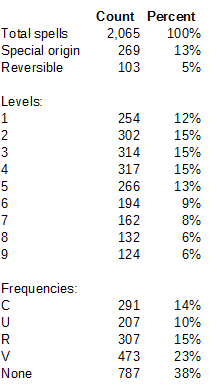
Here are the level statistics in chart form:

For the levels, note that levels 3-4 are modal; this seems to be the "natural" thing to happen if someone doesn't enforce an outside requirement on level frequency -- it's the same thing that appears in Original D&D Vol-1. And here are the frequencies in a chart:

As you may expect, the letters C, U, R, V stand for the frequencies Common, Uncommon, Rare, and Very Rare. These are only entered as they appear in the Volume 4 "General Mage Spell List" (p. 1093-1101). The implication is that the 38% of spells marked as "None" here, that is, not appearing in that list, are "Restricted" spells given only to some specialty wizard type, and presumably appearing in one of the many other tables that follow in the Compendium. It's interesting that Uncommon is the most infrequently-used frequency.
We can also dis-aggregate the spells by level and frequency on separate axes. Consider the following chart:

Looking down the depth of that 3D chart, notice that at 1st level, more of the spells are Common than any other frequency. Meanwhile, around levels 2-5 there are more spells at the Rare or Very Rare ratings (and these are approximately the same at levels 3-4). However, at levels 6-9 the spells are mostly Very Rare (and the Rare category is almost totally unused at the uppermost levels).
Finally, here are compilations of the special origins and schools of magic to be found in the database:
- Special Origins: 21 [Alhoon, Bard, Beholder, Dragon, Dragon Knight, Drow, Elf, Galeb Duhr, Ghul, Hishna, Necromancer, Neogi, Ninja, Old Empire, Paramander, Phaerimm, Pluma, Red Wizard, Savant, Witch, Wu Jen]
- Schools of Magic: 28 [Abjuration, Air, Alchemy, All, Alteration, Artifice, Charm, Chronomancy, Conjuration, Dimension, Divination, Earth, Enchantment, Evocation, Fire, Force, Geometry, Illusion, Invocation, Mentalism, Necromancy, Phantasm, Shadow, Song, Summoning, Universal, Water, Wild]
Further Research
Among the limitations in the current index are the lack of data for setting-specific information, which are indicated in the Compendium with graphical icons next to many of the spells (e.g., Dragonlance, Dark Sun, Ravenloft, etc.; see p. 1126-1136). While the information for many specialty wizards can be parsed from the schools field (assuming no errors there?), other specialty mages appear at the end of the Compendium that would need additional field(s) to include (e.g., Deathmaster, Frost Mage, Red Wizards, Storm Mage, Witches, etc.; see p. 1137-1148). If you're generous enough with your time to add those, then do please forward it here so that we can share them.Of course, many of us use a ruleset with different spell formatting than 2E. If I were to use a few entries here as surprise spice in my games, I'd probably convert all the ranges to either 6, 12, or 24 inches (depending on whether the listed range was closest to 60, 120, or 240 yards for a 12th-level wizard [i.e., 5, 10, or 20 yards/level]). And I'd convert durations to either 3, 6, or 12 turns (depending on whether the listed duration was closest to 1, 2, or 5 rounds per level). This is actually the conversion protocol that I generally used when analyzing spells for the 2nd edition of the Book of Spells work.
Data Download
Get the revised Wizard's Spell Compendium Index at the link below!And if you need the original text, you can use the following affiliate link to get all volumes 1-4 volumes of the AD&D Wizard's Spell Compendium (and help support the Wandering DMs channel at the same time):
2017-07-22
Saturday Software: Minidice

Minidice.
2017-07-17
Climbing Through the Ages
Climbing, by thieves and non-thieves, possibly with rope assistance, is a common dungeon, cave, and wilderness activity for explorers. It’s also one of those mundane, real-life skills that I would expect we could “dial in” correctly to our gaming ruleset. Coincidentally, just a day or two after our Rappan Athuk game, my friend Duncan posted a video of himself climbing a free-hanging rope for about 20’ in a gym, which looked pretty impressive to me. Discussion follows:

Indeed. Taking inspiration from the many climbing challenges last week, I felt obligated to investigate the rules present in classic D&D.
OD&D
Chainmail (1971) mentions the use of ladders in the Siege rules (which are at man-to-man scale) -- 3 men can climb a ladder per turn (1 minute); defender above always gets first strike (p. 23, 25). The only direct mention of climbing in the D&D LBBs (1974) is that swimmers may climb the side of a ship to board (Vol-3, p. 31). Of the first pit trap, it is said, “it would only mean about one turn of time to clamber out, providing the character had spikes or associates to pull him out, and providing the pit wasn't one with a snap-shut door and the victim was alone.” (Vol-3, p. 5).
Of course, Sup-I (1976) introduces the Thief class with their special ability to “climb nearly sheer surfaces, upwards or downwards” (p. 4). The mechanic couldn’t be simpler: “There is a basic chance of 13% that a 1st level thief will slip and fall in climbing. With each higher level attained by the thief this chance is reduced by 1%”. As a formula, that is: 14% – L chance of slipping. Note what is not addressed: time, distance, speed, encumbrance, ability scores, or how many checks are required for a long climb.
AD&D Core Rules
Again, in the core rulebooks, only thieves climbing vertical surfaces is addressed. The probability is similar to OD&D, with an 85% chance of success at 1st level, a 99% at 10th, and so forth (AD&D PHB, 1978). Racial type may modify this; while Dexterity modifies most other Thief abilities, it does not do so for climbing.
The extra/errata notes in the DMG (1979) give movement and surface details for the first time (p. 19). In particular: “SLIGHTLY SLIPPERY surfaces DOUBLE chances of slipping and falling. SLIPPERY surfaces make chances of slipping and falling TEN TIMES more likely.” One interesting thing is how this mechanic makes the most sense in the context of OD&D, where percentages were given in chances to fail (see prior section); but it’s more confusing math when the percentages have been converted to a chance to succeed in the AD&D PHB (last paragraph). For example: 100% – 2 × (100% – P) for a slightly slippery surface, where P is the base chance of success. Like many AD&D rules, this was long a source of confusion to me, until I read OD&D which clarifies the conrext in which the rule was first written. And I think of this as one of many examples that to Gygax, the game was all one continuous work and not discrete, separate editions.
This latter rule is in fact exacerbated in that further down that page it is written, “Most dungeon walls will fall into the fairly rough to rough category. Some will be non-slippery, but most will be slightly slippery due to dampness and slime growth.” That is: Applied strictly, the default chance of falling is twice that apparent to players from reading the PHB.
And there’s yet another subtle-but-significant rule change between the PHB and DMG and that is: the time scale and number of rolls involved in one climb. The PHB asserts that only one roll need to be made for any climb: “It is assumed that the thief is successful until the mid point of the climb. At that point the dice are rolled to determine continued success. A score in excess of the adjusted base chance indicates the thief has slipped and fallen.” But the DMG gives a chart of move rates in “FEET PER ROUND”, in units of either 0, 3, 6, 9, 12, 18, or 24 feet per round; and then it specifies, “Be certain to check each round of vertical or horizontal movement for chance of slipping and falling”. So this page of the DMG has made climbing massively more dangerous to thieves, both generally doubling the chance to fall, and moving from a single such roll per climb to likely many.
AD&D DSG
For climbing by non-thieves, we’ll need to look outside the core rules by Gygax. For example, such rules appear in the AD&D Dungeoneer’s Survival Guide (1986). While this is past the time when Gygax departed TSR, the author Doug Niles gets instant credibility from me because of his excellent design work in the miniatures rules for AD&D Battlesystem and Star Frontiers: Knight Hawks. Like much of the book, the rules are somewhat too expansive to discuss here in full (p. 14-19), but an overview can be given.
Sheer surfaces like those detailed for thieves in the DMG simply cannot be climbed by non-thieves (p. 14). Compared to thieves, non-thieves are given a base climb chance of 40%, but this can only be applied to easier categories of climb like, “Rough, ledges... pole... tree... sloping wall... rope and wall” (p. 14-15). Bonuses per category apply, between +20% and +40%, making any of these climbs automatic for thieves. Abilities and encumbrance are not considered, but armor is: –5% for padded/studded, –15% for chain/splint/scale/banded, and complete prohibition for any characters in plate mail (p. 16). An even easier mechanic is given for characters rappelling downwards with a rope; +50% modifier and increased speed (p. 17).
Now, the movement rates are again given in units of feet-per-round, so in this aspect the DSG work looks continuous with the rule given in the DMG. However, there is a possibly subtle wrinkle to this; Niles writes, “When a non-thief character begins a climb, he must make a successful Climbing Check roll on 1d100... If a Climbing Check fails, the character can never climb that wall.” Now, read closely, this has the appearance of switching back to only one check per climb (due to the “begins a climb” language), and not rolling round-by-round as per the DMG. That makes climbing safer, although we might wonder about the last part of the rule, esp. for downward-direction climbs (maybe the most common usage in standard dungeon designs?). What happens when a character goes over the edge of a cliff on a rope and fails their check – are they just stuck there helplessly?

Consider the chart above which summarizes different types of characters climbing a rope-and-wall for 100 feet. (The percentages shown would be identical at any level.) Clearly there is a degradation in climbing chances, mostly related to the armor worn by the character. The roll indicated would only be made once; if successful, time spent climbing would be either 3 or 5 rounds by class (where allegedly 1 round = 1 minute).
B/X Rules
In the Moldvay/Cook B/X rules (1981), only climbing rules for thieves are addressed. The chance to climb is actually identical to that back in OD&D (only translated from chance-to-fail to an equivalent chance-to-succeed). The rule stipulates, “This roll should only be made once per 100’ of climb attempted. If failed, the fall will be from halfway up the surface.” (p. B8). So: Here we again see a once-per-climb mechanic (as opposed to the AD&D DMG).
Edit: Scott Keeney points out that Moldvay does briefly mention climbing for non-thieves in his two pages of "Dungeon Mastering as a Fine Art" advice at the very end of the book (p. B60-61). In this case, it's "To perform a difficult task (such as climbing a rope or thinking of a forgotten clue), the player should roll the ability score or less on 1d20." Cook backs this up with a paragraph on Climbing in the Expert rules, suggesting a Dexterity-based check when "climbing a tree in a high wind, or climbing up a crumbling wall." (p. X51)
Edit: Scott Keeney points out that Moldvay does briefly mention climbing for non-thieves in his two pages of "Dungeon Mastering as a Fine Art" advice at the very end of the book (p. B60-61). In this case, it's "To perform a difficult task (such as climbing a rope or thinking of a forgotten clue), the player should roll the ability score or less on 1d20." Cook backs this up with a paragraph on Climbing in the Expert rules, suggesting a Dexterity-based check when "climbing a tree in a high wind, or climbing up a crumbling wall." (p. X51)
AD&D 2E
The subject of climbing is the very last topic in my copy of the AD&D 2E PHB (1989), just before the appendices. Broadly speaking, the rules are the same as those found in the DSG. Base success chance is again 40% for non-thieves; climbing categories are roughly the same; modifiers are slightly adjusted (e.g., +55% for rope and wall); modifiers for armor are mostly the same (exception: plate at –50%, not totally prohibited); checks are again only once at the start of a climb; the rule for quick rappelling downward is maintained; climbing is permanently barred if a character misses their roll. Modifiers for encumbrance rating are added. And another paragraph has been inserted after the table for climbing chances: “On particularly long climbs--those greater than 100 feet or requiring more than one turn (10 minutes) of climbing time--the DM may require additional checks. The frequency of these checks is for the DM to decide. Characters who fail a check could fall a very long way, so it is wise to carry ropes and tools.” (Note that Dave “Zeb” Cook was the listed author for both 2E and the D&D Expert rules, so the echo of the 100’ unit from B/X should not be too surprising.)

In summary, it looks like climbing for non-thieves got significantly more generous than in the 1E DSG. Combined with the boosts to both the rope-in-wall case that we’re considering, and the improved situation for plate, fighter in plate armor have gone from an impossible situation to an almost 50% chance to make such a climb.
D&D 3E
Now, in the 3rd Edition PHB (2000), the formerly percentage-based rules, along with everything else, were converted to the d20-based uniform mechanic. Use of the Climb Skill (p. 64-65) is uniform for all character classes; it’s a class skill and so easily obtained by both Thief-types and Fighter-types (in fact, it’s the very first skill suggested for Fighters in their “starting package”, p. 37); so these classes might be expected to have skill points up to their level + 3 (the maximum). The skill is modified by Strength and Armor (e.g., –1 for studded leather, –5 for chain, –7 for half-plate), but not by encumbrance generally. The d20 target challenge ratings are, for example: DC 5 for a rope and wall; DC 10 for ledges; DC 15 for very rough natural rock or a tree; DC 20 for typical dungeon wall; DC 25 for overhang. DC is +5 for a slippery surface. Many modifiers are given for other situations and synergies. So it looks like, very roughly speaking, the categories of surface are approximately analogous to those first seen in the AD&D DSG.
But one aspect the re-emerges is significant: Rolls must again be made every round. “With each successful Climb check you can advance up, down, or across a slope or a wall or other steep incline (or even a ceiling with handholds) one-half your speed as miscellaneous full-round action.” In conjunction with this, a unique mechanic is that failures are not necessarily falls: “A failed Climb check means that you make no progress, and a check that fails by 5 or more means that you fall from whatever height you have already attained.”
The rule for rapid and easy downward rappelling is missing. But, a rule is added for something that I do think was overlooked in any prior editions: “Someone using a rope can haul a character upward (or lower the character) through sheer strength. Use double your maximum load... to determine how much a character can lift.”

Compare the case-study chart above to those given previously. Although the 3E requests that a check made each round of climbing (counter to the prior case studies), it is in other ways much more generous than in the DSG or even 2E. The modifiers for encumbrance are gone; the effects of armor are more significantly lessened (effectively only a –35% for plate); classes such as fighters as likely to have additional points in the skill; Strength bonuses can apply; and there is no prohibition against re-trying after the first failure. For example, Fighters in plate (–7 check) have that penalty exactly cancelled out by the 4th level (+7 skill); so while they need to roll DC 5 on a raw d20 to succeed in any round, it is impossible for them to fail by 5 and thus fall. They are in fact guaranteed success at climbing a 100' rope in about 1 minute of time (on average around 12 rounds, accounting for failed rolls; and note that 1 round = 6 seconds here).
This is, of course, the furthest possible cry from the 1E DSG where such a climb was strictly prohibited. But if a character is of lower level, or does not have maximum possible ranks in the Climb skill, then the chance of success will be lower -- and due to the multiplication rule for compound probabilities, the total chance to make the climb without a fall degenerates at a shocking rate. For example: At only one level lower (3rd), the fighter in plate will have a 5% less chance to make any particular climb roll (1 pip in 20). But then that opens up the possibility for a fall (on a natural "1"), and over the 10 Climb checks necessary in the example above, the chance for succeeding at the whole climb is only 52.4%. For a 1st level fighter with max skill the total chance is just 12.5%; and for an unskilled climber in plate, the chance becomes less than 1%! (Assuming no Strength bonus, which would move the example back in the other direction.) 1
This is, of course, the furthest possible cry from the 1E DSG where such a climb was strictly prohibited. But if a character is of lower level, or does not have maximum possible ranks in the Climb skill, then the chance of success will be lower -- and due to the multiplication rule for compound probabilities, the total chance to make the climb without a fall degenerates at a shocking rate. For example: At only one level lower (3rd), the fighter in plate will have a 5% less chance to make any particular climb roll (1 pip in 20). But then that opens up the possibility for a fall (on a natural "1"), and over the 10 Climb checks necessary in the example above, the chance for succeeding at the whole climb is only 52.4%. For a 1st level fighter with max skill the total chance is just 12.5%; and for an unskilled climber in plate, the chance becomes less than 1%! (Assuming no Strength bonus, which would move the example back in the other direction.) 1
Poll Results
I also asked this question on the Facebook 1E AD&D group. The results were approximately 3:2 in preference of a check every round (i.e., following the official 1E DMG rule), with another group answering some form of "it depends" (often by distance or surface type).
For what it's worth, everyone whom I know personally picked "one check per climb" (offering a good case study in how your friends can be non-representational of the population at large). EGG Jr. selected "one check per round".
Open Questions
I think that the last time I edited my OED house rules on the subject, I was primarily looking at the 3E rule for base probabilities; however; on my simplified d6 mechanic, making the climb more difficult (as in 1E) would be pretty much countered by the chance-to-fail-but-not-fall (in 3E), for about the same result.
So: Which of the above rules for climbing do you like the best? How risky should climbing be for an unskilled man, a fighter in plate mail, etc.? Do you prefer the frequency of checks to be once per climb (OD&D, B/X, 1E PHB, DSG, 2E), or once per round (1E DMG, 3E)? Should failed checks prohibit any further climbing (as in DSG, 2E), or not? What would be the best simulation of the real thing?
So: Which of the above rules for climbing do you like the best? How risky should climbing be for an unskilled man, a fighter in plate mail, etc.? Do you prefer the frequency of checks to be once per climb (OD&D, B/X, 1E PHB, DSG, 2E), or once per round (1E DMG, 3E)? Should failed checks prohibit any further climbing (as in DSG, 2E), or not? What would be the best simulation of the real thing?
Finally: Anyone ever see anyone test climbing (rope, rock wall, etc.) in any kind of chain or plate armor?
1 This calculation is done by recognizing that the 4-pip window on the check in which no movement or fall occurs can be effectively ignored for this purpose, and proportionally consider the chance to fall out of 16 (with any negative modifier taken as the numerator). Thus, the chance for the 3rd level fighter in plate to avoid any fall is (1 – 1/16)^10 = 0.524; at 1st level it's (1 – 3/16)^10 =0.125; unskilled it's (1 – 7/16)^10 = 0.003. Also checked by computer simulation.
2017-07-16
Rappan Athuk Week – Postmortem
What Went Right
- Index Cards: This may seem like a minuscule change, but for the first time I tried running the game encounters via index cards, and it really worked like a charm. I’ve got one card with PC summary stats (name, class, AC, weapon-in-hand, effects in pencil), and another card with monsters that gets filled in as an encounter starts (AC, MV, HD, hp). Previously I would document that on a standard pad of paper, taking up four times the space. With this I can stand or walk around with the two cards in my hand and run a whole encounter. Then I can document any after-effects (treasure found?) and put away the monster card, so my crazy scribbling don’t visually distract me thereafter. If some monster gets charmed or controlled that then becomes a new “live” card in play, and I don’t have to go hunting for it in my notepad. I have more free space behind the screen. And a nice coherent stack that I can go through later as an adventure log/ XP record/ notes for a narrative write-up. It seems silly, but boy, it improved my game.

- Spell Cards: On a thematically similar note, Paul’s design of Spell Cards for the OED Book of Spells was a complete master-stroke. I was a little reserved when he first came up with the idea, because I’ve always lobbied that it’s a nice thematic echo to have wizard-players riffling through books just like their wizard-PCs are doing. But both of us have been giving players in our games the option of book or cards, and everyone has been unanimous in picking the cards since we started doing that. This allows players to take out the cards for the spells they’ve memorized on one day and only look at those from now on. The OED spell text easily fits on each card in its entirety. If a wizard casts an effect on another PC, the card just slides over to that player to remind them what the exact effect is. That’s really killer. Paul wins.

- Rolling in the Open: An oldie but a goodie; I make all rolls in the open (excepting surveillance/ searching/ hiding type stuff). It increases the drama and the tension. It make things count. It actually makes it much easier for me as a DM, because it takes away the mental load of whether I “want” to override a die-roll or not. Even wandering-monster checks are declared and rolled in the open. So many moments of the game, both glorious and horrifying, would not have been possible (or believable, or as effective), without this. I’ve been doing this for years, and I honestly can’t imagine anyone wanting to do it otherwise now.
- Using a Tablet: For the first time I was running a dungeon via a PDF on my tablet. Partly as an experiment, and partly as a way to manage the ~500 page adventure text. This was essentially a big success, and I’d be happy to do it again in the future. The only complication was the PCs going into unexpected areas and my needing to swipe back-and-forth constantly between map and text. Ideally (according to original plan) I’d have a paper map in front of me and just need to browse text on one page at a time. Even better if the adventure text was digest-sized (instead of full-letter-page size). Also at one point I did run the power down and need to get an extension cord.
- Miniature Usage: I find that I’ve gone back-and-forth about miniature usage multiple times over the years, which is surprising. I was trying to use them heavily in the 3E era, and at some point I snapped and swore to god I’d never use them again for anything. Then multiple players started setting up marching orders for their own benefit, and that did seem helpful. Then occasionally I couldn’t resist putting down a scary miniature from one side or the other to show (or ask) which PC was getting attacked. Occasionally now I have a prepared battlemap, or ink out a critical area. There are no complicated 3E-era rules for movement (diagonals, attacks-of-opportunity, etc.). It seems to work very well for everyone. I think my current rough rule is; we have a marching order in front of us all the time, and only when some player asks or gets confused about positioning do I put down a few monster miniatures around that to clarify. (Paul has a supply of Dwarven Forge dungeon blocks but we never used that all weekend.)


What Went Wrong
- Main Secret Door: Gads, that initial secret door to level 1! Arguably that’s a really bad design decision – and yet it seems really integral to the way the initial encounter and introduction to Rappan Athuk is set up. I think I’ve had that lesson pounded into me numerous times over the years and I still got hit in the head by this. Partly this is a criticism of my capacities as a DM that I couldn’t avoid it. Granted that I only DM about 3 times a year currently, I find that I tend to start off a bit OCD/literalist to the text, and then later on start to massage or bend encounters a bit more for dramatic or pacing purposes. It’s possible that in the future that I’d move the secret door to the sarcophagus itself (a clear point of interest to be searched), or give it up automatically. Numerous accounts on the Necromancer forums seem to indicate players finding the secret door without difficulty – but I’m not sure on the details DMs are using to adjudicate that (e.g., if it’s 3E/Pathfinder then everyone can use a “Take 20” for automatic success if they have the time in-game). This threw my players in a different, much more dangerous direction that I really wasn’t prepared for all weekend long.
- Climbing Up/Down: Coupled with the fact that my players became convinced that there was no way into the dungeon aside from the Well (see above), the biggest single point of contention was frustration at the risk of falling and damage/death from climbing ropes up the 90’ well or cliff areas. Honestly, I’m pretty confident that there has to be some amount of risk here, especially for non-thieves making such a climb. But I have to listen sympathetically when the players get half-pissed off about this. If I’m hearing correctly, I think some argued that their PCs should know about the need to use a backup rope/rappel seat type setup in that kind of situation in the first place. Maybe I should explicate or investigate that more in the future.
- Maze/Labyrinths: Oh my god, those stupid maze locations. They just go on and on and on. And the fact that the text says to magically screw with the PC directions in random and utterly untraceable ways makes the labyrinths, by the book, absolutely impossible to get through. At least I knew enough to abort that particular aspect in our game. I would prefer if there was simply some purely abstract mechanic to it (like I think there was in earlier editions). Or be smaller or have some mechanic that the players could engage with, puzzle through, or out-think.
- Opaque Saving Throws: The OED house rules turn saving throws into a mechanic whereby PCs roll 1d20 + level + modifier based on category (spells/breath/stone/wands/death, respectively +0/1/2/3/4). It’s pretty close the equivalent to the RAW saving throw rules. On Saturday, I would tend to call for a save, the players would add d20 + level, and then I would do the rest of the math in my head to save them the effort. But as a result they couldn’t tell which category or bonus was in use, or how to gauge the chances of success. (In stock D&D you have target numbers on the PC sheet, but that’s something I clear off.) On Sunday I got more explicit about the type of save and exactly what modifier was being added, and that helped (not perfect, though). The numbers are on the Player Aid Card, but that was getting shuffled out of sight on the table – in the future I should probably post it in larger text on the outside of the DM screen. Thanks to Paul for pointing this out on Saturday night.
- Prepping on the Fly: This wasn’t a total catastrophe, but it did make last weekend one of the most challenging DM experiences I’ve ever undertaken. When the PCs went off from the prepared main levels (having read, prepared, annotated, printed maps, and noted monster tactics in main levels 1-4; see item #1 in this list), I was in emergency mode for two days straight trying to read a few pages ahead to see what was coming up next in the dungeon. Or thinking about how to adjudicate some of the stranger (or possibly more frustrating) challenges. And swiping back-and-forth to see the map and the text. Or scrambling to get a sense of the multiple branching side levels where the PCs might possibly go next. Hoo boy! I was sweating bullets. It was soooo worth it, though.
More Tales of Rappan Athuk
2017-07-15
Rappan Athuk Week – Part Six
After dinner, two of the players had to leave – specifically, both of the Thief characters (who have been key to successfully navigating the areas where rappelling was necessary). There was a question of whether further adventuring would even be justified or unproductively frustrating or not. It was decided that the remaining 4 players would take one more go at it.
Iparaguire hired posters for two new hires; one, another fighter-women to take the place of Maxine (hiring Hilda the spearwoman), and two, a dextrous and stealthy treasure-hunter named Klaus (who for affirmative-action purposes Iparaguire had wished to be a woman, and so took to calling him Klaudia, to his recurrent displeasure). Desperate for additional help (or at least a good time), Gardy herself tried the dungeon-procured mushrooms -- and found that they gave her infravision! When they were next in the dungeon, everyone would take one. Another jug of healing was procured, and the PCs were off again.
The group regained their magical candelabra, went down the Well and the Rat’s Cliff, through the labyrinth without harm, to the minotaur’s cave. Where to go now? They chose the unexplored passage on the side by the entryway, leading south – into another section of maze. Monster rolls went their way, and they came out the other side.
PCs found themselves in a 40’ round hemisphere of a room, apparently a dead end. They checked the walls and floor carefully. What about the roof? Errosali jumped and tapped the roof with a pole, and it seemed to sound differently than the walls. The group made a 3-high human pyramid with the elf at the top to search for secret doors. i Indeed, he found a cleverly-concealed catch! The opening slid aside and he went to climb up into the space. Just in time, he spotted a hidden gelatinous cube sliding out to engulf him, and he jumped back down into the arms of his comrades.
The thing slid over the opening and Raimund cast his spear, hitting it for a point of damage, at which point the thing retreated out of sight. The party decided to send this worthy up to contend with the thing. As soon as he peered over the edge, the cube hit him in the head with a pseudopod – a natural “20” for a critical hit, at which point he lost 2d6 Intelligence permanently! He was also paralyzed and fell back down to his anxious friends. But this made the cube visible to be struck by two magic missile spells, which tore holes through the evil jelly and destroyed it.
Clambering up, the PCs found themselves in a smaller hemispherical chamber above the first, with a tunnel south. This led into yet another labyrinth which they persisted through, coming to a long flight of stairs farther down into the bowels of the earth. They took these, descending some hundreds of feet. ii
The stairs deposit them in a circular stone chamber. Three doors on the perimeter are stoutly locked. Melchior (who has a giant strength of 20 thanks to Gardy’s magical spell of strength) goes around and kicks down all of the doors. Two lead to more sets of precipitous stairs, while one stays level. They take this corridor.
A hundred feet or so later, the PCs come to a 4-way intersection. Coming from the north, passages branch east and west; while a double-width corridor runs south. They take this for 60’ and come to a large set of brass doors. The doors are covered with terrifying bas-relief images of demons, devils, undead, the fires of hell, torn apart victims. The PCs listen and hear a pandemonium of noises: A chanting of many voices. Shrieking. Burbling. An unearthly whirring, spinning sound. Inhuman bestial grunting. Crushing footsteps. Should they investigate? The players are too excited to avoid it. They are unanimous that they must see what’s on the other side of the door. Melchior shouts, “Oh, yeah!!” and swings open the door. iii
So, this is the Lower Temple of Orcus. It’s as big as the entirety of our battlemap surface, so I push the marching-order PCs to one side. There’s a 70' diameter pentacle inscribed in silver, glowing eldritch runes, two 20’-wide vats of boiling blood of the innocents, a black stone altar, and a spinning golden orb in the air above the altar, showering the room with protection from good and blur effects. To the sides are a hideous toad-demon and a Frankensteinian monster. A half-dozen cloaked cultists are 6th level each. The evil high priest, garbed in magical plate, shield, helmet, and mace stands behind the altar (12th level). Melchior cries, “Oh, no!!” and tries to shut the door, but he is spotted. iv
 |
| Priests of the Lower Temple of Orcus |
Should the party flee or fight? In real-time it’s pretty late at night, and it seems like the game is coming to a closure either way. At least half the party decides to go out in a blaze of glory. The priest gets initiative and casts an insect swarm at the PCs; the immense cloud/carpet of flying, crawling, biting insects terrifies the henchmen and they all run insanely into the darkness, most never to be seen again. The demons and cultists approach with weapons. Gardy heroically charges them, triggering her wand; one is paralyzed. Iparaguire invisibly sneaks past the line of cultists and the approaching flesh golem. The EHP casts finger of death at Gardy; she saves, but then succumbs to a lesser priest’s hold person spell; the cultists and demon leap upon her motionless body, stab and bite her horribly; dead, her blood pools out on the ground and her wand is lost. What else is there to do?
The only attack spell anyone has left is Iparaguire’s 1st-level charm person. In fact, he has maneuvered himself just barely in range to make one final attempt at the EHP, and he casts it now, becoming visible, alone and cut off in the middle of the temple area. The EHP has so many bonuses to his save that it takes me a while to add them all up. In total, the save is going to be this: roll a d20, add +15, and get a 20 or better. I announce this and roll the die. Everyone leans forward to see this final, last-gasp result.
 |
| Goddamn it. |
No one can believe it. The players all start laughing and cheering. Momentarily I have no idea how I’m going to handle this. And neither does Paul, who cast the spell. Attacking now may possibly break the spell. So now what do the PCs do?
Iparaguire demands that the evil high priest bid his underlings to gather all the temple’s treasures and deposit them in the hall. And so they do. Piles and piles of treasure. Three huge chests of coins and valuables. A life-sized, solid platinum statue. Finely-crafted ornamental swords with many valuable gems. A magical silver swan fountain that perpetually gushes water. A solid-gold flute with gems. A magical horn. The high priest happily hands Iparaguire the massive, golden Sphere of Souls. Enormous fine tapestries. And on and on and on. All the treasures taken from decades of prior sacrificed adventurers.
The high priest is then invited to enter the hallway alone and strip off his magic armor, shield, mace, potion, etc., which he eagerly does. His belief is that Iparaguire the Evening Wizard is about to induct him into a new series of evil rites so hideous, so mind-numbingly horrifying, that none of his minions could withstand viewing them. He literally cackles with glee and delight. Then they show him the ruby-hilted dagger and he starts shrieking in stark terror. The Key! The Key of Three! If joined with the others, we are all doomed!! He screams unintelligibly. “Yeah, that’s, like, kind of a lot to process right now,” says Melchior. Iparaguire tells the EHP to wait right where he is, and they’ll be back in just a moment. v
Of course, the amount of treasure heaped up is comically beyond the remaining 3 PCs’ ability to carry away, but they try their best. They pick out the most bejeweled items and pack them away. The swords, flute, horn, armor, shield, mace, potion, scroll, wand, etc. are all taken. Iparaguire has the golden orb. Errosali takes the magic swan-fountain which sloshes water wherever he walks from now on. Melchior has one of the tapestries tucked under his arm. Each PC walks off dragging a huge chest. They do not go quickly into that good night.
To get out, the PCs will need to navigate 3 labyrinth zones, the upper round chamber, the minotaur’s cave, rat’s cliff, black pudding, tunnels of terror, the Well, etc. Halfway through the first maze a wandering monster encounter occurs; but it’s only 5 goblins. That’s not so bad.
A goblin stabs Errosali with a spear – a natural “20” for a critical hit. Christian needs to roll percentile dice for the effect on his character. This comes up “98” – “throat cut, immediate death”. So now the group is down to 2 PCs.
The Veteran Raimund runs out of the darkness, terrified and panting. Iparaguire and Melchior load him up with the fallen Errosali’s pile of treasure and they proceed.
In the next maze, a half-dozen giant rats are encountered, but these are more easily defeated.
The Rat’s Cliff is reached. Melchior takes off his armor and climbs. He pulls up a sack with his armor and treasure. Then Raimund does the same, with Melchior belaying. But he rolls a “1” to climb – he slips, the backup rope swinging him safely (?) into the cliff side. At this point a whole pack of rats clinging to the cliff slash and jump at him, and he takes several hits. When Melchior pulls him up he is covered with a dozen bleeding rat bites – he, too, is dead. vi
Melchior and Iparaguire avoid other wandering checks, get up the well, pack up their horses as quickly as possible, and head back to town.
Most of the fabulous pile of treasure is sold off. But what to do with the golden orb? A suspicious buyer comes around, offering to pay 10,000 silver for the item. Iparaguire argues this may well put it back in the hands of evil cultists, and it would be better to melt the thing down. Melchior argues for the Neutral stance – that it’s not his concern either way; it's just good business to maximize the sale. This is an impasse with only two characters surviving.
Paul asks, “Want to dice for it?” Max says, “Yes”. They roll, and the result is 13 to 3. However: Paul has rolled a d20 and Max a d6 – they never said aloud what type of die. Sometime past midnight, this is approximately the funniest thing ever. We’re all laughing, tears streaming down our faces, for about 10 minutes. Amazingly good-natured, Max actually agrees to accept this result. vii
Enough treasure has been looted that both PCs easily go up a level, and they also split up the various treasures, between Fighter and Wizard. They go to bed and the game is over. viii
Wait, no, it’s not. Melchior awakes screaming, naked, attacked by a Gargoyle in his very bed while he sleeps at night! Bloody chunks get torn out by the thing’s claws, but the Dwarf Melchior is now made of stronger stuff. He rolls over and picks up the evil priest’s magic shield to defend himself. Iparaguire wakens and rushes to help. Melchior then picks up the magic axe and rapid attacks – one-two, the thing seems scrawny and only partly formed, and it shatters into rubble. Melchior picks up the black eye-orbs and goes to add them to his collection – but the prior ones seem to be missing.
“Do I have any enemies in town?” asks Max. Um, yes, I’m pretty sure you do at this point. “So, late at night I go to their house – and throw the eyes through the window. Then we get on our horses and skip town.” Thus Iparaguire and Melchior escape elsewhere into the wide world. They are not bothered by gargoyles again. Do they ever return to Rappan Athuk? If so, that is a tale for another time. ix
i We were starting to get a little punchy at this point as the evening wore on. There was some debate, compared to the 90’ climbing scenes, about how risky such a move would be. If necessary, could we pull it off ourselves? I actually offered that if the players could just form a single-high pyramid on hands and knees, then I’d give them the move in-game at no risk. They didn’t take me up on that, but a d6 roll came up in their favor.
ii The PCs are now entering Dungeon Level 9, with a listed Difficulty Level of 9. Now this is getting friggin’ ridiculous. I am stone-cold sure that they either need to leave immediately or the game is going to end in a complete bloodbath. Fortunately, many of the players are fond of horror RPGs like Call of Cthulhu, so my expectation is that they will appreciate their upcoming gruesome fate.
iv A question can be posed here about how the evil priests are coherent, when officially in my OED rules no clerics are permitted. Now, if I were creating an adventure locale myself, I'd generally make cultists like this wizards, or possibly fighter/wizards. While I’ve done a conversion like that on clerics in pre-published adventures in the past (e.g., all the drow priestesses throughout GDQ), it’s a bit tedious. Nowadays if there are evil clerics in a module I leave them as-is, using only powers found in OD&D Vol-1. That is: While there are no clerics, there can be anti-clerics (as per last page of Vol-1), given power from pacts with dark entities, in my campaign world. Compare to classic D&D articles where clerics are very few (e.g., Sup-IV, p. 47, where Conan’s nemesis the Priest-King of Set is primarily a 30th-level wizard [and secondarily a 15th level anti-cleric]).
v Okay, so we can reasonably debate if the other evil priests or demon would object or obstruct this in some way. Honestly, my instinct is that an evil high priest is probably a psychopath, and associates of psychopaths learn not to question them when they go hot/cold on them at random (in this case, on point of bloody sacrifice). In addition, my feeling is that the natural “1” that came up indicates that things have gone as bad for the villains as can possibly be imagined. This result was simply my favorite possible way for this scene to work out. Role-playing the suddenly “flipped” crazy EHP was a joy, and the players noticed (most of the rest of the game was mindless undead and oozes). Presumably when he snapped out of it the next day, hideous revenge was plotted.
vi He’d also contracted contagious Black Plague from the rat bites (another natural “1” behind the screen). But that turned out to be unnecessary overkill.
vii Never bring a d6 to a d20 fight. Paul actually gifted Max a game card saying this afterward for his graceful play. Good show!
viii On this last foray, 13 HD of monsters were slain, and some 20,780 sp worth of treasure. Total XP: 22,080 ÷ 2 = 11,040 for each of the two PCs. Not only did they achieve 5th level, but they’re well on their way to the next level after that.
ix Happy Birthday, Paul!
Subscribe to:
Posts (Atom)


