2011-10-07

Testing Balanced Dice Power

The point of this not too far-fetched scenario is that chi-square is a test of rather low power; its ability to reject the null hypothesis, even when the null hypothesis is patently false, is quite weak. And the smaller the size of the sample, the weaker it is. -- Richard Lowry, Vassar College
One of the things that's gotten a lot of interest on this blog is my presentation of how to test for fair (balanced) dice -- a statistical application of the well-known Pearson's chi-square test. (See prior posts on the subject here, here, and here.) One of the things I said about the test, early in the first post was this:
It has a significance level of 5%; that is, there's a 5% chance for a die that's actually perfectly balanced to fail this test (Type I error). There's also some chance for a crooked die to accidentally pass the test, but that probability is a sliding function of how crooked the die is (Type II error). A graph could be shown for that possibility, but I've omitted it here (usually referred to as the "power curve" for the test).
And when I said, "a graph could be shown for that possibility, but I've omitted it here", that was, of course, code-speak for "I have no f*ing idea how to compute that or what it would look like". At least one person later expressed interest in seeing it, so at that point my goose was cooked, so to speak. (Thank you very much, Mr. JohnF.)

Therefore, what I did recently was sit down and write a short Java program to simulate the appropriate power-test results by random simulation, and I'll present them below. This investigation was quite instructional to me personally, because it was a significant step outside my comfort zone, and not something that I could find explicitly done anywhere online or in any textbook I could access.

Let me first explain some testing terminology, so that we can be careful with it. In statistical hypothesis testing, there is defined a "null hypothesis" (nothing is changed from normal), and a competing "alternative hypothesis" (something is changed from normal). Usually we, the experimenter, are in some way rooting for the alternative hypothesis (as in: this drug makes sick people recover faster, so now we can build a manufacturing plant and start selling it). To be safe, hypothesis tests are therefore set up with a very high burden of proof for the alternative hypothesis. The end result is technically one of either "reject the null hypothesis" or "do not reject the null hypothesis" -- and without extraordinary evidence to the contrary, we "do not reject the null hypothesis" (i.e., assume nothing has changed by default: compare to other notions like burden of proof and Occam's razor).

Mathematically for us, the null hypothesis will be a specific fixed number (probability distribution), and the alternative hypothesis will be that something varies from that expected number. For dice-testing, therefore, the null hypothesis is actually that the die is perfectly balanced (no face different than the others; e.g., 1/6 chance each for a d6). The alternative hypothesis is that the die is malformed in some way (i.e., at least one face with an altered chance of appearing). So based on what I just said above, if the test says that the die is unbalanced (reject the null hypothesis), then you can pretty much take that to the bank. But if the test fails to say that -- then we've got an open question as to what, exactly, that tells us. (Hence, this investigation.)

Here are three important terms in a hypothesis test: n, α (alpha), and β (beta). The value n is the sample size; how many times we roll the die for our test (previously I'd said the test is justified for a minimum of n=5 times the faces on the die; i.e., 30 rolls for a d6, 100 rolls for a d20). Value α is the chance of a false positive (Type I error; rejecting the null hypothesis when it's true; apparently getting evidence of an unfair die when it's actually balanced; also called the "significance level"). Value β is the chance of a false negative (Type II error; non-rejection of the null hypothesis when it's false; finding no evidence of an unfair die when it's actually unbalanced; also 1 - "power level"). More on these error types here.

Going into the test, you can pick any 2 of the 3 (the last term is logically determined by the others). Obviously, we would like both α and β to be as low as possible, but neither can be zero. A higher sample size n, of course, always helps us. But for a fixed sample size n lowering α increases β and vice-versa (it is, therefore, a balancing act). In practice, you usually set n to whatever size you can best achieve (time and grant-money permitting), and α to the industry-standard of 5%.

In theory you could solve for the resulting β value -- except that to do so would require perfect knowledge of the balance of the die you're testing -- and of course, that's what you're trying to determine in the first place with the hypothesis test.

So: here's what you'll be getting below. Assume that your die has a single odd face that is biased in some way (different probability than the others: I'll call this special probability P0), and that the other faces all have equal probability from what's left. We'll make a graph for every possible value of P0 (on the x-axis), and compare it to the simulated value of 1-β (so that higher is better, on the y-axis), and see what that looks like. This is called the "power curve" for the test; it's an important analysis, but usually glossed over in introductory statistics courses.

(Side note: Is the "one odd face" model realistic? Probably not: if you shave down one edge, then you'll change the likelihood of at least two faces appearing. If one face appears less, then the opposite face should come up more. But at least this model gives us an impression of the test's power.)

This is accomplished by the following Java program (GPL v.2 license). The program takes a certain type of die and fixed levels for n and α, and outputs a bunch of (x,y) values, where x = P0 and y = Power of the test for that odd-face-probability value. These values I copy into a spreadsheet program and then generate a chart from the results. (The program only makes one table at a time; to change die-sides, n, α, or anything else, you've got to manually edit & recompile).


Below are the results for a d6, across several increasing values of n (number of rolls we might perform). Or click here for a PDF with some additional charts:

This shape is basically what we expect from a "power curve" chart: something of a "V" shape, with the bottom-point at the value of an actual balanced face (here, 1/6 = 0.17). The y-axis shows the power of the test: the probability of rejecting the null hypothesis in the test (i.e., a finding for the alternative: that the die is unbalanced). It's more likely for this to happen the more skewed the die is (further left or right). It's less likely for this to happen if the die is minimally skewed or actually balanced (near the center). The fact that in each case it actually bottoms out at a value of approximately 0.05 -- that is, the α value: what we initially chose as the chance of a Type I error (rejection when it's balanced) -- gives us confidence that the simulation is giving us accurate results.

So, what is the major lesson here? At moderately low values of n, this test freaking sucks. Look at the chart for n=50 (first one above) and consider, for example, the case where one face never shows up at all (P0=0.00). The test only has an 88% chance of reporting that die as being unbalanced. It's even worse at n=30 (not shown here), which we previously said was a permissible number of rolls for the test; then the power is only about 40%. That is, for n=30, the test only has a 40% chance of telling any difference between a d5 and a d6!

The n=50 d6 power curve has a very gentle bend to it, and what we would like is something with a much sharper dip -- ideally a low chance of rejection at P0=1/6 (17%), a high chance away from it, and as rapid a switchover as possible. For that purpose, n=100 looks a little better, and n=200 even better than that. At n=500 we've really got something: nearly 100% chance of rejection if the special face comes up less than 10% or over 25% of the time. (The PDF shows even sharper power curves for n=1000 and n=2000.)

Let's try that again for a d20 (which would be balanced at a value of P0=0.05):
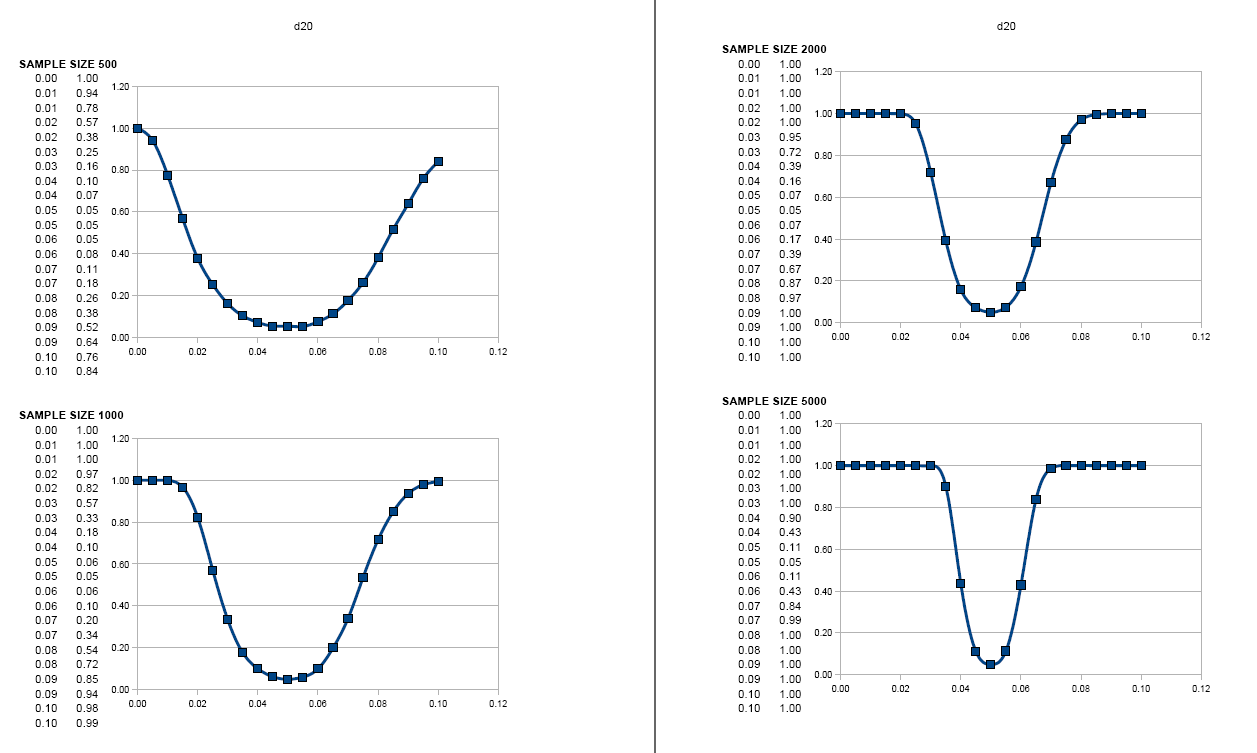
Here, I didn't even bother to show anything less than n=500, since the curves below that point are just dreadful (shown in the PDF again linked here). For example, at n=100 (previously the nominal minimum number of rolls), the chance of the test detecting the difference between a d19 and a d20 (i.e. one face missing) is only 16%! So in this case, although we have the same low false positive rate of α=5%, we have a sky-high false negative rate of β=84%. While a finding of "unbalanced" is one that we can count on, a finding of "not unbalanced" tells us almost nothing: it would usually do that anyway, even for a die entirely missing one or more faces.

This is honestly not something that I realized before doing the simulation experiment.

Take-away lesson is this, I think: The bare-minimum number of rolls given previously (5 times faces on the die) is pretty much useless for the test to be powerful enough to actually detect an unbalanced die. For a d6, I wouldn't want to use any less than n=100 as a minimum (and ideally something like n=500 if you're serious about it). For a d20, n=500 would be a useful minimum (and at least several thousand to find reasonably small variations). So realize that it takes a lot of rolling to have a chance of actually detecting unbalanced dice; look at the charts above and decide for yourself how small a bias you want to have a chance of identifying.


Postscript: Again, this is an analysis that is frequently overlooked, and if you got through this whole post, then you probably have a deeper understanding of the power of Pearson's chi-square test than even some professional statisticians (I dare say). For example, in the old Dragon magazine article on the subject (Dragon #78, Oct-1983), writer D.G. Weeks completely screwed up on this point. He wrote:
If your chi-square is less than the value in column one (labelled .10), the die is almost certainly fair (or close enough for any reasonable purpose).
Well, that's just totally false. At minimal sample sizes, the test is of such low power, that the die can be almost certainly unfair and still pass the criteria. Furthermore, Weeks presented the possibility of a test for a given suspected die-face frequency and included it in the attached BASIC computer program, in doing so vastly confusing the issue of what's the null and what's the alternative hypothesis. To wit:
In this case it might make more sense to test directly whether this observation is really accurate, rather than simply making the general test described earlier. If what you suspect is true, a specialized test will show the bias more readily...
What I would say is that this would actually prove the bias LESS readily, since your suspicion has now become the null hypothesis, and non-rejection of the null hypothesis tells us next to nothing about the die -- because that's what happens by default anyway, and the test is so very low-powered. In fact, Weeks is making precisely the mistake that we are being warned about by Professor Lowry in the quote at the very top of this blog post (read more at that link if you like: "it is a terrible idea to accept the null hypothesis upon failing to find a significant result in a one-dimensional chi-square test..."). Don't you make the same error!

2011-10-05

Book of War Core Rules Justification Part 2

I usually don't trust myself to do a computation just once. Customarily I try to construct: (1) a procedural computer simulation, and (2) a formal math calculation, and if the two results synch up together, then I can have some confidence in them.

So last time I presented the Java computer-simulation version of the Book of War Core Rules mechanic (the 3/4/5/6 target on d6 to score a hit on a 1:10 scale figure wearing no armor/leather/chain/plate). For me, that's always the more concrete demonstration, but the truth is that we don't really need it: we can also do a direct math calculation.

Let's just do one case as an example. Say you've got normal men attacking normal men in chain mail (no shield: AC 5). Per the OD&D hit chart, those men hit on a score of 14 or more on d20; i.e. (excluding the lower 13), 7 chances in 20, or probability 7/20 = 0.35. From prior work, we know that on average it takes 1.52 successful hits to kill a 1-HD man. (See the two proofs of that here and here). The one attack roll per BOW turn represents 3 D&D rounds, with 5 men along the front line attacking, but it takes 10 kills before a whole mass figure is eliminated. So the expected value (probability) of figure kills each turn is:

0.35 × 1/1.52 × 3 × 5 / 10 = 0.345

Note that all the factors after the initial probability basically cancel out; so, the probability of a hit in D&D is basically the same as the probability for a figure-hit at our chosen BOW scale! So nice. In any event, we can convert this probability to a d6 target value using our standard formula:

7-6*p = 7-6*(0.345) = 4.93 ≈ 5

And of course, that's the same "AH 5" value that we've been claiming all along for targets in chain mail armor. Moreover, we can do this for every possible AC value if we want to be really careful with it. Here's the result:

(Click above for a PDF version. Or click here for an Excel spreadsheet, if you want to tweak or check the calculations.) Okay, so it turns out that the totally correct conversion isn't exactly just a divide-by-3 operation, but it's really close. Leather & shield should technically be AH5 according to this, like basic chain mail. And we can also see what should happen for mega-hardened AC values at the bottom of the chart (clearly unhittable by normal men in OD&D).

This table actually appears in the Book of War Optional Rules section at the back, in case anyone wants to be totally precise with that. But for most purposes, I'm very happy with the 3/4/5/6 per armor-type Core Rule, being exceedingly simple and elegant. The other thing noted in the table is that while in OD&D, normal men can hit AC -1 on a perfect 20, this 1-in-20 chance is negligible in terms of d6 success rates; so, for example, I'm pretty happy with the language in the heroic-level section wherein I summarize this as, "characters with negative ACs are given AH 7" (or greater) [BOW, p. 13].


One final thing to keep in mind: We've now twice-confirmed that the expected values of BOW combat are the same as D&D combat played tens or hundreds of men at a time (i.e., on average, BOW combat produces the same results as D&D combat). But what could not be kept identical with the scale-switching was the variance of the results; that is, BOW combat should be more "swingy" than if you really played out mass combat at the D&D man-to-man scale. (My estimate is that standard deviation has been multiplied by a factor of √15 = 3.87 , since one BOW roll represents 15 D&D attacks; but maybe less than that because damage hit point rolls have been abstracted out of the equation?) Personally I don't mind that, since it says that we're giving the underdog a bit more chance to come out on top, say.

Nevertheless, in practice we've actually found that games at equal point-values (and no enormous mistakes by either player) tend to be almost supernaturally even; we've seen lots of games that come down to the last two opposing figures on the table, with a single hit determining the victor (even if the game swung back-and-forth before that, over the course of play). So our confidence that Book of War is a game balanced unto itself is also quite high. More on why that's the case a bit later.

2011-10-03

Book of War Core Rules Justification Part 1

So last week, I presented the Book of War Core Rules in an Open Game Content format, and discussed why the scales were determined as they were. I pointed out that we use a fundamental conversion rate of 1 BOW turn = 3 D&D rounds, and the basic combat mechanic is to roll a d6 for mass attacks (with success on 3/4/5/6 for no armor/leather/chain/plate, i.e., divide d20 target numbers by 3 and round down). So now you could ask two questions:

Why the 1 turn = 3 rounds equivalence? Am I just slavishly copying what Gygax set down in Swords & Spells (and Niles in Battlesystem)? Answer: No, I was ready to use something else if it created an elegant and statistically correct mechanic. But, it turns out that the 1:3 rate is particularly special.

And, granted that the 3/4/5/6 hit rule (divide targets by 3) is convenient and easy to remember, but is it an accurate portrayal of mass scale attacks (noting that hit points, 1:10 men, and 1:3 rounds have all been abstracted away)? Answer: Yes, as you can see below.

So, take a step back to the point before I'd settled on either the core hit mechanic or the 1:3 round equivalence. I wrote a short computer program that simulates a couple million random D&D-style combats and investigates the results. You can check out the Java code version for the program below (released under GPL v.2):


What this program does is create a separate table for each possible round ratio from 1 to 6. Each table is a matrix of different key ACs (in the none/leather/chain/plate categories) and possible target Hit Dice. For each combination we run 10,000 rounds of simulated combat each. (We assume that attackers are all normal men/1st level; hit dice and damage are 6-sided as in OD&D; and that 1:10 figures are meeting along a 5-man front face, such that 5 attacks are delivered each round. When one man dies, another steps up from behind him to take his place.)

We then take the total number of men killed, and turn that into an average number of figures killed per turn (i.e., mean or "expected value"; which is also a probability-per-turn if between 0 and 1). For multi-Hit-Dice types, multiply by the HD to pro-rate this to a chance of a "figure hit" per turn. Finally, convert that probability to a d6 target value, by computing (7-6*p) and rounding off. The output appears in the following text document:


Now, most of those numbers are kind of a garbled mess, except that one table in particular looks quite memorable, namely this one:

Core Mechanic @ 3 round(s) per turn:

HD
AC 1 2 3 4 5 6 7 8
--------------------
10 3 3 2 2 2 2 2 2
7 4 4 4 3 3 3 3 3
4 5 5 5 5 5 4 4 4
1 6 6 6 6 6 6 6 6

So this immediately attracted me, in that if we set the time scale at 1 turn = 3 rounds, then you get this super-easy to memorize core mechanic (reading down the first few columns): a figure of normal men need to roll a 3/4/5/6, on average, to score a "figure hit" against a 1- or 2-HD target, in each of the basic armor categories. And that's really why I chose it.

A few comments: Note that a single die roll here actually represents 15 normal D&D attacks (sword-thrusts or arrow-shots; 5 men in the front line × 3 rounds per turn). When I say a "figure hit", that's actually the elimination of 10 Hit Dice worth of damage (which is a whole 1:10 figure eliminated for 1st-level types, or half of a 2-HD group, etc.)

And the other thing that can be noted here is that technically, it gets marginally easier to score a hit against higher-HD types (by the 8-HD level, most of the target numbers have decremented by one). But we already knew this: Higher Hit Dice are actually devalued in terms of hits taken (from two years ago: proof one; proof two). Short explanation: Low-HD monsters "waste" more received damage as they quickly dip below zero hit points; while high-HD types will suffer full value from the same hits. Nevertheless, in this context I'm happy to gloss over the technicality for the sake of simplicity: we give high-HD types full value in terms of hits taken, thereby giving them an extra bit of a boost.


If you like (and have the programming capacity), then you can take this little simulation and modify it to check out the results if any of your assumptions about basic D&D combat differ from mine. (Or check my code to make sure I didn't make any mistakes.) Here's one modification that immediately springs to mind: What if you play D&D by post-Greyhawk (OD&D Supplement I) rules, wherein hit dice are 8-sided, and weapons like a sword, battleaxe, or polearm also do 8-sided damage? Let's see the modified results of that right now:

Core Mechanic @ 3 round(s) per turn:
[Modified for 8-sided hits and damage]

HD
AC 1 2 3 4 5 6 7 8
--------------------
10 4 3 2 2 2 2 2 2
7 4 4 4 3 3 3 3 3
4 5 5 5 5 5 5 4 4
1 6 6 6 6 6 6 6 6

Well, as you might guess, that's basically the exact same thing with one notable exception: 1-HD men in "no armor" would be hit on a 4 instead of a 3. (And I guess there's one other number that's different if you look closely enough, at the 6HD level.) So as long as your battles don't commonly feature lots of completely unarmored normal men joining the fight, then you can call this "close enough", and be confident that the Book of War system functions exactly the same, on average, as any other version of classic D&D.

2011-09-30

Brilliant Arneson Quote of the Day

In honor of Dave Arneson's birthday tomorrow, something that tickled me recently at Beyond the Black Gate:
To say that Dave was completely impartial with regards to the game was not to say that Dave was completely impartial with regards to players, often with hilarious results. Once, while the party was being attacked by some sort of flying machines over the swamps near the Temple, a player whinged a bit that, since he had been paralyzed, he had nothing to do while everyone else got to fight the machines, and how unfair that was. Dave regarded him quietly for a moment, then handed him a d6, and said "here, roll that every round." The player, confused, asked why. "That," Dave said, "is how much damage you take every round. That should keep you busy." I don't believe anyone else complained about anything for the rest of the session.
Holy smoke do I love that! Let me analyze it a bit: (a) It's a jolly good answer. (b) It's unapologetic that if you get paralyzed or put down, it will last a while and you will be out of the action. (c) It actually is something to do each round for the player, physically. (d) It sort of makes sense that some shrapnel might be flying around and you're utterly unable to avoid it. (e) It's the exact inverse of action points in that kind of situation. (f) It's a fairly small amount of damage that may not be lethal -- not like a "bolt from the blue" insta-destruction. (g) It's above-board and explicit -- not some later behind-the-scenes passive-aggressive move wherein the DM sics a monster on you specifically, and you're left wondering why that happened. Delicious!

Happy birthday, Mr. Arneson. (And more Book of War stuff next week.)

2011-09-28

Book of War Core Rules

Below is an OGL-ized version of the Book of War Core Rules (page 5 from the actual book). This page has had some product identity cleanup done, so that we can designate everything here as Open Game Content (whenever you see "the FRPG", read that as "the original fantasy role-playing game, as published by Gygax and Arneson in 1974"). Click for a PDF version:

Hopefully you see the fundamental idea -- We can basically convert any D&D d20-based target number to d6 by dividing by 3 and rounding down (20/3 ~ 6.67), and this allows us to roll lots of 1:10 figure attacks with big fistfuls of d6's (as in many other wargames). You can easily convert any D&D monsters to this system by using the exact same Movement and Hit Dice values, and a single conversion for the "Armor Hit" target value on d6 (that being eminently memorable). At this point, I've done it on the fly several times for large numbers of D&D random wilderness encounters, and it's worked very well.

Any other modifiers from D&D can likewise get converted in a divide-by-3 operation (noting that many minor adjustments will disappear from our abstraction entirely). In fact, if you use new-style "ascending Armor Class", then you can just go ahead and divide that by 3 for your AH, as well (for some time I was working on this game under 3E principles, and while that part worked, the rest of the 3E system was pretty much too complicated to deal with -- which was one reason among many that I switched back to OD&D, around the time this blog started).

More than one person has told me now that they've actually played some games of man-to-man D&D itself using this cut-down d6 system, with good results (although that wasn't the original intent).

Now, let's pose some questions about whether the scales chosen make sense. I suppose the first assumption is simply what kind of miniature figures we'll be using: and I definitely wanted to use the "standard" 25-28mm figures that you've already got for your D&D or Warhammer games, with base sizes as noted above (those being my best guess for what they're already on). With that as a given:


Why 10 men per figure?

Having thought about this quite a bit, I came to the exact same conclusion that Gygax did in the Introduction to Swords & Spells. I wound up re-discovering every point that he made there:
After considerable contemplation a 10:1 ratio was decided upon. If this seems somewhat small for a supposedly large-scale set of rules, the following factors must be remembered: First, most fantasy battles which involve numbers too large to handle at 1:1 are still on a relatively small scale -- hundreds and thousands rather than tens of thousands. More importantly, the exceptional creatures had to be allowed for, and this could not practically be done on a scale greater than 10:1. [S&S, p. 1]
Indeed. If mass figures are at 1:10 scale (10 HD per figure), then a 10+ level monster or character can appear as an equivalent-strength independent figure (plus, it's in the tradition of works like Swords & Spells and Battlesystem). If mass scale was 1:20 (as in Chainmail), then that would effectively rule out any hero figures of less than 20th level -- notably, all the monsters in Original D&D.


Why 20 feet per inch?

This took considerably more thought. Here are 3 separate pieces of evidence why this is the correct scale:

(1) We can do a direct math calculation. If Chainmail is correct that 1:20 mass action works at 1"=30 feet (and I think it does, from a realism perspective), then by halving the men per figure, the overall area covered should also be halved. Say the original area is given on the order of A=s2 (s is the old scale in feet, i.e., 30), that is, s=√A. Then our new scale should be s'=√(A/2). Compute: s'=√(A/2)=√A/√2 = s/√2 ~ 30/1.4 = 21 feet. Round that off to 20 feet for convenience.

(2) We can reason from the size of individual men in the figure. Assume that the 10 men in each figure are arrayed in 2 ranks of 5 men each (that's an important assumption!), and that they take up 3 feet each, shoulder-to-shoulder in formation (historical double-check; 168/56=3). Then compute our resulting scale from that and the figure base size: 3 feet/man × 5 men wide/figure × 1 figure/(0.75 inch) = 20 feet/inch.

(3) Consider scale ships & castles. (This was an important consideration for my games -- in fact, the original motivation was largely to be able to operate a D&D naval campaign in a reasonable way.) If you make historical ships & castles at a scale of 1"=30 feet, then they're actually too small for the figures we've chosen to stand on top of them. But if you use 1"=20 feet, i.e., larger scale models, then our figures fit beautifully on top of realistic boats, tower-tops, gatehouses, etc. I've tried both, and you really need the latter scale.

Quick example on that last point: To the right you'll see a photo of the main gate and flanking towers of the Keep on the Borderlands, which I modeled at the indicated 1"=20 feet. Note that one figure of crossbowmen nicely fit atop each tower (per the text, there's a total of 8 such men with crossbows in each tower). If the scale were instead 1"=30 feet, then those towers would be smaller by a factor of 2/3, and the figures would no longer fit there.

So -- It looks like 20 feet per inch has a preponderance of evidence in its favor.


Why 30 seconds per turn?

Again, we can reason from Chainmail; if 1:20 action takes place at 1 minute intervals (again, pretty reasonable), then 1:10 action should have turns of about half that length, or 30 seconds. More-or-less.

Or, more importantly: It turns out that the "golden" number of rounds-per-turn for our game is 3; that is, we say that 3 rounds of D&D action is equal to one turn in Book of War. If we use a source like Holmes that says 1 round=10 seconds (the most reasonable that I've seen), then clearly 1 turn=30 seconds here.

One of the really nice things about this is that it's coincidentally (?) about the same as our increase in distance scale, above. If you play D&D at 1"=5 feet (and I do), then our BOW scale is 4 times that (1"=20 feet). And you can see here that our time scale is itself 3 times that of D&D. So I call these numbers "approximately equal", and since we've increased both time & distance by about the same factor, our Movement rates in inches stay the same. If a horse runs 24"/round in D&D, then it runs 24"/turn in Book of War. That simplifies things enormously.

Now, let's say you disagree with my interpretations of D&D scale (like 1 round = 10 sec, per Holmes), and you want to stick with the legacy of 1 round = 1 minute for man-to-man scale. Well, that's not a problem; the far more important issue is that 1 BOW turn = 3 rounds of D&D. So for you, 1 BOW turn is 3 minutes. Everything else stays the same.


Next time: Why the statistics magically work at the conversion rate of 1 BOW turn = 3 D&D rounds.

2011-09-26

Book of War Released!

Today I'm releasing my mass-combat miniatures rules, compatible with original D&D and similar systems, for public consumption. Hopefully you'll find it to be fast, simple, fun, and compatible with what you'd expect from a D&D-based wargame. You can get it right now on Lulu. In celebration, I've also started a new website called OED Games.

I've been working on a system like this for over 10+ years or something like that. (Maybe more, if you count all the way back to the 80's and me being frustrated with how existing systems played out.) The primary goal has been to create something that's statistically consistent with what would happen if D&D were played out with hundreds of men per side, while still making it elegant to play, and keeping an eye to history whenever possible. That said, I wanted it to be immediately accessible to brand-new players, without any wargaming or D&D experience required, and from what I've seen, it seems to fit the bill. And, I've tried to keep it as short and concise as humanly possible -- 24 pages (about 2 pages per year; cost to you: $1/year softcover).

Nothing in this world is perfect. But as I've ramped up the refinements and playtests in the last year or so, I've noticed that the edits at each step have been constantly shrinking in size. (In this form of the book I've gone through "zero" versions from letter A to M.) I was proofreading yet another version on the bus a few weeks ago, got to the end, and realized that there wasn't anything else I could detect that needed changing. As my best-girl Isabelle texted back to me that day: "Good! Now set it free! Release the Kraken!!"

I can imagine someone seeing the core of the rules (which I'll present here on Wednesday), and thinking that they're so incredibly simple, they could have come up with the same thing in a few short minutes; and that may be the case (part of a response might be: 80% of the effort has gone into cost-balancing the different units). But, I plan to keep discussing the game and presenting design notes, justifications, and expansions here on the blog in the coming months. My greatest wish is that together we can find some ways to make improvements and that there'll be a "Version 2" at some point in the future.

If you get Book of War, I truly hope that you enjoy playing it. And in any event, I always appreciate your reading and commenting here (and elsewhere!), as that's the fuel that got me to finally finish this project. Appreciatively,

- Daniel R. "Delta" Collins

2011-09-23

On Burning Oil

Wrapping up another flame-filled week at the Hotspot: I'll come out and say that the use of burning oil bugs me in D&D. Let's see if I can explain why.

First of all, if you look at classic D&D, the player's materials (OD&D Vol-1, or AD&D PHB, etc.) contain descriptions of offensive resources like weapons and their damage, class abilities, attack spells, etc. Then burning oil gets described in the referee's book (Vol-3, or DMG), and it's like this "secret" resource that only expert players know to call out for. It's not something out in the open for regular players to opt for. And worse, if oil turns out to be a better weapon than some other element, then it will pretty quickly replace that other element in your milieu (maybe daggers, or slings, or hold portal spells, etc.), even if you didn't foresee your gaming being about oil-slinging adventurers, or whatever.

I mean, I've had acquaintances who were D&D players in other games proudly announce, "We got giant barrels of oil and just flooded the whole dungeon and lit it on fire from the outside, and got all the XP!" I mean: That game sounds like it royally sucks, man. And it's certainly not what the D&D game "says on the tin", so-to-speak.

Secondly, but a related point: Since oil is obviously such a secondary-thought bolt-on to the system, there's not much consistency to its effect. In OD&D the effect is actually nothing except for possibly scaring off pursuing monsters: "Burning oil will deter many monsters from continuing pursuit." [Vol-3, p. 12] -- in addition to the other options of food (for dumb monsters) and treasure (for intelligent ones). Although, in its brevity I guess that allowed lots of people to interpret their own damage statistics for oil, frequently numbers that rivaled fireballs or any other mundane weapon. In AD&D, this was officially set at 2d6+1d6 (over two rounds) for a direct hit from a flask of oil. Well hot damn, that's more than any other weapon in the system, see what I mean? (Exception: tied with a heavy lance or 2-handed sword vs. large opponent.) And that's just for one flask, when your players start asking for whole barrels of the stuff, and arguing that it does 20d6 or something per barrel, and whole exploding fire-ships in your naval game, what do you do then?

Thirdly, I don't even think that it makes real-world sense that you can use a flask of oil meant for burning in a lamp, and get it to explode like Greek fire in this way. I'm no chemist, but it sounds like someone's conflating different kinds of oil in a way that's not justified. Check out the Wikipedia page on Oil:
Types

Organic Oils

Organic oils are produced in remarkable diversity by plants, animals, and other organisms through natural metabolic processes. Lipid is the scientific term for the fatty acids, steroids and similar chemicals often found in the oils produced by living things, while oil refers to an overall mixture of chemicals. Organic oils may also contain chemicals other than lipids, including proteins, waxes and alkaloids...

Mineral oils

Crude oil, or petroleum, and its refined components, collectively termed petrochemicals, are crucial resources in the modern economy. Crude oil originates from ancient fossilized organic materials, such as zooplankton and algae, which geochemical processes convert into oil.[6] It is classified as a mineral oil because it does not have an organic origin on human timescales, but is instead obtained from rocks, underground traps, or sands; however, mineral oil by itself refers to a specific distillate of crude oil.

So it appears to me like you've got two very different kinds of substances that both happen to called "oil" due to a linguistic quirk. Which did medieval-style lamps run on? The former. ("The main fuel in Western nations was olive oil in ancient Mediterranean cultures, though extracts from fish, crude fish oil, nuts, and cheese were also used." Link.) Which does a weapon like a Molotov cocktail use? The latter. ("A Molotov cocktail is a breakable bottle containing a flammable substance such as gasoline or a napalm-like mixture and usually a source of ignition such as a burning cloth wick held in place by the bottle's stopper." Link.) Then I've also had friends start talking to me about the need to aerosol-ize the oil for weaponization, although I'm afraid that's not a claim that's within my personal area of knowledge. But clearly there's a reason why Greek fire was so special in the ancient world. ("Most modern scholars agree that the actual Greek fire was based on petroleum, either crude or refined; comparable to modern napalm..." Link.)

Therefore, I think that the next time someone asks for burning oil in one of my D&D games, my response will be: "This oil is actually olive oil for use in lamps, and it cannot burn in the open as a weapon." -- you know, quite a bit like the Gygaxian response to someone choosing to dig up some saltpeter and construct gunpowder in a D&D campaign (except perhaps better justified). Not that following real-world physics is a necessity, but more importantly because the gameplay I want is not about oil-slinging dungeoneers to the exclusion of their other weapons and spells; and as usual: real-life research solves a lot of game design problems.

Have I got the chemistry issue right? Would medieval lamp oil burn in the open like a weapon (or worse, explode)? And what's your take on the gameplay considerations?

(Photo by visionshare under CC2.)