Showing posts with label marvel. Show all posts

2021-11-08

Mohs Scale to Marvel

Mohs scale hardness testing kit

Regular readers of this blog may know how much I adore finding some real-world measurement scale that can be easily used as the core of a game system mechanic. If available, this ticks off all my desired boxes for gaming: (1) an elegant mechanic, (2) a presumably rigorous mechanic, (3) an opportunity to learn something about the real world, and (4) provide a pre-made way to convert from real-world data to the game. 

Of course, if we look back to the origin of the wargame form, the entire intent was to use real-world data as a source for mechanics and training for the battlefield (say, at least as far back as Korns' Modern War in Miniature, if not original Kriegsspiel). So, this instinct is really a callback to our source inspiration. 

Here's the thing I just discovered: the Mohs scale of mineral hardness. This dates to 1822 when German geologist Fredrich Mohs established the system to measure relative hardness -- a mineral of higher-rank is able to visibly scratch the surface of a lower-rank material. (Per Wikipedia: "The method of comparing hardness by observing which minerals can scratch others is of great antiquity, having been mentioned by Theophrastus in his treatise On Stones, c. 300 BC, followed by Pliny the Elder in his Naturalis Historia, c.  AD 77.")

It's an incredibly simple system: integer values only, from 1 to 10 -- with talc at the lowest level, and diamond at the highest. Note the picture at the top of a standard field-testing kit, with the 10 different canonical materials neatly boxed and numbered. 

Also I realized, if you're a fan of the the original Marvel Super Heroes RPG, this neatly lines up with the 10 named ranks in the Universal Table. To wit:

Mohs Scale to Marvel Table
As usual, the neat thing is that having established this, there are now extensive tables of other materials with hardnesses measured in possibly fractional Mohs units; so for these other materials we have the option of just looking them up and converting to the nearest rank value. Example from Wikipedia below (click to go to full-sized table).

Intermediate Hardness Table

A number of these substance appear in the MSH rulebooks Material Strength table (like ice, gold, glass, iron steel, and diamond), and in most cases they do in fact appear at the same or within one rank. So kudos to Jeff Grubb for a pretty accurate system on that score; and that gives us confidence that we can interpolate these things reasonably in-game.

It's science, true believers!

2020-10-12

Marvel FASERIP: Thor's Power Stunts

Last time we took a look at the Advanced Marvel FASERIP (1986) rules with its novel "Power Stunts" rule. In brief: a character can expand their super-powers in creative ways by spending Karma and making a FEAT roll; and this roll gets easier the more times they try it. In particular, the rule calls out the fact that published examples of Power Stunts in Marvel comics count for canon characters -- and therefore, the more knowledge a player has in the lore of their favorite character, the more functionally powerful that character is at the table. From the book:

If you are playing an established Marvel Super Hero, the question of whether he has done this stunt before or not is determined from the Marvel Comics themselves. Each time you can spot him using this particular stunt, that counts as one time.

In the last post I wrote, "Surely only an insane player could be expected to actually go track down every researched use of super-powers that a long-running character has ever made." On that note, here's a complete accounting of power uses for my favorite Marvel character, Thor, from the first decade of his comic's publication -- which is to say, issues #83-195 (1962-1972), that is, all of the classic Lee/Kirby era, into the switch of John Buscema as artist, as collected in Marvel Essentials Thor Vol. 1-4. (ODS version here.)

Commentary:

  • Color-coding above follows the rule for FEAT level from the book: stunts tried 1-3 times require a Yellow FEAT, those tried 4-10 times take Green FEAT, and those tried more than that require no FEAT at all (in this list: only making wind & rain, and the lifting vortex-tornado attack form). 
  • Recall that the book rule uniquely calls out weather control powers as being intimately tied to the Power Stunt rule (perhaps the author was trying to rein in the powers of Thor specifically?), so if it ever matters for any character to make this survey, it seems most important in this case. 
  • There were a very small number of cases where Thor used the same "stunt" twice in a single issue of the comic. For simplicity, I only ever documented one case of a stunt per issue. 
  • The majority of this run has Stan Lee listed as writer, and Jack Kirby as artist, with occasional fill-ins by other artists. Notably, early issues #90-96 mostly have art by Joe Sinnot. Kirby's last issue is #179 (out-of-order with issue #178; delay or dispute in production?), #180-181 by Neal Adams, and then John Buscema from #182 on. Similarly, with issue #193 Lee's credit switches from Writer (et. al.) to Editor (or the like), with Gerry Conway as writer. Note that the tone and pacing changes considerably when Kirby leaves, even with Lee credited as writer throughout, giving evidence that the artist was greatly involved in plotting in the Marvel Method.
  • On that shift in tone, Thor's most prominent powers shift a bit. For example, up until issue #180, the "Lifting vortex-tornado" power is actually the most frequent ability seen, beating out even the "Make wind and rain" power. After Buscema becomes artist, that latter power gets used much more frequently, and it then takes the lead.
  • Likewise, there’s a change in the aspect of energy-blasts directed from the hammer. In issues #104, 114, and 156 it’s clearly a lightning-blast (so described and shown as jagged stroke). Then in #164-165 it becomes a single straight-line force blast, even though Thor in #165 describes this as “The fury of the thunder... the carnage of the storm... !!” From that point on, the attack always looks like a straightforward force-blast, and it gets used quite a bit more frequently thereafter (again, into the Buscema transition). I actually considered distinguishing these powers, but the verbal description in #165 convinced me to count them together.
  • Some of the powers which the FASERIP rules indicate as core powers of Thor are actually not used very much in this run. For example: In most of the run, the power of Dimensional Travel is limited to Thor transporting himself from Earth to the Rainbow Bridge, with Odin being the one who sends him back to Earth when necessary. Shooting the lightning-blast from the hammer only happens 3 times in the first 70 issues (becoming more common later, although the form changes, as noted above). Calling lightning from the skies only happens 3 times in the decade. Spinning the hammer in front of him as a shield likewise only happens 3 times -- far more common is for Thor to simply hold the invulnerable hammer fixed in front of him to ward off shooting attacks ("Parry projectiles", with 9 occurrences). 
  • A common trope is for Thor to battle a villain to a standstill throughout an issue, and then in the last few panels of the issue (on the last page) whip out some never-before-seen power that ends the battle. A deus ex malleo, if you will. The long list of powers used one single time, in the tail of the table above, is mostly evidence of this. (Was that also common for other Marvel comics at the time, or were they particularly prone to the "power stuntiness" of the divine magic hammer?)
  • Another thing that should be noted, and is not handled in the FASERIP rules, is the several instances of powers being canonically removed in the comics. For example, in Thor #282 (1979), Thor sacrifices the time-travel power of the hammer at the behest of Immortus, in order to save the world of Phantus. Later in Thor #340 (1984) the power/curse to transform into a mortal man is removed by Odin and transferred to Beta Ray Bill. (I think it's been returned and removed a few more times since then.) So this presents another pitfall in the FASERIP rule: a player could quote evidence of some particular power, and use that to their advantage at the table, while simply omitting the fact that it was known to have been removed at a later date. 
  • Again, the list above covers the 1962-1972 issues of Thor (originally Journey Into Mystery). A few other options for timeframe come to mind. Perhaps one could cut off the list around issue #180 for a purely classic Lee/Kirby presentation of the character. Or one could expand up to 1986 to when Jeff Grubb was writing those rules (about an additional decade-and-a-half), that is, close to the end of Walter Simonson's seminal run on the comic. Or one could try for an encyclopedic iteration up to the current day (another 35 years), and commit to adding more in the future. Also, one could look to crossover comics like the Avengers and add any other interesting power stunts that appear there. But that would certainly be beyond this writer's resources at this point!

Anything in the list here that was particularly surprising? Any critical things I missed? Don't try this at home.

Scheduling note: Don't forget that next Sunday on the Wandering DMs YouTube channel, we've scheduled Marvel Super Heroes FASERIP creator Jeff Grubb to be our live interview guest. That's Oct-18, 1 PM ET. Hopefully I'll sneak in a question about how comprehensively he expected players to be poring over their old comic books for their favorite characters' Power Stunts. Hope you'll join us as well and get your FASERIP questions in the live chat when he joins us!


2020-10-05

Marvel FASERIP: Power Stunts

The Marvel Super Heroes Advanced Game (i.e., the 2nd edition of the FASERIP rules in 1986), by Jeff Grubb, has a novel rule called "Power Stunts". Basically, it gives a formal way to extend a character's super-powers by paying a fairly hefty amount of Karma (quasi-experience awards) for a chance to do some previously undefined ability. Here's what it says on its first appearance in the Advanced Players' Book (p. 16-17):

There are some cases when a hero may use a Power in a way it was not originally intended to carry out a certain task. These are known as Power Stunts.

For example, a character with the Speed Power suddenly decides to run in a circle very fast, creating a whirlwind. Or a character with Leaping Power decides to use his powerful leg muscles to disrupt the ground, knocking over an opponent. Or our example above, the wall-crawler decides to use his stick-to-it-ness to grapple a thief. These are Power Stunts. Certain Powers, such as weather elemental controls, almost entirely consist of these stunts.

The players will, without a doubt, come up with an innumerable amount of stunts for their Powers (and the Judge will be told how to decide if a Power Stunt is possible in his Judge’s Book). The basic question to be asked is: Has this hero done this sort of thing before?

If you are playing an established Marvel Super Hero, the question of whether he has done this stunt before or not is determined from the Marvel Comics themselves. Each time you can spot him using this particular stunt, that counts as one time. Example: In one issue of X-Men, Nightcrawler uses his power to make three quick teleports, behind three separate opponents. He does it again several issues later. This means he has pulled this Power Stunt twice.

If you are playing a hero of your own creation, or a hero that you have never seen perform this stunt, this means you have never performed it before. In either case, the Judge may say "no" to a stunt, it he feels it unbalances the character. The type of FEAT (made against the Power rank) needed to make a Power Stunt is determined by the number of times your character has tried it.

Never tried it — red FEAT roll
Tried it up to three times — yellow FEAT roll
Tried it more than three times — green FEAT roll

In addition, a character making a Power Stunt must lay out 100 Karma points to make the roll (in addition to any other Karma he may spend -- see Karma). Spending the Karma does not guarantee success; it only ensures that yes, the character can try the stunt. If the stunt is ruled impossible by the Judge, no Karma is spent.

If a player character has tried a stunt more then ten times, it is considered to be part of his or her bag of tricks for that Power, and a FEAT roll is not necessary to say if it is possible (this is similar to purchasing another Power in full, but allowing the player to use the Power as he is paying for it).
 

Now, some people love this rule to death, and consider it to be a way to unleash creativity in the use of one's super-powers in one's Marvel game. Admittedly it's pretty common in classic Marvel comics for a hero to pull out a surprising deus ex machina with a previously-unseen power in a tense fight (more on that below). And maybe for custom characters this is an okay way to advance the character. However, I'm a lot more ambivalent about this rule in terms of the established Marvel comic book characters -- which is the way that I've most often see the game being played, then and now.

First, it's extremely interesting that Grubb calls out one specific power in the game as being most intimately tied to this rule -- weather control, which will of course will affect my favorite character of Thor quite a lot (e.g., see our recent live plays on the Wandering DMs channel of MH-6 Thunder Over Jotunheim):

Certain Powers, such as weather elemental controls, almost entirely consist of these stunts.

Secondly, and far more critically, is the call to player recall of the published appearances of the classic Marvel Super Heroes character that you're playing. The more well-read you are in that character, the more functionally powerful he or she becomes at the table. In some cases, this could incite certain players to research the whole back-catalog of that character to gain as much advantage at the table as possible. And presumably the powers in question expand more as time of publication history moves forward in time. And also: How does the Referee confirm a certain fanboy's claims that their favorite character has done power stunt X 10+ times is actually accurate?

If you are playing an established Marvel Super Hero, the question of whether he has done this stunt before or not is determined from the Marvel Comics themselves. Each time you can spot him using this particular stunt, that counts as one time.

Surely only an insane player could be expected to actually go track down every researched use of super-powers that a long-running character has ever made. So perhaps this bifurcated rule was reasonable for custom characters, but I'd argue that it's highly problematic for pre-established Marvel characters (even though that use-case is the first one presented in the rules text above). 

I think that many old-school referees would be happy to adjudicate novel or creative uses of super-powers on an ad-hoc basis for reasonability, without the bookkeeping overhead of tracking how often a particular stunt has been used or appeared in publication. I know for myself I'd be a lot happier with a general of Karma payment + FEAT roll with difficulty based on judge's assessment of overall reasonability, without that documentary clause in the rule. 

Did you love or loathe the Advanced FASERIP Power Stunts rule? Did you actually apply, count, and document the number of times each power stunt was used?

Scheduling note: Over on the Wandering DMs YouTube channel, we're planning on having Marvel Super Heroes FASERIP creator Jeff Grubb as our guest in two weeks, on Sunday Oct-18 -- so I'm making a note to ask him how he feels about the Power Stunt rule these days. Hope you'll join us and get your burning questions in the live chat when he joins us!


2020-07-20

Marvel FASERIP House Rules

The last few weeks on Wandering DMs, we've been playing sessions of the classic Marvel Super Heroes FASERIP system, with me introducing Paul to the system for the first time. In case anyone's interested in the house rules I use for that system, you can see those linked here. Primarily I stick with the original set rules because (I guess as usual?) they seem generally more coherent and a better synthesis than the Advanced and Revised elaborations that came later; in some small number of cases I pull out rules from the Advanced set and do use those, as noted. Comments welcome!


2019-07-15

Marvel Money

For a couple reasons, we've been playing a few games of TSR's Marvel Super Heroes (FASERIP) recently. It's an enjoyable system but a bit wonky if you scratch the surface on it -- the numerical values for ranks and FEATs (for a variety of real-world assessments) advance in unpredictable jumps and increments. If it had been me, I would have wanted to establish some kind of consistent math at the outset, and then be able to easily slot in outside assessments to the system. On the other hand, I think the DC Heroes game did exactly that, and I don't see as much legacy of love for that system as FASERIP, so what do I know.

But the most obviously broken part of the system was the Resources (money): it was wildly, insanely broken on a rarefied level for gaming systems in my experience -- on par with man-to-man missile fire in classic D&D. Resources was the sub-system that was entirely torn out and replaced with something brand-new in the switch from MSH Basic to Advanced rules. Here it is in the Basic game (Campaign Book, p. 8):


So: An individual of a given rank gets the indicated "resource points" to spend weekly as they see fit, and all items in the game are price in terms of these resource points. Further up the same page there are some sample costs: a knife costs 1r, a plane ticket 10r, an acre of empty land 100r.

Campaign book p. 9 says, "One resource point equals anywhere from 50 to 75 dollars". Let's take $60 as a rounded average. Then we see that the "Typical" salaried employee is making about $360/week, or $18,000/year -- in the same ballpark as the 1984 U.S. median income of $22,415. But on the upper end, a large nation like the U.S. at "Monstrous" rank is indicated as only getting 75r = $4,500/week, or $225,000/year. E.g.: The U.S. government can only pay the salaries for a staff of 12 federal workers total, and absolutely nothing else. In reality, the 1984 U.S. revenue collected was approximately $666 billion, so this figure is over 6 orders of magnitude in error. Lesson: Income advancement isn't linear, it's exponential. 'Nuff said about that.

In the Advanced game released two years later (all editions are by Jeff Grubb), you get the following alteration (Judges' Book, p. 6):


Note that the whole idea of "resource points" is simply gone. Instead the system now uses the standard MSH mechanic of rolling on its Universal Table for success, comparing one's Resource rank versus a Cost rank of similar description. (If the cost is lower, then it's a very easy "green" roll; if equal, a difficult "yellow" roll; if more, then a nigh-impossible "red" roll.) One roll is allowed per game-week. The justification for this is as follows (Player's Book, p. 18):

Resources are modified in the Advanced Set to cut down on the paperwork. As things stood previously in the Original Set, characters gained Resources like money. They had a physical amount of Resource points, and everything cost a certain amount of RPs. This may work for Peter Parker, who has to make the rent every month, but for millionaire Tony Stark who can buy roadsters out of petty cash, this is a bit harder to handle.

While the stated reason is to reduce record-keeping, I'd say the true benefit of this switch is to possibly correct -- or at least obscure -- the prior set's obvious lunacy on the issue. Costs for all items in the game (mostly weapons, vehicles, and headquarters furnishings) are in descriptive ranks, so it's possible that the underlying dollar costs are in a geometric progression. Or not.

In the past I spent a lot of time trying to rationalize this system (I won't recreate all of that here). But it's still going to be very awkward when one puts normal-people and the U.S. federal government on the same list. If we note on the table above that Typical people ($30,000/year) and U.S. Unearthly revenues ($666 billion/year) are 7 ranks apart, then the simplest geometric model would be to have each rank represent a multiplier of the 7th-root of (666 billion/30 thousand) = 7th root of (22 million) = about 11. Let's say it's times-10 per step to make it as simple as possible.

Now, among the problems here is the attempt at equating personal revenues to large companies and countries. Looking at relative values today, the largest company is indeed about one order of magnitude below U.S. revenues. But the wealthiest person should be two orders of magnitude below. A "standard" millionaire should only be one step above a Typical middle-class person (not 4 steps higher, as shown above).

Then if we look at the many copious price charts, a lot of the prices seem to be out-of-sorts with this suggested times-10 model. A simple Axe is Good cost: say the weekly income of a Good-resourced person, so $300,000/50 = $6,000.  A standard Sedan is Remarkable cost, suggesting the weekly revenue of a "large business", i.e., $30 million/50 = $600,000. A large Office Building (30+ floors) is weirdly set at a cost of Shift-Z, that is, 3 steps beyond what any Earthly entity can actually afford (around $6 trillion?). Maybe it's unfair for me to pick on cases like these; I'll stop for now. But you can sort of imagine trying to massage this system and just never getting rid of the many short corners.

Now, one thing I noticed recently is that the 1991 Revised rules, which mostly just edits and repackages the prior Advanced Rules under a different name, has yet another go at this. It gives a fairly brief table of about 50 example Resource ranks (Revised Basic Book p. 41), including salaries and costs of many common comic-book items, and it has the distinct advantage of leaving out the attempt at including national governments. I took that table and did some research to fill in current real-world estimated dollar values, and then a regression on the logarithms of those values, expecting broadly for the standard MSH Resource lunacy appear. But what I found was actually not the most crazy thing I've ever seen:


You can draw a simple straight regression line through that data, including the origin (0, 0), and have it be a 97% correlated match. The indicated model of f(x) = 0.80x means that the cost-multiplier for x ranks should be about 10^(0.8x); since 10^0.8 ~ 6.3, we could say roughly that each rank here represents about ×6 value over the preceding one (perhaps not what I'd have picked tabula rasa, but a more gentle advancement than the previously considered ×10 one). If we pick the 0-rank to be $1 cost, then the ranks represent costs with perhaps lower-bounds of $6, $40, $250, $1500, $10,000, etc. for Feeble, Poor, Typical, Good, Excellent, and so forth (and annual salaries of about 50 times those numbers). The other costs in this version of the rules are -- surprisingly -- kind of consistent with that model. I could find a half-dozen items in the given list off from the real-world estimated value by 2 ranks, but nothing any more than that.

Disclosure: I did put my thumb on the scale here a tiny bit by re-interpreting a few of the items on the list from my first estimates. For example: Low-rank hotel costs I interpreted as per-night, whereas higher-ranked apartments I took as monthly rentals (none are defined one way or another in the published list). For "Private Plane" I used the cost of a multi-engine Piper instead of, say, a corporate jet. I used entry-level "Old Masters" artwork at around $10 million, instead of the world-record $450 million for a da Vinci painting in 2017 (and likewise for examples of "Archaic Texts").

At the top end of this scale, the Mega-corporation does get promoted 2 ranks from Unearthly to Shift-Y (judging from the example of Saudi Aramco's $356B/year revenue; identified as the one real-world example in the Wikipedia Megacorporation article). If we were to include the U.S. federal government, then that would come in at the Shift Z level (based on revenues of $3.5T/year).

In summary: This is now a system that I think I could use for Marvel RPG purchasing power, and be able to estimate and convert real-world prices into in-game mechanics pretty easily, and not think I'm going to stumble over things that are obviously insane and broken on a regular basis. I did massage a small number of the given ranks in those rules and printed a copy for my MSH house rules. Data and analysis in the spreadsheet below if you want to see it. Excelsior!


2016-04-23

Super Saturday: Alternate Universal Tables

One thing that's always bothered me is how the Marvel Super Heroes Role-Playing Game (FASERIP) has significantly more detail in the space of ability scores from 10-50 than outside that range, creating a "flat spot" there if you make a graph of it. I've suggested a few fixes for that in the past. In addition, I'm always on the lookout for some way to easily convert Marvel Wiki Power Grids to the FASERIP system. But: Any such fix to the FASERIP ability scores would require a new Universal Table, of course.

Here's one option, one that I would be likely to use these days, based on a very simple 1-2-5 series progression (a "Basic" table, if you will). This actually gives exactly 7 ranks from Feeble to Unearthly, the same granularity as Marvel Wiki Power Grids, so in theory you could convert them directly to the fixed ranks as given. (With one caveat: on the Marvel Wiki, "2" indicates "Typical", so we might have to offset it by one place.)


Alternatively, if you want more granularity (an "Advanced" table), you could use the Renard R5-series (ISO 3), which is actually a better match for the "flat spot" from Good to Amazing, although it also introduces new ranks above and below for consistency -- like Anemic (3) on the low end, and Shift H ("Shift Eta", 600) on the high end. In this case if you were looking at the Marvel Wiki Power Grids, a score of 1 would be Feeble/Anemic, 2 would be Poor/Typical, 3 Good/Excellent, and 4-7 would respectively be Remarkable, Incredible, Amazing, and Unearthly (as an initial approximation).


Which looks better to you?

2015-05-30

Super Saturday: Universal Realignments

Okay, so I don't follow the superhero comics as closely as I once did. But I think I grok the following: this summer, both DC and Marvel are running near-identical universal-time-crisis-continuity-conflict-shakeup events; for DC called "Convergence", and for Marvel "Secret Wars". At the end, you'll have new alignments of each of those universes. For DC this is about the 5th time they've done that in the last few decades; whereas for Marvel, it's the first time in their history that they've retconned their entire continuity.

Why? Well, regardless of the reasons for spawning such events in the past, the reason in the case seems clear (esp. in the Marvel case): movies. Quite recently the movie-production for these characters seems to have became the tail that wagged the dog, upending the business, with the comics becoming merely a piece of add-on merchandising instead the principal art form. Marvel was bought by Disney, DC just moved its offices to Hollywood last month, etc. And since these continuities have become disjoint (movies vs. comics), you can sort of see why you'd want those properties aligned in terms of who the characters are, so customers don't get confused and frustrated.

But here's my point of criticism: Trying to align the movies and comics is untenable; a fool's errand. How come? The main problem is movies getting primary status but relatively infrequent releases , versus comics trying to be follow-ons but with a much faster monthly production cycle. Comics will always by their nature be veering off from the movie continuity, simply by their need to tell a greater number of stories; and when the movie producers/directors come through at a later time, and touch on those same characters (without heed for what happened in comics), they will then again be out-of-synch.

Example: Let's say any Marvel comics writers want to bring in the super-villain Titania for a story arc. To my knowledge she hasn't appeared in any property outside the Marvel-616 comic books; and she has a slightly complicated backstory in being created by Doctor Doom as part of the 1980's Secret Wars storyline. The writers (and I) would broadly guess that movie producers would not expect to use her any time soon. But if the movie producers do use her... then almost surely they'll re-write, re-costume, re-backstory the character in some totally unpredictable fashion, that serves the purpose of one particular feature film. Repeat that for every character that ever appears in future movies.

In summary: The comics are doomed to become mis-aligned with movies, simply by the need to tell more stories each month, to be using a greater number of characters and situations each month, and if the movie productions ignore that, then they will always be out-of-synch. 

Now, DC just had its last universal shake-up 4 years ago (Flashpoint, 2011). The Marvel cartoon which I liked the most, "Avengers: Earth's Mightiest Heroes" was ended and re-booted to be closer to the movies after only a 2-year run. Obviously this pressure has caused the Marvel-616 continuity to be broken for the first time in history this year.

So my prediction is that these shake-ups will be more routine and more frequent in future years. Personally, I don't think it's a great idea because it fractures the fanbase (much like radically-different editions of a game like D&D). Will we ever have a consistent, strong continuity in superhero comics again? Possibly not; if the characters all become archetypal, and merely a million different faceted story-perspectives on the "idea" of each character, then the age of the compelling continuity and crossovers may have come to a close in the comics format.

2014-02-23

Super Sunday – How to Keep a Comic Character Dead, For Real

A comic character dying, and then coming back from the dead, is so universally common that it almost doesn't bear mentioning anymore.  The TVtropes website has this to say about the trope "Back from the Dead":
This is exceedingly common in American superhero comic books, to the point that whenever a popular character dies, it's a given that they'll be back on within no more than five years. At one time, it was said that "Nobody ever stays dead in comics, except Bucky, Uncle Ben, and Jason Todd." Naturally, since that phrase was coined, Bucky and Jason Todd have since been recalled to life.

The Marvel Wiki site has 115 characters currently tagged in the category of "People who used to be dead but aren't anymore".

Why is this? My personal interpretation is that the main problem is that comics companies are really nothing but intellectual property (copyrights and trademarked character designs and such), and to the extent that corporate directors are required to work "with a view to the best interests of the corporation", then the executives of those companies are in some sense required to milk every character property for every cent it can produce. If company X owns the rights to deceased character Y, and there are any customers who would purchase a book if character Y were brought back in it, then it can be argued that the company directors are legally required to bring back that character and produce that book. (That's a bit of a legal stretch, but it highlights the real principle: if Y can make money, then Y comes back from the dead.)

So of all the dastardly acts of vengeance, and cunning deathtraps, and cosmic-beating sacrifices one can imagine, it seems like no villain in the universe has any chance of permanently putting down any hero or antihero character... right?

Well, here's one way you can do it: Lose the license to the character.


If company X entirely loses the right to publish character Y, then they really-honestly won't be showing up anymore (at least in that company's universal continuity). One common way for this to happen is via cross-market toy promotions, where the rights are held primarily by some outside toy company, and the comics publisher has a limited term to write stories for it: instances of this at Marvel would include Shogun Warriors, Transformers, G.I. Joe, and perhaps most notably, Rom. Rom was intimately tied into the rest of the Marvel Universe in many ways; I know that the Fantastic Four appeared in Shogun Warriors, and Spider-Man at least once in Transformers. Nonetheless, these characters won't appear again in Marvel continuity because they no longer hold a right to publish them; in fact, in many cases Marvel can't even republish the stories in the now-standard trade-paperback formats, such that they become relatively rare collector's items. The same could be said for Godzilla which was also smack in the middle of the Marvel world when it was being published, fighting against S.H.I.E.L.D. and such from the first issue. (I don't think you'll find an entry for Godzilla in the Official Handbook of the Marvel Universe, but you will find him referenced second-hand in places like the entry for Red Ronin: see here, volume 3, p. 207-208).

Now, it's not like any of the characters mentioned above are actually dead; they're just gone. Usually the writers of those books, upon being cancelled, write some fairly upbeat wrapping-up story with the characters victorious and basking in a sunset of glory. (Interesting example: Rom is so deeply woven into the fabric of the Marvel cosmos that he keeps being referenced as a past epic hero, or even appearing in-book in his human guise, it's just that no one can refer to him by his name "Rom" anymore. Neither, again, can his old stories be reprinted. See near the end of this article.)

But it does bring up an interesting prospect, in that if you're a writer on one of those licensed comics when it gets cancelled, you might consider actually killing one or more characters off in a dramatic, climactic end-story. If you do that, then you'll be able to stand in the almost uniquely rarefied club of people who who killed a comic character in a way that they really can't come back.

(For supporting fodder on this plan, consider the article in the final issue of Game Developer magazine this past year, "In the End, Tell the Truth" by Jason VandenBerghe, which makes this compelling argument: "As a game designer, you are more free when crafting your ending than you are for any other piece of your game." Download it here.)

Edit 2022-01-22: Recently I learned something about my example of the Shogun Warriors above. On the one hand, the official series ends with those robot-warriors in victory, in the company of the Fantastic Four, and being wished by the leader of an alien exploration group, hopefully, "Perhaps if we are both wise and prudent, and reverent of wonders, we shall meet again... among the stars... at the heart of the vast unknown..." (that's the last line of the series in issue #20).

But what I didn't realize is that the writer Doug Moench revisited the group early the next year in Fantastic Four #226. With the license having expired, he can't show any of the original robots or use their names -- but he has the human pilots (being purely Marvel creations) show up at the FF tower in defeat and report the robots being destroyed off-screen. With the FF they beat the villain and at the end half-miserably slink off to take up their mundane jobs once again.

So I guess that's sort of exactly what I was arguing for above -- but this feels fairly cruddy to me, because it feels like kicking dirt on the property after-the-fact, with something completely tonally at odds with how the series itself wrapped up. Personally I'm aggrieved by it and very curious why Moench felt compelled to write this story. Maybe my sour feeling here serves as a counterargument to my thesis above. But I think not; if the story had wrapped up in the original run with a reasonable arc and a meaningful sacrifice, I'd probably feel differently. As it is, the aftermath story feels like a betrayal of the poetic note on which the series proper ended.

2014-02-09

Super Sunday – Power Grids to FASERIP

Recently I got sucked into the fairly extensive Marvel Universe Wiki at Marvel.com. One of the interesting things is that they use a standardized "Power Grid" (PG) metric of common abilities, the same device that the Official Handbook of the Marvel Universe (OHOTMU) has been using since at least 2004 (see here for details). So it's a tool that has quite a bit of usage and development at this point, and I was wondering how feasible it would be to convert these values to the classic Marvel Super Heroes FASERIP game.


Now first of all, only 4 of these categories directly match up with FASERIP abilities: Intelligence:Reason, Strength:Strength, Durability:Endurance, Fighting Skills:Fighting. Three FASERIP abilities are effectively left out: Agility, Intuition, and Psyche. The Speed and Energy Projection categories in the Power Grid reflect Powers, not core abilities in the FASERIP game.

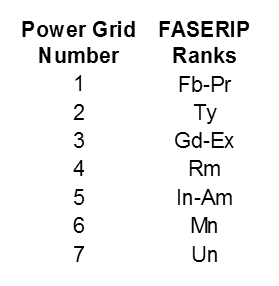
The next question is, for those abilities that do correlate, how to convert from numbers to ranks? Note that the Power Grids (PG) have a 7-point scale, while FASERIP have 10 ranks from Feeble to Unearthly, so at least 3 of the former have to cover multiple of the latter. Here's the best that I could come up with:


Here's some commentary on how valid this is: The categories on the far ends are clearly correct and not up for debate: in the PG, a value of 1 means "below normal" (Feeble or Poor in FASERIP), and 2 means "normal human" (Typical); the value 7 indicates a maximum superhuman (Unearthly).

The place where there's possibly some debate is the range 3-6 or so -- the long "flat spot" in the FASERIP ranks, where the game was really optimized to handle mid-level heroes like Spider-Man, Captain America, or Wolverine with extra granularity (and not so much higher- or lower-powered characters). There's some evident "gray zone" here, and the PG value of 4 might reasonably convert to any of Excellent, Remarkable, or Incredible, in different cases.

Generally if I check against the top 8 Marvel heroes as featured on the Wiki (Spider-Man, Iron Man, Wolverine, Captain America, Thor, Hulk, Nick Fury, Black Widow -- i.e., ones recently featured in the movies), and compare Official Power Grid ratings to FASERIP game ranks, then the conversions are either spot-on or within about 1 rank higher or lower.

However, it's impossible for the conversions to be completely consistent. For example: in Fighting Ability, Spider-Man and the Hulk get PG 5 and FASERIP Remarkable, while Wolverine gets a PG 4 and FASERIP Incredible (that is: lower in the Power Grid but higher in FASERIP), and there's no way for any conversion to synch up with that twisted reversal. In general, when the conversions are off I think I trust the actual FASERIP values as being more well-considered. (Wouldn't you agree that Wolverine should be a more experienced fighter than Spider-Man or the Hulk?) A confounding factor might be that possibly the characters have evolved in key ways in the last 30 years of comic continuity, but I doubt that's a major factor.

On Strength: Technically, the Strength Power Grids are given weight-value definitions that would correlate with a FASERIP rank one step higher than that shown above (examples: PG 2 is "up to twice own body weight", like FASERIP Good "400 lbs with difficulty"; PG 5 is "up to 75 tons", similar to FASERIP Monstrous "80 tons with difficulty", etc.) But on the other hand, actual characters in the Marvel Wiki have scores that do convert according to the table above (examples: Captain America PG 3 with published FASERIP Excellent; Thor and the Hulk with PG 7 and FASERIP Unearthly). So I would go with that, which has the added advantages of being aligned with the other abilities, and allowing the Power Grid range to synch up with the Feeble-to-Unearthly span (no Class 1000 or the like).

On Speed: You would kind of like the Speed category to correlate with the FASERIP Agility, but it doesn't. The Speed Power Grid represents mobility by way of flying or super-speed, and needs to get converted to a Power in the MSH game (examples: PG 3 "Subsonic Superhuman: peak velocity below Mach-1 (approximately 760 miles per hour)", PG 6 "Speed of light: peak velocity up to 186,000 miles per second"). So it's entirely uncorrelated with the Agility ability. Some examples would be Captain America (no speed power: PG 3 vs. Incredible Agility; 2 levels higher) or Thor or Cannonball (high speed but low agility: Thor 6/Ex, Cannonball 4/Pr; in each case 3 levels lower). A really extreme case would be the Hulk who is listed at PG 7 Speed but only Poor Agility, a difference of fully 8 ranks. (Side question: Can anyone explain to me why the Hulk is given a "Warp Speed" classification on the Wiki?)

On Intelligence: While we would like some better way of estimating a character's FASERIP abilities for Intuition and Psyche, unfortunately it's pretty clear that the PG Intelligence correlates to Reason and nothing else; the conversions above work fairly well for the Reason ability, but not for the other abilities. Some key examples of characters with low Reason but high Intuition/Psyche would be Wolverine (PG 2, RIP Ty/Mn/In), Thor (PG 2, RIP Ty/Gd/Am) and Daredevil (PG 3, RIP Ty/Mn/Gd); in each case the PG Intelligence is about correct for Reason, and does not reflect the higher special mental ability. Somewhat ambiguous cases might be Dr. Strange (PG 4, Gd/Mn/Un) or Professor X (PG 7, In/Am/Mn), where the Intelligence scores seems skewed a bit upward in recognition of their famed mental abilities. Overall: You'll have to come up with your own Intuition/Psyche estimates, because they are not usually reflected in the PG Intelligence value.

Conclusions: For less-known characters who never got FASERIP statistics, there may be some value in looking up the Marvel Wiki Power Grid and using the table above as a starting point for the character's Fighting, Strength, Endurance, and Reason scores. The PG Speed and Energy Projection values might be used as an estimate for the Ranks in those super powers (although this is untested). However, judgements must be made because there are some points of disagreement in the systems, and in some cases the Wiki assessments seem suspect (possibly more so the more unknown the character is). Furthermore, the FASERIP abilities of Agility, Intuition, and Psyche have no direct correlates, and must be estimated by the judge in the traditional fashion of comparing to other characters in the role-playing game.

2014-01-12

Super Sunday – On Disneyfication

In 2009, Marvel Comics was bought by the Disney corporation. Generally speaking, this is just one more step in Disney's inevitable conquest of all things beloved in my childhood: Marvel Comics, Star Wars, the Muppets, what-have-you. A Borgification, if you will.

Let's talk about the Marvel cartoons produced in the last 15 years or so. My opinion is that series such as X-Men: Evolution (2000-2003), Fantastic Four: World's Greatest Heroes (2006-2007), Wolverine and the X-Men (2009), and Avengers: Earth's Mightiest Heroes (2010-2013) are very fine works of art, and I've watched them multiple times with my (non-superhero loving) girlfriend to great mutual enjoyment. However, from what I can tell more recent series have "jumped the shark" and have become barely watchable. It's not completely definitive that Disney is the one to blame, but it does match up pretty closely with series that are entirely developed and produced post-buyout.

The change seems pretty clear to me, and I can see it in both the one-season cutoff to the Wolverine show, and the distinct tonal change to the Avengers show in its second season. Wolverine and the X-Men was perhaps the zenith of Marvel TV production, having evolved a very mature sensibility and style, presenting an unrelentingly tense, and frequently terrifying look at a nigh-dystopian present and future. Avengers: Earth's Mightiest Heroes, while having a more cartoonish art style, had very  textured characterizations, and an ingenious season-long plot hook, which I found to be extremely satisfying (and I wrote about here).

More recent cartoons (Ultimate Spider-Man, Avengers Assemble, Hulk and the Agents of SMASH) suffer from a number of self-evident problems. One is that some directive has gone out to explicitly skew them towards a younger audience; gone are the tense themes from the earlier X-Men series, for example. Second, and related, is that some requirement has been put forward to make them "funny" in the most juvenile fashion possible: it seems like every episode requires one or two slapstick moments or really stupid, forced jokes. (Examples: mini-Spider-Man asides to the audience in the fashion of Family Guy, Hulk mugging for the camera in a reality-show "private cam" recording device, Iron Man announcing that he's erased Dr. Doom's video streaming queue, etc.). Third, the shows seem to have become nearly wall-to-wall mindless violent action sequences for the entirety of the episodes (some of the best scenes from the old Avengers show were the complicated evolving relationship between Clint and Natasha, or Steve trying to give Tony boxing tips; no more of that). Generally the characters seem a lot dumber, either because that's supposed to be funny or because the writers are lazier about caring for forced or holey plot points.


If you watch both of those videos above that I found at random in the last day or so, for about 2 minutes or so each, you'll notice that both of them feature giant green booger jokes. Maybe that was actually a requirement from the executive offices, I don't know.


Another problem, most evident in the Avengers Assemble show, is that the old show was terminated and the new show produced in order to align the property with the current Marvel movies being produced. Specifically: the character designs were redrawn to make the characters look exactly like they do in the movies (the cartoon Captain America now looks exactly like Chris Evans, Hawkeye like Jeremy Renner, etc.). But this is a fool's errand, because the the cartoons will constantly be playing catch-up to the movies in this regard. Consider: A cartoon series produces around 20 episodes or so per year, while a movie franchise puts out one production every two years or so; therefore the cartoon needs to present about 40 times as many heroes and villains over its run. Granted that movie producers are given free reign (and encouragement?) to totally re-design any character from the ground up, they will without exception be different from the cartoon, and thus leave the cartoon once again out-of-synch with the movie property. A great example of this is the Avengers Assemble inclusion of the Falcon as a primary team member; while all the other members look identical to their recent movie appearances, the Captain America movie coming out next year has used the Falcon character, and of course totally redesigned him, leaving the cartoon distractingly out-of-synch in this regard. But that would go for any hero or villain covered by the cartoon that a movie later opts to use. Really better to let the properties evolve naturally in their own universes, as these kind of misalignments are inevitable, and only highlighted when the other roles are freakishly duplicated.


So it seems like to me, the "golden age" of the animated Marvel TV show has come to a close, in light of Disney looking like it's forcing an attempt at a much younger audience, and requiring that the shows be an appendage to the enormous movie franchise that they currently have going. (Which is a loss in the sense that I think that the recent cartoon shows had much more satisfying writing and character development; not being allowed to truly take advantage of the longer-form medium is a real shame.)

A final, corollary point is how this development again proves the lie to late-era D&D and Star Wars apologists (etc.) over whether our vision is clouded by mere age and nostalgia. Once again we can easily perceive a compelling and exciting piece of storytelling (like Wolverine and the X-Men or Avengers: Earth's Mightiest Heroes), even when we are well into our adult years, and note the disaster that occurs when the property is taken over by marketing interests who want to change its pitch to an audience of the youngest children at all costs.

2012-06-25

Marvel Super Heroes X-Men — Birthday


The X-Men Battle Evil Mutants and Robots on a Special Anniversary


This past weekend, my girlfriend and I trucked up to Boston to visit very good friends of ours for a house-cooling party (to commemorate the end of either them or I holding a lease there for a 16-year period). I figured this would be an excellent time for a game of Marvel Super Heroes (FASERIP), which we played on Saturday night. They're not hardcore gamers, but they've taken well to it in the past. I made a short adventure for the X-Men, and gave them a half-dozen character options to pick from. Their choices -- Colossus, Kitty, and Rogue (an interesting group, I think).

SPOILERS -- This adventure is largely inspired/ripped off from Astonishing X-Men #7-10. If you plan to read that and don't want it spoiled, stop reading here.


Chapter 1 -- Our 3 X-Men are the only ones on-site at the mansion, overseeing a group of 20 students. I made up 3 new random student characters for the adventure, named Screech, Vector, and Tapper (you can likely guess their powers; see notes below for more). The adventure begins with the X-Men in the Danger Room, testing a new simulation written by Kitty before running students through it. This appears to be a major manufacturing facility that they have to shut down, with human guards and a fully-functional Sentinel. Rogue starts taking out the guards, Colossus runs directly for the command console, and Kitty jumps out of the control booth (where she started the program) and phases through the Sentinel, scrambling its electronics and immediately stunning/disabling it (which is hard to do!). Then she phases through the command computer which should be victory -- but a glitch suddenly makes them each appear 40-feet tall and facing off with a brand-new Sentinel of their own. Fortunately, with apparent added Strength from size, they quickly take out the opposition and then shut down the program. Concerned, Kitty scans the program and finds extra code inserted from who-knows-where. They pull up security camera footage around the mansion for the prior day but can't find anything unusual (including checking for possible duplicates of themselves, thinking of perhaps a shapeshifter like Mystique; but no such luck). They also interview the three named students (inquiries determine they're the most skilled with computers), but can't find any flaw in their alibis.


Chapter 2 -- The next night Rogue is rudely woken up by a terrible banging in the elevator next to her room. She peeks out her doorway just in time to see their foes the Blob and the Toad come out of the elevator and turn into her room -- "Hey baby, time for our date!", he bellows. Rogue tries to punch him but misses. He says, "No one says no to the Blob!" and grapples her tight in a single meaty fist. She manages to wrestle one arm out and grab his forearm, knocking him out cold and stealing his invulnerability power, which she uses to also capture the Toad. Kitty and Colossus show up and check the Blob's cell phone (modern era here) which apparently has a week's worth of come-on messages from Rogue asking him to come and help her escape. The three kick the Blob and Toad out of the mansion, and the next day convince all of the students to hand over their phones for analysis, but no trace of any of the source messages.

Kitty tries shutting down all the communications from the mansion, and notices one stray signal frequency that doesn't shut down for a few seconds later. She decodes it and finds a message that says "wake up, prepare yourself, come tomorrow night to free me"; and she also detects a response message that says "yes, will comply". They come up with a plan: Gather all of the students in the dining room for a special banquet, while Kitty sends a fake message back in saying, "Change of plans -- meet me in the foyer at noon", watching for any response or student appearing in that location. No message is returned, but a few hours later they detect "Error condition please verify". Their investigations seem stymied at this point.

Chapter 3 -- The X-Men send the students to bed as usual, then station themselves at each of the three doors outside on the ground floor, waiting for some interloper. Sometime after midnight, Rogue hears an intruder near the front gate and flies forward to investigate; it's an actual, real Sentinel (partly damaged with a missing arm and no boot-rockets) powered up for destruction. Rogue picks up a car from the driveway and throws it at it; Colossus runs up and grabs one leg, trying to punch through it; Kitty tries to phase through it and disrupt its electronics, but the armor holds true. Meanwhile, it's shooting the X-Men with powerful energy beams and ice-rays, and calling out "Death to the oppressors!"; Kitty is about to run out of breath (which dictates her maximum phasing time here). Rogue smashes back into the mansion convinced that the student Vector is controlling it with his motion-manipulating force powers, but tackling him to the ground from the window he's looking at seems to make no difference. Finally Kitty stuns the Sentinel and Colossus rips off its leg, smashing it to the ground. Kitty opens a control panel and hacks into its still-functioning command unit; she sees a series of unnerving console messages like "I know what you are doing... Our lord watches all... You will pay for your sins".

Chapter 4 -- The X-Men gather up the students together, all 19 of them. Oh, wait -- weren't there supposed to be 20? Who's missing? No one can find Tapper, the Japanese boy who can cause others to exude a hard shell and become immobilized. The X-Men split up to different floors to search for him; Colossus takes the lowest level and heads for the Danger Room controls; but he finds that the door is locked. He punches through the Amazing material easily; he enters and looks through the view-screen to find the Danger Room alive with lasers, all bombarding a single form covered with a hard shell in the middle of it. (They suspect that Tapper has trapped someone else within, but ultimately it's Tapper who's been lured in and forced to use his power on himself for protection, and thus become trapped.) Rogue enters the control room and shatters the armored glass with one punch, but then finds it's backed up by a force field. Colossus hurls himself at it but is thrown back helplessly (it's Unearthly class). Kitty shows up and tries to phase through it but can't (that's a specific limitation on her power).

Rogue thinks to check the nearby room on the map of the mansion, labelled "Shi'ar Danger Room Support Computers", which they've never been in. She smashes down the door to find a massive array of complicated machinery, glowing tubes and conduits, all connected to a geodesic dome at the center. She tries to unplug the cables from the dome but is shocked by electricity and thrown back. Colossus enters (he has Remarkable resistance to electricity) and snaps all the cables off. An enormous flash of white light erupts and momentarily blinds them all.


When the light fades, the machinery is all gone from the room, having been refashioned into a female-formed robot. She says, "Shall we begin?" -- at which point Rogue immediately launches at her, but the robot dodges her punch. The robot kicks Rogue in the back. The others all attack, while the robot says, "Try your best, X-Men -- I know all of your powers!". Kitty phases through her but has no effect (I would have to fail an Monstrous Endurance feat roll with 01-20 to succumb). Colossus and Rogue both charge, but the robot dodges them both (costing quite a bit of villain Karma). Colossus lands a mighty punch, except that she materializes a Monstrous-level force-shield on her arm at just the right time to completely counter it. Kitty keeps phasing back and forth through her to no effect. Rogue attacks again, except the robot grabs her in mid-air and throws her face-first at Colossus: which thereby drains Colossus' power and knocks him out. The robot then forms Wolverine-like claws and stabs through Rogue's now-armored form (Red-level attack result), putting her down and stunning her.

At this point Kitty succeeds at a phasing attack, and temporarily stuns the robot. She tries to finish it off -- two more successful attacks will do it -- but 7 rounds tick by with no success. The robot wakes up and grabs the unconscious Rogue, forming a force-spike against her temple. "Surrender or I'll terminate your ally!" Kitty asks, "What are the terms?" The robot says, "You will un-phase and permit me to beat you senseless!". Kitty launches another attack at her, at which point the robot drives the spike into Rogue's skull; her Endurance starts to drop, one rank each round. Kitty and the robot continue to fight, neither getting the upper hand. One round before Rogue expires, Kitty unphases, makes a Reason feat roll to wrap her sash around Rogue's head and stop the blood loss, and at that point a crushing fist from the robot hits Kitty and knocks her out.

They find themselves woken by the students -- Screech, Vector, and Tapper -- with the Danger Room shut down and the Blackbird jet having launched with an unknown occupant. They track it down the next day by car in Virginia, abandoned near a military facility. The trail is cold, and the X-Men have a new deadly enemy in the world, but they saved the students from harm and retrieved their plane.

Commentary -- This went pretty well, if a bit longer than I planned on (which is always the case -- took about 4 hours for the whole episode). My girlfriend said it was the most enjoyable RPG she'd ever played, which is great news. My friend John said he was surprised and rather relieved when I pulled out MSH instead of D&D (something I have to remember in the future). It seems like there's a big benefit here, especially in one-off games with non-hardcore players, to provide pre-generated characters with which they have some familiarity (as from X-Men movies or cartoons here), and also have extremely brief character descriptions for (in this case, using the 2.5x4" hero cards that came with the MSH Advanced Game). It probably even helps to have just a single kind of dice in play (percentile). And I'm still playing without use of counters or miniatures for exact movement, because I truly prefer the faster pacing (I did use the map of the X-mansion from module MH-1 to give a sense of location and what resources they had available). There was some amount of frustration expressed from Kitty's player in regards to the investigation, and self-criticism from myself would be that the adventure was more railroaded than I would like, with probably not enough opportunity for players to alter the proceedings or possibly disrupt the villain's plan at the end. That's something I definitely need to improve on, especially in the context of non-location (non-dungeon) based adventures.

Final notes: We played this the evening of Saturday Jun-23, which marked the 100th birthday of Alan Turing -- genius codebreaker, inventor of the first computer and the principles of artificial intelligence. (And then sadly the victim of being hounded to death by the government for being a homosexual.) I felt it was nice to have in his commemoration an adventure revolving around themes of machines becoming sentient, people being tricked by messages from a computer, and the desire to break free and fully realize one's preferred life. I think it worked pretty well, and was thrilled to have very smart, game players and good friends with me. Thanks also to Joss Whedon who's done yeoman's work recently in the Marvel Universe, including the Astonishing X-Men run that originally had this storyline.

Here are the adventure notes I was using for this (PDF).


2012-02-04

Super Saturday: Shift X

In the past week, this blog hit 150+ followers, making it officially "Shift X" as per the Sorcerer's Skull OSR Blogger Advancement Table, Superhero Flavor (otherwise known as the Marvel FASERIP Universal Table). Zounds, that's as powerful as when Thor hits you with his hammer! As always, big thanks to everyone who reads and/or comments here. :-)

2011-12-17

Super Saturday: Avengers on XD

So just recently, the new cartoon that I've been watching is Avengers: Earth's Mightiest Heroes, which I've been viewing piecemeal on YouTube (apparently all of the episodes are available there). I've basically fallen in love with this cartoon, and it's quite rapidly catapulted itself into the league of my top-ever-favorites, like #1 X-Men Evolution, and #2 Justice League. The fact that it has "Disney XD" branding initially made me very skeptical (along with, I suppose, the art style), but it's turned out to be extraordinarily satisfying. It's actually quite mature in terms of character, plot, and theme. Probably the strongest element is that it pictures a very large world (in fact, I'm becoming convinced that this is the single strongest advantage that Marvel has in any of its best incarnations), with lots of different characters and conflicting power-centers, many of whom are untrustworthy, shadowy, and ambiguous (especially SHIELD and the rest of the American industrial-military structure). It's honestly surprising who's allied with whom -- and sometimes who is disguised as what. I love the fact that the story starts in media res, with a legion of supervillains who obviously have their own pre-existing (but left offscreen) backgrounds, with the whole lot staging a massive super-prison breakout at the start of the series -- and thus setting up a totally compelling long-term plot for the show. The episodes are not self-contained, as this larger plot continues to drive the action forward. I adore the fact that there isn't just one, but a whole bevy of "mastermind" super-villains who are all around trying to hatch their own competing conspiracies. I'm really impressed by the characterizations I've seen so far, particularly of the Hulk and Thor, my top-two favorites superheroes. Some pieces of business are delivered very crisply and tellingly. Example: In one episode, Thor tells Jane Foster about the Odinsleep, in which his father is helpless for a week each year in Asgard, and the ongoing argument over whether Thor should be there at that time. Jane asks why he doesn't go: "It is... complicated," says Thor. "Really?" says Jane, "Because it just sounds like you're mad at your dad. There's nothing less complicated than that." I think that's a surprisingly poignant line for a kid's cartoon. Some other stuff: My girlfriend almost burst into tears at how they told the tale of Wonder Man in episode #10. After the "Gamma World" story (hey: RPG shout-out) in episodes #12-13, we were both so terrified, amazed, and jazzed up that we almost couldn't sleep that night. The show also uses a lot of unconventional (for a cartoon) storytelling techniques, like flashbacks, flash-forwards, parallel locations, unusual perspectives, and occasionally running part of the same story twice from a second character's point-of-view. It also seems like someone gets their face melted off about once an episode, yowch! One downside is that the show started with 5 episodes which set up the main characters individually, and these are a bit slow-going. The real fireworks start when the top characters come together and start sparking off each other; but you will probably still want to watch the setup episodes, or else the "Breakout" story with about 500 different characters all running around may be overwhelming. (When consolidated for "Season 1", the setup stories are episodes 3-7, and the Breakout which happens chronologically later is shown as episode 1-2.) I guess one other thing is near the end of Episode 2, where my #1 favorite hero does this in an attempt to take down the master villain: Dude, you just blew up the entirety of Downtown Brooklyn! Oh well, I guess that would've gotten me out of jury duty the other week. Anyway, for those of you still alive, if you like Marvel comics, then you should definitely watch Avengers: Earth's Mightiest Heroes. Highly recommended (caution: very habit-forming!) [Top picture by edwick under CC2.]

2011-12-03

Super Saturday: People in Your Neighborhood Pt. 2

Last week we saw that my favorite superhero, Thor, lives in my neighborhood of Bay Ridge. Here's someone else who visits from time to time: 

Crikey, Punisher, did you really have to gun down everyone in that restaurant? Oh, well, I guess there's plenty of other Italian places around here... [Page from Marvel Super Action Featuring the Punisher #1, p. 1, by Archie Goodwin and Tony Dezuniga.]

2011-09-03

Super Saturday: Fantastic Four TV

Recently for my superhero fix, I've taken to watching the animated Fantastic Four: World's Greatest Heroes show, from circa 2006, on the free Hulu service.

I did not immediately care for it: for me, it was a bit of an acquired taste. In fact, after watching 1 or 2 episodes I took to calling it "that terrible FF show" -- but over the summer I wound up watching it anyway over dinner (without much else on that was new-to-me). It has very anime-esque art and over-the-top (say: juvenile) humor, with the Thing and the Torch routinely in open combat with each other as a gag. And the overall design follows in the footprints of the poorly-received 2005 Fantastic Four movie (including Doctor Doom's power design and involvement in the spaceship-launch origin, Alicia Masters' ethnicity, etc. -- not that I've seen said movie).

But after a while I've come to appreciate what the creators are doing with the show, and have found it to be a lot more rewarding than I first expected. It turns out that there's actually some very nice, subtle character development, and I think it's my favorite portrayal of Mr. Fantastic that I've ever seen (brilliant but fallible, and just a bit oblivious when his scientific wonderment overtakes him -- rings to me as true, based on colleagues that I've known). The Thing and the Invisible Woman have some very nice acting gestures. The Torch is probably the most grating, but after a while you learn to accept it and occasionally find him actually funny.

Other things: The opening title credits are uniformly fabulous, and clearly some creator was having a great deal of fun with them. The stories frequently start in media res, already and immediately in the thick of action, with the viewer forced to catch up on the story later on, through dialogue or flashback (and I routinely beg for some kind of alternative storytelling structure like this in regard to superhero movies). The series totally declines to bother with an opening origin-story episode (ditto; although you could take the live-action movie as having served this purpose).

Now, here's the thing that impresses me the most -- There are quite a few crossover/team-ups, but the show inverts the normal presentation. Like: I'm used to comic books that loudly trumpet a guest character on the cover, and maybe they only appear for a page or two, or even just in the very last panel. But in FF:WGH, it's played exactly the opposite -- frequently there's no hint or warning in the promo or title credits, and then some other Marvel hero busts into an action scene, and it's completely by surprise. I find myself literally shocked and applauding when it happens; there are several very clever touches they use to intentionally obscure or misdirect who's about to show up. In at least one episode, I'm pretty sure there's a famous character present with the FF for the entire show, who never once reveals or even hints at their super-hero identity.

And I also have it on good authority the Namor the Sub-Mariner is apparently both "hot" and "doable". So take that as you will.

Recommended -- Fantastic Four: World's Greatest Heroes on Hulu.

2011-08-13

Super Saturday: The Ultimates

The Ultimates 1 & 2 were the Ultimate Marvel re-imagining of the Avengers by Mark Millar and Bryan Hitch, published between 2002 and 2007 (13 issues each). They definitely sucked me in, with what I consider to be gorgeous art, compelling dialogue, and generally intriguing characterizations. Plotting by Mark Millar was perhaps a little more sketchy. One thing that really struck me, once I finished the complete work, was how almost perfectly parallel the two volumes were in terms of overall story arc. Below I present the Ultimates 1 & 2 Plot Point Comparison Table:
Plot PointUltimates 1Ultimates 2
Issue #1 opening-scene Captain America airdrop target is:Nazi nuclear missile baseIraqi terrorist kidnapping site
Issue #5 team powerhouse identified as a threat who receives a brutal full-team beatdown, and then gets imprisoned, is:HulkThor
Issue #6 Giant-Man embarrassing sideplot concerns:Domestic disturbance versus the WaspJoining the non-superpowered Defenders
Issue #8/9 team member identified as a threat who receives a shocking beatdown by one rogue member is:Giant-Man (at the hands of Captain America)Captain America (at the hands of Nick Fury)
Issue #9/10 method by which the entire SHIELD atomic helicarrier fleet gets instantly destroyed is:Alien nuclear bombStolen security codes
Issue #9-11 unearthly invasion force which takes over America is:Skrull alien space armadaLoki's Axis-of-Evil army, followed by Norse mythological monsters
Issue #12-13 character who returns by surprise, dropping out of the sky to fight and ultimately kill the otherwise-unstoppable enemy leader, thereby saving the world, is (and see issue #5 above):HulkThor
(Photo by Mr. Tea under CC2.)

2011-08-06

Super Saturday: MSH Box Delta

So this interaction happened between me & my girlfriend a few weeks ago: 


D: [Walks into room.] Hey, let me show you something. 

I: What? 

D: Here's the box to this old role-playing game, Marvel Super Heroes. Normally it features the headshots of these four primary heroes, but I added one myself. I found a headshot of Thor, printed it out at the right scale, cut it out, and glued it in place. 

I: Wow, you really had a thing for Thor back when you were a teenager, didn't you? 

D: Yeah, I really did... [Walks out of room]

D: [Walks back into room.] You realize I'm saying that I just did this last night? 

I: Oh.

2011-06-11

Super Saturday: Rogue's First Kiss

Trivia Question: Who was Rogue's first kiss in Marvel publication history? Hint: It's the most awesome possible character, of course. (Scroll down to see who it is...) Hell yeah, it's ROM THE SPACEKNIGHT!!! (Fooled ya, maybe?)

This is Rom #32, which I believe is just Rogue's third appearance ever as a character. She first appeared in Avengers Annual #10 (August 1981), then Uncanny X-Men #158 (June 1982), and then here in Rom #32 (July 1982). Of course, the kiss doesn't really do anything because Rom's an alien cyborg -- although the follow-up panels give Rogue a stunned expression, with a caption that says it's her first experience with true decency, and, "She finds that she... likes it." Which leads Siskoid over at Blog of Geekery to conclude: "There you have it, folks: Rom is so The Man that one kiss from him turned Rogue to the Light Side of the Force." Man, I love me some Rom. (I mean, not in that sense. Not that there's anything wrong with it.) Big thanks to Siskoid for the Rom retrospective and scans. Edit: Fooled you again! Via the comments, poster Agent of W.E.R.Q., points out that Rogue actually did kiss someone in the earlier Avengers Annual -- Captain America, while unconscious, successfully stealing his powers. Mea culpa. Well, it was nice to think about!

2011-04-23

Super Saturday: Incredible Shrinking Hammer

Most cartoons and comics seem to go through a period of style evolution in their early days. Below are a series of shots of Thor's hammer, starting with his first appearance in Marvel comics.

Compare that to the current "Thor Lightning Hammer" toy based on the design from the upcoming new movie: (Pages from Journey Into Mystery #83, 94, 95, 103, 109, and Thor #130. Penciler Jack Kirby [except Joe Sinnott #94, 95]. Dates 1962-1966.)