2020-02-24

In Which Gygax Gets Disenchanted with Wandering Monsters

Graffiti of monster eating human

Here's the standard rule for wandering monsters in OD&D Vol-3 (1974), p. 10; underlined emphasis by me:

Wandering Monsters: At the end of every turn the referee will roll a six-sided die to see if a "wandering monster" has been encountered. A roll of 6 indicates a wandering monster has appeared. The direction of appearance is determined by random number generation considering the number of possible entries. Distance and surprise are decided in the usual manner. The kind of monster is determined on the table below... 

Recall that in these rules, one exploratory turn is meant to be 10 minutes. So that's quite a few wandering monsters; we expect one every hour of in-game time at that rate. Now let's fast forward to the AD&D DMG (1979), p. 9, in the first section of "Introduction":
The final word, then, is the game. Read how and why the system is as if is, follow the parameters, and then cut portions as needed to maintain excitement. For example, the rules call for wandering monsters, but these can be not only irritating - if not deadly - but the appearance of such con actually spoil a game by interfering with an orderly expedition. You have set up an area full of clever tricks and traps, populated it with well-thought-out creature complexes, given clues about it to pique players’ interest, and the group has worked hard to supply themselves with everything by way of information and equipment they will need to face and overcome the imagined perils. They are gathered together and eager to spend an enjoyable evening playing their favorite game, with the expectation of going to a new, strange area and doing their best to triumph. They are willing to accept the hazards of the dice, be it loss of items, wounding, insanity, disease, death, as long as the process is exciting. But lo!, everytime you throw the "monster die" a wandering nasty is indicated, and the party’s strength is spent trying to fight their way into the area. Spells expended, battered and wounded, the characters trek back to their base. Expectations have been dashed, and probably interest too, by random chance. Rather than spoil such an otherwise enjoyable time, omit the wandering monsters indicated by the die. No, don’t allow the party to kill them easily or escape unnaturally, for that goes contrary to the major precepts of the game. Wandering monsters, however, are included for two reasons, as is explained in the section about them. If a party deserves to have these beasties inflicted upon them, that is another matter, but in the example above it is assumed that they are doing everything possible to travel quickly and quietly to their planned destination. If your work as a DM has been sufficient, the players will have all they can handle upon arrival, so let them get there, give them a chance. The game is the thing, and certain rules can be distorted or disregarded altogether in favor of play.

In summary: an extended a harangue about what a bad idea randomly-generated wandering monsters are. Note the passage references the fact that, "Wandering monsters, however, are included for two reasons, as is explained in the section about them" -- but as far as I can tell, there isn't any section in the book which gives a standard process for checking for wandering monsters, nor any explanation of "two reasons" for including them.

This is one of many cases in the transition from OD&D to AD&D in which it's easy to recreate Gary's brain saying, "I'm pretty sure I wrote a rule for that somewhere, right?", with the answer being, "Yes, back in OD&D". Recall the "presumed axiom" understood by Gygax & co., as shared by Frank Mentzer last year:
Presumed Axiom: 1e rules set should expand upon, and not directly contradict, 0e rules.

Anyway, what can we deduce about the rule for AD&D dungeon wandering monsters? Despite the preceding, and without any explicit written rule section in the DMG, looking at a parenthetical aside in the example of play it seems that a change has indeed been made, on p. 98:
(Here, as about 3 turns have elapsed, the DM rolls a d6 to see if a 'wandering monster' appears; the resulting 5 indicates none.)

That is; the checks for wandering monsters have been reduced by a factor of 3. Over the course of a 4-hour adventuring session (say), instead of expecting 4 wandering monsters encounters , now we would only expect around 1. It's a little odd that Gygax didn't call out this change clearly as a rule; perhaps he felt somehow constrained by the "presumed axiom" in a way that prevented him from doing so.

Interestingly, the earlier Holmes Basic D&D rules (1977) feature the same rule, on p. 10:
At the end of each three turns the Dungeon Master can roll a die to see if a wandering monster has come down the corridor. A roll of 6 means that something has come "strolling" along.

Zenopus Archives informs us that this rule is unchanged between Holmes' initial draft manuscript, and Gygax's later editorial pass. So who initiated this revision? Did Gygax somehow inform Holmes about it, or did Holmes invent it and prompted Gygax to follow suit, or something else?

(Side note: Commentator Chris reminds me that the DMG Random Dungeon Generation has a 1-in-20 chance of a wandering monster per periodic check on Appendix A: Table I. If one roll is made per turn, then that's again roughly equivalent to the 1-in-6 chance every 20/6 ≈ 3 turns.)

Personal opinion: This aspect of Gygax's curating of the rules, as seen in the long DMG p. 9 warning -- "here is the rule, but the rule is bad, so it should be ignored" -- is probably my least favorite of all gestures that he makes. If we find from experience that a rule is not working satisfactorily, then fix it until it does. Spending time and space making excuses for it, or saying that good DMs can be expected to compensate for it, is not productive. The "presumed axiom" perhaps inculcated too much conservatism in what could have been an opportunity for smart edits in other places from more play experience.

2020-02-20

The Khopesh Curve

Here's something of a follow-up to last weekend's discussion of different approaches to XP Awards on Wandering DMs. I've previously looked at the radical switch in monster XP awards that occurred between OD&D Vol-1 (1974) and the Sup-I Greyhawk supplement (1975; which then became the basis for all XP awards in Holmes Basic, B/X, Mentzer, AD&D 1E and 2E, etc.). But I've been looking for a clearer visualization of that curve.

Here's the raw data just for Sup-I base XP awards (not including special abilities, although that just shadows this data pretty closely). You can see that the HD 1 to 8 range is where XP awards have been depressed, following roughly a quadratic curve; and then the higher HD 9 to 20 range, where the XP pretty much follows the same linear 100-per-HD award seen in the earlier Vol-1:


Now, here's a cleaned-up version showing just the regressed curves in the two pieces (using Wolfram Alpha):


For future identification purposes, I hereby name this shape the "Khopesh Curve":


Side note: The Wandering DMs are at TotalCon in Marlborough MA all this weekend -- check out our live streaming updates and if you're there, please say hi to us in person!

2020-02-17

Subterrane Surveys: Caves of Chaos

This week we're looking at possibly the most-played of all D&D modules, Gary Gygax's Dungeon Module B2: The Keep on The Borderland (1980). Of course, we're not so interested in the Keep as the nearby, humanoid-infested adventure area, the Caves of Chaos. Bear in mind that this was the third adventure-supplement to be included in versions of the Holmes Basic D&D set (previously including the Dungeon Geomorphs, and later Mike Carr's Module B1: In Search of the Unknown). A smart move by Gygax, granted that the Basic D&D set had surprisingly become TSR's top seller (S. Applecline cites an estimate of some 1.5 million copies of module B2 being produced). That said, there is evidence that B2 was originally drafted using OD&D rules for hit dice.

Design: The adventure site here has a markedly different design from Gygax's early Castle Greyhawk or Dungeon Geomorphs mapping style. The map has a lot of negative space (it's not fully-packed with navigable space as are his earlier top-level maps). It has 11 different identified "cave" complexes, each with their own entry point from the central outside ravine. The cave complexes average about 6 keyed areas each (range between 1 and 14). Most are inhabited by a single humanoid type; and most have a secret entrance connecting to one other cave complex.

The stocking in most cases follows a regular pattern; given 6 standard areas, there are usually something like 2 guard rooms, 1 common room, 1 chief's room, and 2 "other" (like a storeroom, banquet area, slave pen, etc.). Usually the chief in each case guards the large treasure cache.

At this point, Gygax seems to have finally abandoned the early ideology that the majority of rooms in a dungeon should be empty of any contents. In fact, none of the 64 keyed entries are entirely empty of contents. Related, he no longer uses duplicated area codes for multiple areas (every space is unique). The vast majority of rooms have monsters in them: 57/64 (89% occupancy rate), very different from his earlier guidelines and dungeons that have only 20% or 33% occupied. (And consider how many more eyes saw this product as exemplary, versus those earlier rules.)


Characters: Under "Notes for the Dungeon Master" on p. 2, Gygax says: "This module has been designed to allow six to nine player characters of first level to play out many adventures, generally working up to second or third level of experience in the process." I think this may mark the first time that, in addition to explicitly stating a standard party size, an adventure also gives an expected progression rate upon completing the module. While 6-9 player characters may seem large by modern standards, consider that it still roughly matches normal convention-game sizes. I'll assume that a group is adventuring with around 8 total PC levels (same as expected for Carr's Module B1).

Monsters: As stated above, most rooms have monsters in them, with 57 total creature encounters in the place. In contrast to earlier adventures (Gygax's Castle Greyhawk, or Mike Carr's B1), the monster numbers here are all fixed specific quantities, not given as ranges. In the table above I've organized statistics for each separate cave complex. Most of the caves have a median encounter strength of 4, 5, or 6 EHD (Equivalent Hit Dice). There are three complexes that have about double that median encounter strength, i.e., 9, 11, or 12 EHD (caves H, J, and K). The module does not identify distinct "levels" to the Caves of Chaos, but we might hypothesize that caves H, J, and K are "2nd level", with the rest all being "1st level". If so, then a group of 8 PCs should generally be able to handle the average threats therein.

But one thing to note is that in many cases the "common area" of a cave complex has a very large number of monsters, presenting an outlier area of possibly extreme danger. For example, the kobold complex (cave A) has a median encounter of EHD 5, but the common chamber (room 6) has 40 adult kobolds all of whom will fight, for a total EHD of 26 by my estimation. Likewise the common rooms for the hobgoblins, bugbears, and gnolls have total EHD of 2 or 3 times the nearby guard rooms; and the evil shrine area has a median EHD of 12 but one area with a veritable army of undead, for a total of EHD 60. Keep in mind that all of these creatures have every reason to spill forth and attack if an alarm is generally raised; and the humanoid common areas would likely have to be entirely filled with bedding from wall to wall to house the indicated numbers. Possibly if PCs fight smart and bottle up the numbers with an organized front line in the narrow passages, then these encounters would be more manageable than the raw numbers indicate.

What about wandering monsters? The text of the module never explicitly says. On the one hand, there is a tear-out rules summary sheet in the center that duplicates the wandering monster lists for levels 1, 2, and 3 (originally as per the Holmes published text, the tables therein created by Gygax; in a later edition the Moldvay B/X tables were inserted instead). We might use the 1st/2nd level classification I suggested above. If so, Gygax's tables in Holmes have an average EHD of 4 at 1st level, and 8 at 2nd level; so they would be only slightly less strong than the set encounter areas. But on the other hand, two of the caves are noted with specific roving guard groups who attack intruders who make a commotion (goblins in cave D, zombies in cave K), so the expectation for wandering monsters is not entirely clear.

Compared to the previous module B1, module B2 is much more densely packed with monsters. B1 had an average EHD of 4 throughout (both levels), and an occupancy rate of only about 32%. In contrast, B2 has median encounters of between 5 and 12 (depending on cave complex), some very highly-populated monster lairs, and an occupancy rate of 89%. In total, B1 will have about 72 EHD of monsters, while B2 has 464 EHD, over 6 times the monster threat. As I've stated before, you can adventure in B1 quite successfully with around 4 total PC levels, but you shouldn't dare try that same thing in B2.

Treasures: Almost all of the areas with monsters also have some kind of treasure; specifically, 49/57 (86% ratio). Gygax is clearly customizing treasures, i.e., not using the book rules, because coin values come in odd values to the units-place, like 76, 139, and 157 (not round 10's, 100's, or 1000's in the various book tables). Moreover, almost every single humanoid is given a small amount of personal treasure, like 1d6 or 2d6 copper, silver, or gold coins. Frankly, this was one of the more frustrating things about analyzing this module, as it took quite a bit of calculator-work on my part to compute expected coinage from all these die-rolls in these scores of areas. In some sense you can understand the gesture of "Gygaxian naturalism" to have many scattered odd-amounts of personal coins, but in many cases the total value is negligible (like 2, 5, or 10gp total in an area), and I think it may detract from the game to have to roll, sum, and document these many weird small numbers.

Note that in OD&D Vol-2, men (and only men) are given this kind of small individual treasure, per the footnote to Treasure Type A (p. 23). In later rules Gygax expanded this to many different types of monsters; the first debut of the idea was when he struck out the old Treasure Types table in the Holmes Basic D&D draft and replaced it with an extended table with various small individual types -- even though none of the monsters in that work used them (see here). This same table was expanded a bit more, and more comprehensively used, in the AD&D Monster Manual. B2 represents the first adventure where this is generally utilized throughout.

In almost every case the chief of a cave complex has a large, significant treasure hidden someplace in their room. I suppose we might argue about whether the small-personal coinage everywhere else should even be counted as a true treasure, but I have done so in the ratio above. Total treasure in the place adds up to 28,657 gp, about 8 times the amount in Greyhawk level 1 or both levels of B1 combined. While that's a much larger total haul of treasure, it's about 60 gp per monster EHD, still very close to the ratio we saw in both of those earlier works (but less than the Gygax-edited Dungeon of Zenopus with a ratio of 100, to say nothing of Holmes' hyper-inflated draft valuation of 500 gp per EHD).

Magic: In addition to every chief having a large treasure, they almost always one or two magic items, as well. (The evil shrine has an even larger proportion of magic.) There are 13 treasures with one or more magic items out of 49 total treasures (27% rate). This is very similar to the ratio in Mike Carr's B1, but less than the earlier Holmes or Greyhawk dungeons (which had rates around 50%).

Experience: As usual I'll ignore wandering monsters (of which there is some ambiguity, above) for this purpose. If we use the Greyhawk-style revised XP awards that appears in Holmes Basic D&D, then total XP from all monsters adds up to about 5,500, and treasures add up to 29,000 or so, for a grand total of about 34,500. The monster: treasure ratio is about 1:5 (16% to 84%). The total is indeed a bit more than enough to promote 8 fighters from 1st to 3rd level, as asserted in the introductory material to the module (see "Characters" above).

Compare to using the Original D&D Vol-1 XP awards where we give a higher, flat 100 XP per EHD. Then, given the incredibly large number of monsters herein, we get 46,400 XP from monsters, added to the 29,000 for treasure, for a total of 75,400 XP. This would be a monster: treasure ratio of about 3:2 (62% to 38%), and the total would actually be enough to promote 8 1st level fighters to 4th level, exceeding the expectation on the 2nd page.

 Or as another alternative, consider: Would Gygax expect to give XP for magic items? While not in the Basic D&D rules this is ostensibly designed for, we know he did this in practice in his own games (and was consistent if you consider various rules in OD&D, the D&D FAQ, and AD&D DMG). Using the AD&D values as a metric, there is about 26,500 XP from magic available in the caves. With Sup-I monster XP awards the grand total would be 61,000, in the ballpark of the prior paragraph. (And the proportions would be 9% monsters, 48% mundane treasure, 43% magic treasure, roughly similar to the ratios seen in the 1st level of Castle Greyhawk.)

The overall lesson is that compared to earlier dungeons, the Caves of Chaos are much more densely packed with content; almost every room is veritably bursting with monsters and oodles of treasure!

2020-02-10

Subterrane Surveys: Caverns of Quasqueton

Today we'll be looking at the overall design, encounters, and treasure in Mike Carr's D&D Module B1: In Search of the Unknown (1979). At one point this was packaged with the Holmes D&D Basic boxed set, so many people have adventured through its dungeon, the Caverns of Quasqueton, and it is much beloved. This beginning module has a special format, in that it comes with about 5 pages of general "how to run an adventure information" (something like Mike Carr's personal addendum to the D&D rules system), and 7 pages as the back of premade PC/hireling lists. While giving extravagantly-detailed room dressing throughout (in fact: I would argue too much), the monsters and primary treasure are given in a roster at the back, with space left in the text for the DM to place those objects as they see fit (and so, automatically customizing the dungeon for each DM and play group). Possibly this is an echo of the structure of the D&D Monster & Treasure Assortments, with its separate 1-100 lists of monsters and treasures for each level, which this module replaced as the insert to the D&D Basic boxed set? This methodology is shared only by the unpublished version of module B3: Palace of the Silver Princess by Jean Wells, and the introductory module for the Top Secret espionage game, Operation: Sprechenhaltestelle by Merle Rasmussen.

Design: Quasqueton has two levels, a basic-dungeon-like upper level and a caverns-like lower level. These designs are mostly very similar to those seen in Gygax's Castle Greyhawk, or the Dungeon Geomorphs product (Basic Dungeon, Caves & Caverns). As is customary, the upper level is mostly fully-packed (use every space), while the caverns level has a good deal of unused negative space. There are many by-the-book navigational tricks and traps, such as: pits that hurl a party to the lower level, mazey sections, death-by-a-thousand-doors sections, invisibly sloping passages to confuse what level you're on, dropping gates, etc.

As noted above, the rooms are copiously detailed with dressing for a mostly-intact former fortress (some room descriptions go on for many paragraphs or even multiple pages), without noting any monsters at all -- those are for the DM to fill in from lists at the back, much like the prior Monster & Treasure Assortments (more on that at a later date; perhaps I should have written a post on that first).

There are 56 keyed areas; unusually, the numbering runs sequentially across both levels (it doesn't restart from 1 on the lower level), and the monster & treasure list is likewise not distinguished by level. Note in the 1979 monochrome version room codes were in Roman numerals, while in the 1981 color-cover version room numbers were switched to Arabic numerals, greatly simplifying reading and writing an index for the site. The stocking pages at the back suggest using 16-20 out of a list of 25 monsters; and 15-25 out of a list of 34 treasures. If we use the median suggestion of 18 monsters in 56 areas, that is a 32% occupancy rate, in line with the OD&D rulebook, Gygax's Castle Greyhawk, the M&TA supplement, etc. However, unlike those prior works, given Carr's elaborate room dressing in almost every area, now almost none of the rooms on the upper level are truly "empty"; only about a half-dozen of the caverns on the lower level are left without any description at all.

This latter quality (practically no empty rooms), and moreover the very extensive room descriptions, marks a really radical break with Gygax's earliest one-line-per-room dungeons. Note that this, with Lawrence Schick's AD&D Module S2: White Plume Mountain, constitute the first two modules published by TSR by people other than Gygax himself (both in 1979), so it's not surprising that the design aesthetics start to evolve more rapidly at this time.

Characters: The module publications at this point in history do finally include explicit party strength recommendations (albeit not on the cover yet). However, it contradicts itself: on p. 2 it specifies "a party of 3 to 6 adventurers", whereas on p. 7 it says, "a party of 3-8 adventurers" is appropriate. (Thanks to Glorious Trousers in the comments for pointing out the two entries.) Anyway, we might assume the implies around 8 total character levels; e.g., maybe 8 1st level characters or 3 3rd level characters on opposite ends of the continuum. Note that the Sutherland illustration on the Players' Background Sheet handout shows a mixed group of 8 adventurers departing a castle for the wilderness. In the lists of characters at the back of the module, rules are given for determining NPC levels; for every class of character, this resolves to rolling a d6 with equal chances for 1st, 2nd, or 3rd levels.

Monsters: Granted the unusual format of module B1, it doesn't help to look at a room-by-room listing, but instead consider the entire monster roster at the back:


Note that monster numbers are given in a range (e.g., 1-4 orcs), much like Gygax's Castle Greyhawk key, the Wandering Monster lists in Holmes Basic D&D, the Monster & Treasure Assortment, etc. The average (mean and median) encounter strength is 4 EHD, exactly like the Holmes sample dungeon (Dungeon of Zenopus); less than Gygax's Castle Greyhawk (with average EHD 6). If we use the suggested 18 or so monsters from this list, then total EHD for the complex would be around 72 EHD.

Separately, this seems to be the first introductory-level module with its own customized wandering-monster tables (that is: not assuming that the rulebook's stock wandering tables represent the ecology of this specific dungeon). Unlike the general monster roster, these are distinguished by level:


We see the wandering monsters on the upper level are indeed a bit weaker (average EHD 3) than those on the lower level (mean EHD 4, median 5). Note these are somewhat weaker than the wandering encounters specified (by Gygax) in the Holmes Basic D&D rulebook. Possibly the new DM should take a clue from this and put stronger, and related, monster lairs on the lower level.

Compared to the standard party strength (seen above), this module makes for a fairly safe training ground for new players. The expected 8 PC levels is twice that of the average EHD 4 monster encounter. And they outweigh the average 1st-level wandering monster by about 3-to-1. That seems in line with the OD&D book suggestion, but different from Gygax's Basic D&D rule (where wandering encounters should be equal to, or more than, the PC strength). Indeed, I've had players be very successful in module B1 and then get annihilated in their first encounter in Gygax's module B2. (Watch out for that next step!)

Treasures: See below for the roster of treasures to be placed by the DM.


The treasures listed here have a median value of 24 gp, mean 85 gp. As usual, the distribution is right-skewed, with a small number of more valuable treasures. (This includes magic item treasures valued here at 0.) If we place the suggested 20 or so treasures, then we would expect a total value of 20 × 85 = 1,700 gp. These treasures tend to be in the 10's or 100's of gp, so clearly not from the rulebook's monster Treasure Types table (which has units in the 1000's). Moreover, the treasures are now detailed down to the units -- not just 20 or 50 coins, but here we see 15, 28, 35, etc.

But wait, there's more, because Mike Carr's detailed room descriptions already include a fair number of valuable objects that the PCs can loot as treasure. When I add these up, coincidentally, they sum to almost exactly the same 1,700 gp. (Leaving out certain objects like a 5,000 gp statue which is described as effectively immovable, a pair of gems which may randomly appear but most likely don't; see rooms 4, 32, and 45.) So the total retrievable treasure is around 3,400 gp value. This gives a ratio of about 50 gp per monster EHD in the place (the exact same figure as in Gygax's Castle Greyhawk; we saw twice as much in Gygax's edited version of the Dungeon of Zenopus, but that was coming down from Holmes' hyper-inflated draft treasures).

Note also that the text suggests placing more treasures than monster encounters. So likely all or almost all of the monsters have a treasure, and others are hidden in the complex as well.

Magic: Carr's treasure list has 8 useful magic items; there are two weapons, two armors, two scrolls, one potion, and one ring. (There are also several trick useless items: a false map, wand, and a cursed bag.) That constitutes about one-quarter (24%) of the whole treasure list; a bit lower than what we see in Gygax or Holmes' earliest works, but nowhere near as low as that suggested in OD&D Vol-3 (5%).

Experience: Let's assume we use the revised Greyhawk XP charts, as officially included in the Basic D&D rules. Ignoring XP from wandering monsters for simplicity, the total XP available is expected to be around 18 × 48 = 864, with treasure XP about 3,400 (as seen above). The grand total available is then 4,264. The monster: treasure ratio would be about 1:4 (20% to 80%). Note this total is only enough to advance 2 fighters to 2nd level, not close to enough for all of an 8-person starting party (similar to what we saw for the Gygax and Holmes dungeons).

On the other hand, if we use original D&D XP awards at 1 EHD = 100 XP, then the expected 72 monster EHD would generate 7,200 XP; combined with the 3,400 treasure, the grand total would be 10,600. This still wouldn't advance an entire 8-person party, but would be enough to advance 5 starting fighters. In this case the monster: treasure ratio would be about 2:1 (68% to 32%). Given that this is a two-level dungeon, it highlights that Carr was taking things easy on the starting adventurers; there's a relatively small number of monsters, and small-value treasures, within the Caverns of Quasqueton.

2020-02-03

Subterrane Surveys: Dungeon of Zenopus (per Gygax)

Today we're again looking at the sample dungeon in the first Basic D&D set (1979), the "Dungeon of Zenopus". Last time we looked at Eric Holmes' original unpublished draft. But after Holmes submitted that work, Gary Gygax took an editorial pass at it, changing many items on a line-by-line basis. Among his larger changes included the entire wandering monster system, the treasure tables and XP, and the monsters and treasures in the sample dungeon itself. Zenopus Archives informed us of all the details. Let's give it a comprehensive analysis.

Design: The dungeon gets a new professional-grade map, although the overall structure is largely the same. Whether the changes here also came from Gygax's direction, or were just artistic flourishes, is not entirely clear -- but the changes do seem in line with Gygaxian written philosophy at the time.

In particular, Gygax was consistent to this point that dungeons should have lots of empty rooms. The map moves in that general direction with the addition of another 3 empty rooms. This gives a total of 8 in 23 rooms that are totally-empty (35%, or 65% with some kind of content). While that's a bit lower content rate, it's still nowhere near the guidelines in Gygax's OD&D Vol-3, the Monster & Treasure Assortment, or Castle Greyhawk (respectively suggesting as low as 33%, 20%, or 25%).


Characters: We've mentioned that at this point in time neither the rulebooks nor adventure have hard specification for the standard adventuring party size. One place Gygax makes very large changes is in the wandering monster section. There, he cuts out the language that Holmes took from OD&D Vol-3 (that monsters should scale to party size at about one-third the numbers). Here he writes:
The number of wandering monsters appearing should be roughly equal to the strength of the party encountering them. First level adventurers encountering monsters typically found on the first level of a dungeon should be faced with roughly equal numbers, i.e. a party of three would encounter 2-6 orcs, 3-12 giant rats, etc. However, if the party were second level, or the first level monsters were encountered on the second level of the dungeon, the number of wandering monsters encountered should be doubled. In a like manner, the number of monsters should be tripled for third level adventures or in the third level of the dungeon if the monsters appearing are first level.
The only example he gives there is for a party size of 3. And while he addresses possibly different character levels, he says nothing about differing character numbers. So perhaps we should take parties of size 3 as the new norm? (Which seems very different from the playgroups of 12 or 20 simultaneous players we've seen in various other sources.)

You may recall from last time that Holmes has a passage in the introduction to his sample dungeon suggesting that if a player adventures solo, then they should take one or more hirelings with them (so maybe just 2 characters). This passage is left unaltered in the published version. However; we'll see below that Gygax went through and increased monster numbers and strength throughout the dungeon, so this advice is no longer appropriate.

As I said last week, when I ran this as my first-ever DM'ing (or RPG play of any sort) experience, I had my friends individually each take 1 PC and 1 hireling -- the result was that all of them died horribly on their first D&D expeditions. That formed our initial impressions of standard D&D play, and arguably, my lifelong quest to make sure that D&D adventures aren't too terribly broken in terms of balance for the expected adventuring party. 

Monsters: There are still 13 monster encounters, as in the Holmes draft. But Gygax increases monster numbers and strength throughout the dungeon. For example, he turns a 1 HD giant spider into a 6 HD monstrosity. He changes a single 1 HD giant rat into a more dangerous swarm of 2-8 half-HD rats. He increases hit dice for skeletons, a giant crab, and an octopus. He increases the number of pirates.

The median encounter is now 3 EHD, with a mean of 4 EHD (up one pip each from the Holmes draft). Also his new wandering monster tables have an average encounter strength of 4 EHD, as well, so on par with the set encounters (up from just 1 EHD in Holmes). I would suggest a party of at least 4 1st-level PCs to be on par with any of these encounters. The total set monster power in the dungeon is now 46 EHD; up from Holmes' version that had just 35 EHD (a 30% increase). 

Treasures: Gygax keeps treasure in all the same locations that Holmes does. But while in his editorial pass he notably increased the monster strength, he even more radically decreased the value of the treasures.

The primary way that he does this is that while Holmes used only silver and gold coins in both his text and dungeon, Gygax inserted the additions of copper, electrum, and platinum, and generally shifted all of the coin treasures to some lower-valued type. He also reduced the largest treasure in the dungeon, the jewelry in the necropolis room, from 3000/3000 gp to just 300/900 gp (in so doing, making them fair game for the edited jewelry rule of 300-1,800 value per piece, the lowest category from OD&D).

It should be pointed out that Gygax struck out the OD&D treasure table that Holmes had copied, and inserted a new one, which expands the Treasure Types from OD&D's A-I with added types J-T. This includes a series of per-individual monster small unit treasures, in contrast to the original types which were all in unit's of 1000's of coins. It looks particularly strange here because almost none of the new types are used by any of the monsters in this book (I think only type Q with a few gems is used in the stirge entry). This table matches the one found in the AD&D Monster Manual (1977), except that work also has space on the page for types U-Z. (See here for details.)

And another thing: In two separate places Gygax adds warning text that the Treasure Types table is only meant to be used for large groups of monsters in their lair. This recalls the rule in OD&D Vol-2 (p. 23) that treasure is only found in the "Lair", as assessed by the probability given in the Monster Reference Table (p. 3-4) -- which itself has monster numbers in the range of hundreds, and is noted as being "primarily only for out-door encounters". And that same rule is again repeated in the AD&D Monster Manual, p. 5 ("The use of treasure type to determine the treasure guarded by a creature in a dungeon is not generally recommended."). So this seems like a place where Gygax as editor seems to think Holmes essentially misunderstood the core rules (cloudy as they may have been expressed), and took action by dramatically reducing all the treasure values involved.

The total treasure available after Gygax's edits is less than 4,700 gp, a sharp drop from the Holmes version with almost 18,000 gp (leaving only about 1/4th the original treasure value). There is very close to 100 gp of treasure per monster EHD in the dungeon.

Magic: Gygax leaves all of Holmes' existing magic items unchanged; and he adds one item, a magic dagger in the hide of his now-colossal spider. This gives 5 treasures with magic out of 9 -- a 55% rate (only slightly off Holmes' original or Gygax's own Castle Greyhawk).

Experience: Gygax strikes out Holmes' abbreviated XP table, and inserts back the more detailed OD&D Supplement-I table (stopping at 5 HD to fit the available space). Using this, total placed monster XP adds up to 940, with treasures of about 4,700, for a grand total of 5,640. The monster: treasure ratio is 1:5 (16% to 83%). This reduced total is not enough to advance 4 1st-level fighters (what would balance the average set and wandering encounters) to 2nd level.

On the other hand, if we used the original Vol-1 XP method (say 100 XP per EHD) then the total 46 EHD gives 4,600 XP, almost the same as the rounded 4,700 gp treasure value; the grand total would then be about 9,300 XP. The ratio is then basically 1:1 (close to 50%:50%). And this total is enough to advance 4 1st level fighters to the 2nd level (assuming they clear out every monster and every treasure).

Possibly the low advancement under the first method highlights that the combination of Gygax reducing XP awards in Greyhawk (to about one-tenth the Vol-1 rule, at low-levels), combined with stripping out awards for magic items (in Basic D&D), has served to produce a fundamentally XP-deficient environment.

On the other hand, Zenopus Archives points out in the comments that in the Monsters section on p. 22 Gygax inserted, "As a guideline, it should take a group of players from 6 to 12 adventures before any of their characters are able to gain sufficient experience for successive levels". On the other other hand, in The Strategic Review Vol II, No. 2 (one year prior), he gave a guideline for leveling that worked out to an average of about 6 games per level. If I ballpark clearing out maybe 7 rooms per game session, then the Dungeon of Zenopus might take 3 or 4 sessions to clear, and Gygax's XP awards would be on track, expecting roughly as many sessions in another location to level-up the party.

I'll say that in my OD&D-style games for the past year or two I've been using the latter method; I plan to set monster and treasure values in about a 1:1 ratio, with monster XP and treasures both equal to 100 times the total enemy EHD, and not bothering with XP for magic items. This seems like a pretty simple, easy-to-remember rule-of-thumb, and progresses the PC levels in a reasonable fashion.

2020-01-27

Subterrane Surveys: Dungeon of Zenopus (per Holmes)

Today we're looking at the sample dungeon from the first-ever D&D Basic Set, edited by Eric Holmes (1979) -- what many of us now call the "Dungeon of Zenopus". This has been very influential over the years -- and just last week, our friend Zenopus Archives published a 5E conversion on DM's Guild. It may be among the best-ever starter dungeons for new players.

We'll be looking at this in two parts, because we can identify at least two versions of the dungeon that differ in significant ways. There's the actual published version, that we'll get to next time. But before we do that I want to look at the original manuscript draft by Holmes -- as shared previously by Zenopus Archives himself. See that link, Parts 47 to 54, for his notes that I'm using for the work here (compiling the statistical information together in one place).

Design: The layout differs markedly from Gygax's early fully-packed (use every space) style, as seen in his Castle Greyhawk or the Dungeon Geomorphs (upper levels). Note that initially the Dungeon Geomorphs were included in the box with this ruleset, so Holmes seems to be striking out a different (simpler?) aesthetic here. He uses a lot of empty/negative space. The halls and chambers are almost totally locked to the graph-paper grid axes (no diagonal hallways, no trapezoidal rooms; except for one circular room in S and the few rough caves in the lower-left). This new design style is perhaps similar to the sample level given in the OD&D Vol-3 text, and later dungeons like the sample in the AD&D DMG.

Many of the chambers are extremely large by basic D&D standards. Most of them are too large to see the entirety using torch light (30' distance in these and other rules), and many are too large for infravision, as well (60' distance). Room A is 120' × 100', so about one-fifth the size of Notre Dame cathedral by area, while possibly only containing beds for just 2 goblins (or a few more depending on party size). Room N is as long and likely equally wide before its north wall collapsed, containing ten sarcophagi. These rooms are far larger than anything seen in Gygax's castle Greyhawk map, shown in the Dungeon Geomorphs product, generated by the AD&D DMG random dungeons tables, etc.

Five of the 20 areas are entirely empty ("E" code on the map); or in other words, 15 of 20 have some kind of content (75%). This is a far higher rate than suggested by Gygax's OD&D Vol-3, or Monster & Treasure Assortment (which argued for just 33% or 20% occupancy rates), or shown in his Castle Greyhawk map (25% with content; see two weeks ago).


Characters: As seen before, to this point in the publication history, no explicit party-size expectations are given in either the rulebook or the adventure materials. In Holmes' draft in the wandering monster section, he keeps the same language from OD&D Vol-3 (and also the same interpretation I take from the slightly muddy language there), that on average a party of 1-3 will meet one monster, a party of 4-6 will meet two, etc. In the introduction to his sample dungeon, he writes:

Because of the nature of some of the traps in the dungeon, it is highly recommended that no one attempt it alone. If only one player is taking his or her character into the dungeon, the Dungeon Master should recommend employing one or more men-at-arms. These non-player characters can then be "rolled up" and hired out for a share of the treasure.

So Holmes seems to be saying that as few as 2 characters working together, of 1st-level each, might be able to adventure successfully here. As a new DM in the first few days after opening the D&D Basic set box, I ran several of my friends through the Dungeon of Zenopus with one PC and a single hireling (more on the results of that next time).

Monsters: There are 13 monster encounters in the 20 keyed rooms (65% occupancy rate). The encounters have a median of EHD 2, and a mean of EHD 3. This means indeed that most of the encounters should be on the order of a fair fight for just 2 1st-level PCs, in accordance with Holmes' advice in the quoted paragraph above. The total placed monster strength is 35 EHD.

In terms of wandering monsters, following his draft rules -- which are close to a copy from OD&D rules -- a party of 1-3 PCs should only be facing one 1st-level wandering monster at a time, which would be EHD 1 in almost all cases; about half-strength from the placed encounters, and should be well-manageable.  

Treasures: Eight of the 13 monster encounters have some kind of treasure present (62%). There are no treasures in rooms without monsters. It seems clear that in almost all cases, Holmes directly used the monster Treasure Type tables from OD&D, copied in his draft, because almost all of the coins treasures come in units of 1000's. (Exceptions: the pirates have 2-12 gp each individually, in accordance with the special rule for Men from OD&D Vol-2 that Holmes copied into his draft Pirates monster entry; and there is one bag of 50 gp in some garbage, possibly in line with the OD&D Vol-3 random dungeon treasure table.)

Holmes' draft has a simple rule for gem and jewelry values; 50-500 gp each. While the gems are all in this range, the jewelry is all weirdly outside this range (a belt worth 1000 gp, and rings and coronets worth 3000 gp). However, they are legitimate products if one were using the OD&D jewelry table. 

Total treasure in the dungeon adds up to about 18,000 gp. On average there are about 500 gp of treasure per monster EHD in the complex. Note that this is ten times higher than in Gygax's Castle Greyhawk, which had a ratio of only 50 gp per EHD. (!)

Magic: Among the 8 treasures, 4 include magic items (50% rate), for a total of 5 items. These include: two scrolls, a potion, a wand, and a magic sword. All but one of these are initially in the control of the wizard who is the principal of the dungeon. This is close to the same rate as seen in Gygax's own Castle Greyhawk (43%), but much more than suggested in the OD&D Vol-3 dungeon treasure table (there: only 5% per treasure on the 1st level).

Experience: Recall that in assessing Gygax's Castle Greyhawk there was a question about whether we should award XP for picking up and keeping magic items or not. That parenthetically-suggested rule in OD&D is entirely excluded from the Holmes book (even post-Gygax edit!), and so too all of the later Basic D&D line. So when assessing an adventure officially for Basic D&D, there is no ambiguity; XP comes only from monsters and monetary treasure. Also, for simplicity, we'll ignore XP from wandering monsters, since we can't tell in advance how many times the party will have such encounters (or more fundamentally, how much time they'll take in the dungeon).

Holmes' draft includes a cut-down version of the revised (reduced awards) monster XP chart fro OD&D Supplement-I, Greyhawk. See here for specifics. Using that schedule, total monster awards add up to (only) about 400 XP, with about 18,000 for treasures, for a grand total of (you guessed it) around 18,400. The monster: treasure XP ratio is about 1:45, or about 2% to 98% (probably the largest differential we'll ever see). This would be enough to promote a party of 3 fighters from 1st to halfway through the 3rd level, which seems quite generous.

On the other hand, let's consider what use of the original, simpler, XP rules from OD&D Vol-1 would buy us; assume a fixed value of 100 XP per monster EHD. The total of 35 monster EHD in the complex would gives us 3,500 monster XP, and with 18,000 in treasure, a grand total of 21,500 XP. The monster: treasure ratio would be a more reasonable 1:5 (16% to 84%), and again the total would be enough to promote 3 fighters from 1st to the upper end of 3rd level.

2020-01-23

In Memoriam: B.J. "BigFella" Johnson

Sadly, one of my best gaming buddies, B.J. Johnson (who identified online as "BigFella"), passed away suddenly and by surprise last weekend, at a fairly young age.

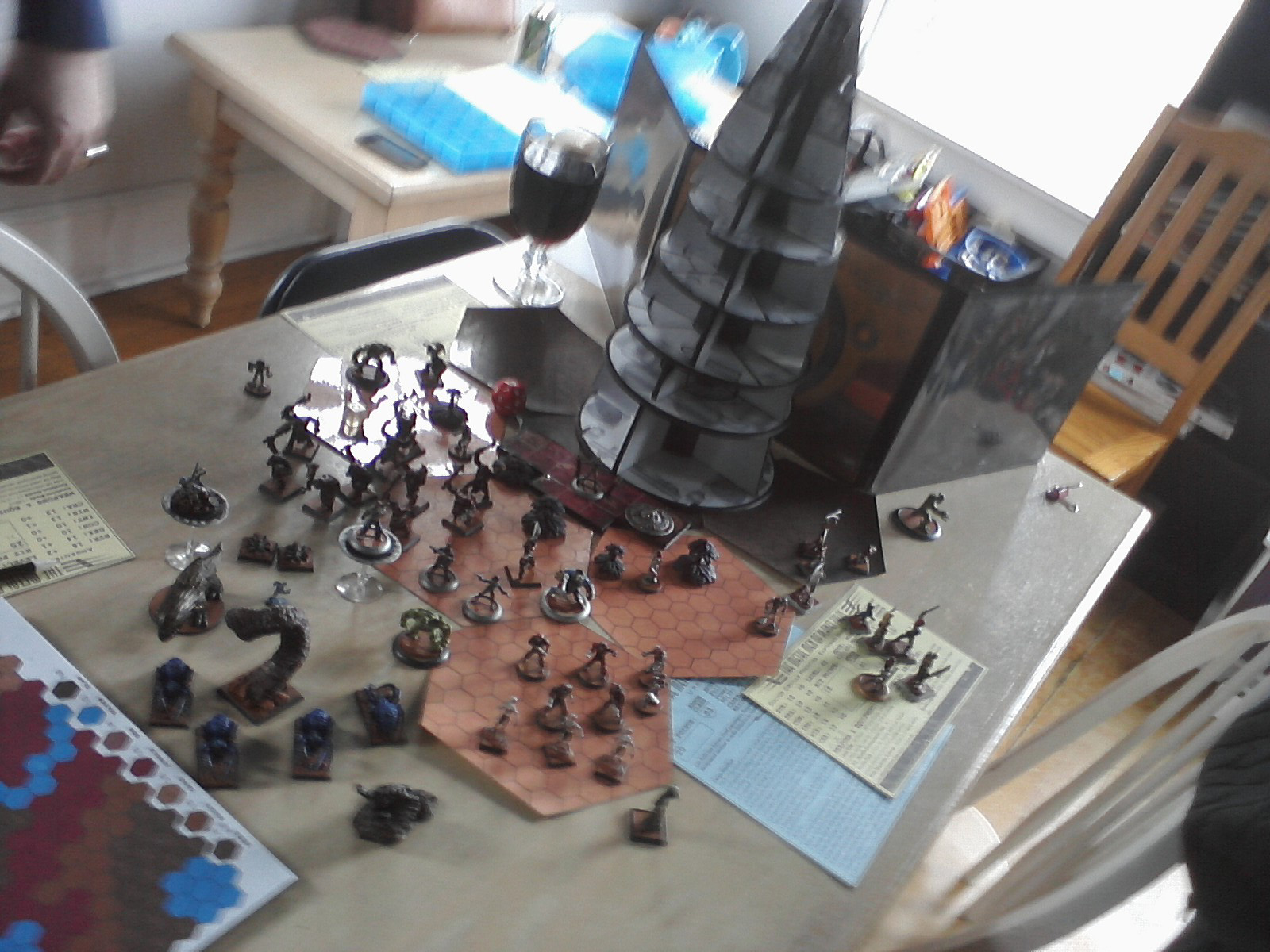
B.J. was at least a triple threat: an incredible artist, game designer, and miniature-modeller. We met around 1998 or so when we were both hired at Genetic Anomalies, Inc. (later a unit of THQ), along with Paul Siegel and others (see Paul's memory here, including the most perfect photo of BJ imaginable). None of us knew each other before that, but we've been lifelong friends ever since. In particular, we all started a regular D&D game that lasted for most of a decade, and allowed us to get to know each other much better outside work.

We've been living in separate states for a while, but we've always been in close contact and saw each other at least once a year at our regular house-con in the spring. Every year BJ would show up with jaw-droppingly elaborate game setups; entirely customized rules, handouts, play maps, 3D structures, customized miniatures for every PC and monster, lore and backstories... just on and on and on in unbelievable depth and detail. I've never seen anything like it, so consistently and in great variety, at any other game or convention I've ever been to. After every game he'd usually spend an hour or two pulling out extra boxes of miniatures and illustrations we didn't get to, telling every one's backstory.


His personal website, collecting samples of artwork, was at BigFella.com. His gaming blog, which he'd kept for the last decade, is on Blogspot: Saturday Night Sandbox. If you browse through those you can see him sharing many of his creations, miniature-making, and so forth. Also in recent years (partly at Paul's urging, which was as usual master-level advice that we all benefited from), he started pulling his multifacted creations into publications which he released on his storefront at DriveThruRPG: Big Fella Games. There you can see his abiding love for Mutant, Western, Arabian, and Halloween-themed stuff (all of which had been playtested for some years by those of us in his annual games).


Last July, one of the pinnacle joys in our Wandering DMs marathon livestream game was the fact that B.J. was watching and posting laugh-out-loud commentary all weekend long in the live chat. (Anytime everyone at the table spontaneously starts laughing it's because of something BJ said online.) In our last show last season, we riffed for a bit on how perfect it would be to have a livestream game where B.J. acted as a color commentary man. In the show from one week ago on self-publishing, at one point I waxed rhapsodical about how the single best thing in game development was to write a new piece of content and hand it off to an artist, who would give it back with some mind-blowing unexpected take on the subject... well, that story was really 100% me thinking about working with B.J. at Genetic Anomalies on the Chron X game (a feat which he pulled off dozens and dozens of times).


Adding to the list of tragedies is that for the past year or so he'd been writing a sci-fi game based on my OED rules for D&D, and had been regularly sending me chapters one after the other for proofreading, as well as artwork pieces, fancy maps, etc. New races, classes, aliens, robots, coding-music-magic system, equipment, spaceships, new worlds, galactic backstory, etc., etc., etc. The whole thing was just incredible and the culmination of about a decade of games he'd been running. It just seems unbelievable that he didn't get to have people see this finished.


I've always looked at BJ's design and world/adventure-building skills with a mixture of awe and jealousy. I figured if I could have even one-quarter of the productivity he did I'd be happy with myself. So, I'm pretty broken up about his passing at the moment.

Being distant it's hard to make this all concrete. As I try to reach out to people I keep thinking that there might be some mistake or miscommunication, that he'll pop up and send a "Hey, wait" email, and then I'll have to apologize to everyone immediately after. Having a project we were halfway through together is making it extra hard. I still have multiple pending messages from him and readings that I had to get back to him on, so every time I open my email right now it feels like I'm still mid-conversation with him.

So I guess I just had to share his embarrassment of creative riches with folks at least one more time. BJ had one of the biggest and most generous hearts of anyone I ever knew. We played off each other incredibly well, in a virtuous cycle, even if sometimes we might get prickly or impatient or hard-to-understand with other people in our lives. He was the epitome of someone being loving and faithful and self-sacrificing to friends and family. A lot of his improvised jokes and one-liners became part of my standard vocabulary. My longest-running PCs were in his games. He was most often voted team leader/caller in the large-player games I'd run, because everyone trusted him to be fair and equitable and supportive. He made the cover artwork to my DM screen. One time the two of us mercilessly massacred another 7-person team at a game of Pictionary. We traded off reading each other's toy-based 80's comic books. I sent him a select batch of my old Dragon magazines to fill out his collection last summer (he had to have all the Wormy comics). He gifted me with his classic ROM action figure after I said my parents had accidentally thrown mine out years ago.

I guess I could go on and on with lots of stories in that vein. Immensely hard to believe all those plot threads got snipped in the last week. If you go check out his work, I hope you'll get a fraction of the brightness that he put into my life. 

You can still see all of BJ's published products at his DriveThruRPG store, via the affiliate link below (and you'll be helping support the Wandering DMs channel while you're there):

Big Fella Games at DriveThruRPG