2010-06-04

Gygax on Conan

Gygax devoted the entirety of his "Sorcerer's Scroll" column in Dragon Magazine #36 (April 1980) to a dossier on Robert E. Howard's Conan character. He says in the first paragraph that this was inspired by the Schick-Moldvay "Giants in the Earth" series that had recently garnered some attention. I think it's interesting in a number of ways. Without reproducing the entire article, I'll present the summary table and briefly outline the rest of the article afterward.


Looking at this table, we see a number of interesting design decisions. As Gygax writes, "All ability statistics are based on the assumption that Conan was a prime example of the physically and mentally superior individual...". All of his ability scores vary up and/or down over the course of Conan's life, not wholly unlike the rules in the DMG. (Intelligence in parentheses was "potential"; Charisma after a slash was with regard to females.) More interestingly, his class levels in Fighter and Thief also go up, peak, and then degenerate later on in life. (While this was never codified in any ruleset, I think it's an excellent idea.)

The rest of the article presents details on Conan's various skills, proficiencies, and special abilities, which take up most of two magazine pages (an immense length, considering standards of the time). These include -- Weapon proficiencies (14 types by age 40), thieving abilities (various bonuses), armor class (usually light armor), number of attacks (specially increased, up to 3 per round), damage per attack (normal weapons act magical, up to +3), special attacks (modified hit roll of 21+ does double damage), special defenses (surprised 1-in-20, saves get +4 bonus, can't die from poison, heals 10 hp/day), magic resistance (25% if aware), psionics (latent, stress situations only, see table above), special abilities (parry with 2nd weapon, run for a day without fatigue, 75% to hide his trail), secondary skills (6 types by age 25), nonlethal combat (special bonuses to pummeling, grappling, overbearing), and weaponless combat (attack with bare hands as a club). Phew!

Another interesting thing is that if you take this list of special abilities, and compare it to the later Barbarian class writeup for AD&D, you'll see that more things overlap than don't. Conan, appearing first in this "Sorcerer's Scroll" article, clearly served as the template for AD&D Barbarians as they would be constructed later.

Final note: You might also compare this to the much shorter writeup that came earlier in OD&D Sup-IV (Gods, Demigods, and Heroes) by Kuntz & Ward. There he's presented as a Neutral Ftr15/Thf9 with hp 117 (S18/00, I16, W10, C17, D18, X15; surprised only 1-in-12), this being somewhat similar to Gygax's writeup between the ages of 25 and 30. Of course, that work has the further advantage of detailing all the other interesting figures in REH's Hyborea, such as Crom, Set, Thoth Amon, several pages of special magic items, and so forth.

2010-06-02

Giant's Armor

When I recently ran Module G1: Steading of the Hill Giant Chief, there were some adjudications I had to make about giant armor. One issue is that although in AD&D giants are given increasingly effective armor per giant type, in OD&D they all have the same fixed value: AC4. A second issue is that while the Steading has an Arsenal/Weapons complex with giant-sized shields, helmets, and spears (Greek style?), there are no rules given as to how this helps the giants if they get in and arm themselves appropriately.

Here's what I decided to do for my OD&D game: Say that all giant types are AC5 naturally without any protection. Then say that the more sophisticated giant types customarily wear better armor, with the same number of steps protection that PCs get from them (or equivalently, normal book armor AC +4 steps). For example:
  • Hill giants, AC5 base. Normally wear no armor (primitive skins) for AC5. If giants in the Steading get to the Armory for shield & helmet, they become AC3 (+1 each).
  • Frost giants, AC5 base. Normally wear leather armor (berserker/barbarian-style) for AC3 (+2 steps improvement).
  • Fire giants, AC5 base. Normally wear giant chain mail (dwarf/heavy foot style) for AC1 (+4 steps improvement).
So you can see it becomes easy to adjudicate if a giant picks up a shield, or gets caught sleeping unarmored, etc. On the one hand, the G1 giants become easier by one step when feasting/unarmored, but are more challenging by one step if they get to their shield/helmet gear. The "normal" protection here results in being within 1 or 2 points of the revised AD&D statistics, frost giants being +1 improved, and fire giants toughened by +2 steps. If you want to make some special giant King that had full plate mail ("black iron armor"?), then he'd weigh in at AC -1, but I wouldn't anticipate using that very frequently.

Finally, if you compute the average AC among all these types in their standard armor, weighting by frequency of occurrence (6:1:1, per Vol-2, p. 9), then you get a mean value of AC 4, exactly as shown in the OD&D monster reference table for all giants.

2010-05-31

GridMapper v1.0

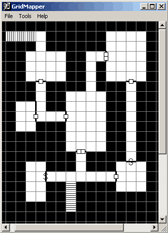
In the continuing list of things I was wishing for 20 years ago, and am getting a chance to check off now, here's GridMapper: an application for Windows that lets you create old-school dungeon complexes in the quickest possible fashion. Start with a filled-in underground map, and from the first mouse-click you're clearing spaces for dungeon rooms, corridors, etc. Additional options under "Tools" allow you to place doors, stairs, and walls. Save, open, print, resize, and copy your map to other image-manipulation software.

I've been using it for a few weeks now to make my own dungeon maps, and I'm finding that it greatly speeds up my ability to jot down ideas, experiment, erase, and play around with the layout. (Also thanks to Al-Krelaan's excellent HexMapper for some inspiration.)

Now, this is Version 1.0, and frankly it's doing everything I need it to at the moment to increase my productivity (and generally make the job more fun), but conceivably it could take some feature expansions in the future. Here's some initial ideas, and I'll let you tell me which ones sound most appealing:
  1. A free-floating toolbar in its own, separate window.
  2. Objects such as statues, trapdoors, water, etc.
  3. Loading custom icons for the various features.
  4. Automated random generation of corridors, rooms, etc.
  5. Possibly better error-handling code throughout.
A few things that I would not ever expect to add to this application are: (a) irregular, diagonal, circular, or cavernous rooms and corridors (the program is simply not set up to deal with anything other than single-square elements), nor (b) annotations like text, room key numbers, etc. I think any of those items are best produced by standard image-editing software, and when I want fine-grained details like those I just copy my base map into Photoshop and go at it from there.

Have at it and tell me what you think!

2010-05-28

Moorcock and Music

One final thing in what's turned out to be "things related to Michael Moorcock" week". Did you know that he played blues and toured all over Europe as a solo act and with bands? That he corresponded with (and covered) Guthrie and Pete Seeger back in the 50's? That he wrote the novelization to the Sex Pistols' movie The Great Rock 'n' Roll Swindle? From an interview at the Zone-sf.com in 2002:
Q: Do you think there was a connection between the social revolution of the 1960s and science fiction and fantasy? Your fiction reflects knowledge of the drugs and party scene at the time - how involved did you get in all that?

Party scene? Sounds strange to me. Didn't do much of that. There were some clubs, but they were mainly full of record business wankers, so I left those for the uni-dropouts like Rosie Boycott who seemed more interested in meeting the stars than working for the revolution.

People of my generation were attracted to SF and rock 'n' roll because they had no standing with any kind of authority - they were well in the margins and so well out of sight. Which meant you could make them your own. Drugs, I suppose, were also a natural part of that from the 1950s onwards. They were simply part of the culture I grew up in. Drugs didn't just suddenly appear in 1965, as it sometimes seems from histories of the times... Ask Charlie Parker.

What happened to rock 'n' roll in Britain also happened to SF. We turned it into something that suited our own voices and concerns. Popular arts had never seemed so good.

Q: Music and SF seem to have changed in similar ways. Do we just look back at the 1960s and 1970s with rose-tinted spectacles, or were those really more exciting times?

We had no borders. We didn't know how far we could go with something until it snapped. We were willing to try new ideas and there was money around to back them. This was before the big companies started applying the lowest common denominator technique to everything, when they didn't know what sold, so they'd back a lot of different kinds of bands. These bands came up on a flood of rage, too - young men who were not being taken on their own terms, at the simplest level, but there was politics and stuff in there, too. Whatever band nowadays admires The Who, they can never capture what The Who had - and that's anger. Anger (frustration, disappointment) also drove the kind of SF that Wells, Huxley, Orwell, Pohl and Kornbluth wrote - anger at social injustice.

In the case of the blues this was exemplified in black musicians, in the case of folk music it was originally inspired by Fenian songs and the like and later what came to be called 'protest'. A few years ago a nice young man came up to me at a funeral. He said he enjoyed my books and it seemed to him the 1960s had been really glamorous. "But my dad says they weren't really like that, they were just the same as any other time."

"That means your dad wasn't there," I said.

Also: If you haven't read James Mal's epitaph for Ronnie James Dio, do so now. And if you're into it, perhaps consider the Facebook group "I Refuse to Admit Dio Died of Cancer, I Believe a Dragon Ate Him."

2010-05-26

The Once and Future King

The book that I've read more times than any other in my life is T.H. White's The Once and Future King. It's a modernist take on the King Arthur legend (dovetailing from Malory's Le Morte d'Arthur), written 1939-1958. It's drop-dead brilliant.

I first read it, I think, when I was about 8 years old, as my mother had it for a college class she was taking. Later it just happened to be assigned reading in high school when I was around 18 or so. I continued the pattern after that, reading it at least once every 10 years or so. I'm on my 5th reading right now, maybe?

It's not part of the pulp-fantasy canon, and I can't remember it coming up with any of my other gaming buddies in conversation. It's not part of Gygax's Appendix N. Maybe it's not really applicable to D&D much at all (the tragic structure, and the sense of pre-ordained fate playing out, doesn't synch up very well with a tabletop game). Nonetheless, it's shaped a lot of my background expectations for fantasy and mythic imagery.

One of the great things about my relationship with The Once and Future King is that every time I read it, I discover new meaning -- details, references, allusions, themes -- and new depth. Each time I return, there's a new understanding that I simply wasn't ready for at a younger age.

This sort of matches the structure of the book itself, written over a period of about 20 years. The first part, "The Sword in the Stone", telling the story of King Arthur's childhood, is light and airy and frequently comical (to the extent that Disney was comfortable making an animated movie based on it); this part caught most of my attention when I was a child myself. The rest of the book, with Arthur in adulthood, was written after White had seen the effects of World War II on the U.K., and it's darker and more brooding and troubled. There's a lot to the portrayal of Lancelot in "The Ill-Made Knight" that my 18-year-old self was suddenly shocked to recognize very deeply, waiting for me like a secret map in a book that I'd already read.

Some of the wonder of White's work comes from his intimate familiarity with archaic pastimes such as falconry, hunting, and fishing. (Apparently he lived by those means in a cottage for a year or so in the mid-1930's.) Later on, he took up flying, and that experience clearly fertilized some lengthy and beautiful scenes of families of birds flying together across the North Sea. He also spent time translating a medieval bestiary (which I would recommend for some great ideas in spicing up otherwise mundane animals in a D&D game -- available online here), which itself makes an appearance in The Once and Future King, Book 2, as the Sons of Lot prepare to go unicorn-hunting.

The Once and Future King may possibly be the single best book I've ever read. Is it absolutely perfect? No, it's not.

Pre-World War II, White wrote and published "The Sword in the Stone", and I think most critics categorize the work as a comedy, even though there are some heartbreaking scenes contained within it; Arthur receives a magical education from Merlin as best he can manage. After World War II, White started writing and publishing the darker sequels, including a concluding work called "The Book of Merlin", set at the end of Arthur's reign, with one final lesson that had been, perhaps, tragically overlooked.

Now, when the whole work was put together into one book called The Once and Future King, guess what White was unable to resist doing? You guessed it: He went back and rewrote parts of the original book from 20 years earlier. He snipped out a section of a more comical adventure with Merlin's Owl, and dropped in the extended scene intended for "The Book of Merlin" in its place (leaving out the rest of that last book, but including the 4 others that came before it).

Without giving spoilers on it, this cut-and-paste scene is the single awkward blemish on an otherwise ideal piece of literature. When you're reading Part 1, this scene very abruptly interrupts other action, and it has a tone and sensibility clearly different from what's around it. White is even forced to create a Merlin-time-dilation-magic rationalization for this part, because it actually doesn't fit into the story-time allotted to it. Then when you're reading Part 4, it ends on a slightly weird note that feels something else should be coming, but it is indeed the end of the collection. And it's a little hard to see how this all-important, extra-long lesson was rather blithely forgotten by Arthur afterward, in the mid-part of the book. If you get a standalone copy of "The Sword in the Stone", apparently that still gets published in the original format.

You might see the connection with what I wrote on Monday: Things like "Artists' best stuff tends to be their early stuff" (White's most renowned and best-loved work is the lighthearted first part), and "You should read/watch stuff in order of publication" (what I'll call the long-lesson works best at the end of the overall story), and "Business corrupts art" (or whatever reason caused White to not include "The Book of Merlin" in the overall collection). Most importantly in this case: Artists going back and altering old works usually ends in tears. But at least he didn't write a prequel (well... unless you count "The Sword in the Stone" itself as being a prequel to Le Morte d'Arthur).

Oh, and one final thing: Michael Moorcock was deeply influenced by T.H. White and his most famous work, apparently having an ongoing correspondence with him for some time. According to Moorcock:
T.H. White's series had also been very enjoyable and equally tragic. White had given me some very good advice on how to write, as had Peake. White was very kind and, looking back, tolerant with me. [Interview with Zone-sf.com, 2002]

2010-05-24

Elric and Art

I wanted to call this blog posting "Elric and Art: Writing, Publishing, Business, and the Evolution of the Artist". What you get is this.

When I read the AD&D Deities & Demigods book, lo these many years ago, I fell in love with the idea of Elric. I'll leave it at that.

So about 10 years ago or so, I finally picked up a big (500+ page) collection of stories called Elric: Song of the Black Sword by White Wolf Publishing. It contains the stories: (1) Elric of Melnibone, (2) The Fortress of the Pearl, (3) The Sailor on the Seas of Fate, (4) The Dreaming City, (5) While the Gods Laugh, and (6) The Singing Citadel. "Spectacular!" I thought to myself, "I'll get a nice big heaping stack of Elric to fill in my previous lack."

And I started reading it, and I found it to be abominable. I'm nearly obsessive-compulsive about finishing stuff, but I almost gave up on this book and just ditched it numerous times. I couldn't believe how bad I was finding the writing, the characters; the sense of pacing was mind-bogglingly awful.

If you're a fan of Elric, bear with me for a bit. Numerous spoilers follow the asterisks!

******************************************************

Here's some more of my experience in reading the Song of the Black Sword collection. The freaking story went nowhere for hundreds and hundreds of pages. The writing seemed to slog on saying nothing about the main character. It seemed like it avoided saying anything of substance about the artifact-sword Stormbringer? Combat description is surprisingly lacking. There's an epic save-the-multiverse adventure that pops out of nowhere, and then is forgotten-as-a-dream afterward. Freaking yucko. I'm thinking, "Where's Moonglum and Yyrkoon and Theleb K'aarna and Cymoril and the Dragons of Melnibone?" All these epic characters I hear about are appearing nowhere in the book.

Finally, after slogging through 425 pages of this stuff, Elric's arch-enemy Yyrkoon and life-love Cymoril finally appear. And ten pages later they're both dead! And ten pages after that, Melnibone is entirely destroyed. WTF!!?!, I say. Why did you waste all my time like that, to almost immediately throw away the star villain, etc.!?

Even more spoilers coming up!

******************************************************

So in the last few months I started to do a bit more literary research on the matter. This was partly due to James Mal's recent posts about Conan & Elric, about which a lot of people seemed genuinely excited. Then I also picked the recent graphic novel, Elric: The Making of a Sorcerer, by Michael Moorcock, working with my all-time comic favorite Walt Simonson, and found it to be absolutely excellent. "How could this be?", I started asking myself.

So here's the deal in a nutshell: The stories in Song of the Black Sword are presented in a different order than they were originally published. Moorcock's first story was "The Dreaming City" (4th in this book), followed by other stuff; later on he started writing prequels. In Song you get these stories re-ordered to in-story chronological order, which was how I experienced them.

Let's unwind this and imagine that I'd instead encountered them in publishing order. The first Elric tale was a short story in Science Fantasy magazine (1961), and it's only 28 pages long. In it, Elric storms his ancient homeland, kills his cousins Yyrkoon and Cymoril (the latter by mistake), fights the ships and Dragons of Melnibone, and razes the whole thing to the ground. I'm sure Moorcock was very glad to get this publication. I think if you came to this fresh and without other preconceived notions, you'd find it to be intense, fast-paced, and overflowing with lots of exciting ideas.

This was sufficiently popular that other short stories were commissioned. In the second one ("While the Gods Laugh", 5th in this book, very near the end; 32 pages long) the sidekick Moonglum is introduced -- coming out of nowhere, but very much a nice complement to Elric's character. "The Singing Citadel" is another adventure like that, but published much later (29 pages long) -- it's last in my collection, and frustratingly ends with the biggest "tune-in-next-time" cliffhanger of any story in the book. (This final kick-in-the-nuts being the last straw for me putting up with any more Elric stories, I thought.)

So after that time (publication-wise), Moorcock wrote more stories, and the popularity allowed them to grow in size to novelettes and novellas. After nine such stories, the saga of Elric came to and end as he killed his patron god Arioch and himself (or so I hear).

But that wouldn't be the end of it! There was sufficient interest and audience demand that more Elric stories could still be sold. So now Moorcock started churning out prequels in the time before the first story, "The Dreaming City". And he was able to expand the scope to full novels. (The recent graphic novel is in fact a prequel-to-those-prequels.)

Big paragraph coming -- Here are some of the ramifications of that. (1) Moorcock's writing style had to "fatten up", with his former quick, fast-paced style needing to evolve to fill up entire novels. (2) Nothing of importance could really happen in the prequels, because the fates of Elric, Yyrkoon, Cymoril, etc., were all fixed in the "future". Thus you get stuff like the save-the-multiverse crossover adventure ("Sailor on the Seas of Fate") that Elric then magically forgets, so as to explain why he never thinks about those momentous events later in continuity. (3) The explanations and introductions for things are all in the wrong place; to Moorcock's readers at the time, they already knew everything about the sword Stormbringer by the time the prequel "Elric of Melnibone" (1st in my book) was written, so the author would have no need to repeat that information (but leaving me in the dark for most of the book). (4) Minor characters are cannibalized; what I saw as a character developed over hundreds of pages and then disposed of as an afterthought (the sea-captain Count Smiorgan) was really just a minor casualty in the 1st-written story, but brought back and developed as a great friend of Elric's in the prequels (so as to have some connection with those earlier stories). (5) Elric's personality arc makes no sense; fundamentally, Moorcock himself lightened in tone over time. In the first-published stories, Elric is a legitimate, total badass -- a cold killer and destroyer, never looking back. Later he had regrets and became a deeper, "torn" antihero; even a caring figure, but cursed to doom those around him. But this makes no sense in chronological order, as he starts out caring, suddenly turns into an ice-cold motherfucker after the middle of the book, and then inexplicably starts being surprised at having regrets near the end.

A side observation: If you read the work in chronological order, it's interesting to see that the whole "Stormbringer lends strength by sucking out souls" bit was not in the original stories; that evolved later. It's clear that to begin with, Elric expected to gain strength and power as soon as he drew the sword out of its scabbard (e.g., p. 468). It seems like there's one single sentence in the original story, which I read as a linguistic flourish, that later got transformed into literal fact (p. 433: "Elric hacked a blood-drenched path through those who attempted to halt him and men fell back, screaming horribly as the runesword drank their souls"; compare to p. 436: "Then Yyrkoon laughed one final cackling shriek and his black soul went howling down to hell.") Or maybe some of this got re-written at a later date; it feels pretty inconsistent.

Here are some lessons I think we can take from this.
  1. Prequels fucking suck. They can't have any real tension, because all the main characters are immune to death or destruction due to the already-established future. In some sense they have to be for "lower stakes" (or some kind of faux-dream-stakes; see above) so the characters aren't jaded and unimpressed by the time they get to the "real" adventure. They tend to cannibalize characters for the "Look! If you loved Captain Smiorgan, here he is again!" factor. Small stuff will get bloated in importance as every thread of relation gets sucked on in this way. Probably some other stuff I can't think of right now.
  2. Artists' best stuff tends to be their early stuff. Not strictly all the time, but frequently this is the case. When the artist is young and radical and unforgiving and with nothing to lose and the sharp edges not-yet-rounded-off, they'll probably be generating their most unique work. Or as I tell all my artist friends, "Your very best stuff will go almost entirely unnoticed."
  3. You should read/watch stuff in order of publication. The tone of the developing artist gives a much deeper "throughline" than any attempt at high-concept continuity. As a corollary: Once the author changes (either in personality or through actual replacement), quit the series in question; it's over.
  4. Business corrupts art. Again, not every single time -- but much of the time. It's an inescapable fact that lots of art will go rotten due to business concerns. For Moorcock, the novel-length publications were fundamentally antithetical to his best writing style. But, it's how the industry best sold books, so he had to do it.
Consider some other artwork series that suffer in similar ways. Think to when Arthur Conan Doyle killed off Sherlock Holmes, and then due to reader demand had to write more stories with him; so, "retcon"ing him back to life. Think about how the big comic-book companies have no real equity whatsoever (they don't own real estate, or printing presses, or retail stores, or long-term contracts with the creators) except for the copyright to some fictional characters; and so in the same way, anyone who dies is legally/economically required to be brought back to life, or the board members could be liable to shareholder action for not fully exploiting the value of the company's assets.

Think about how great Isaac Asimov's short stories are, and how absolutely shitty his full-length novels are -- he only ever had a single "event" in any of his stories, whether short or long, and in the latter case merely became bloated with do-nothing page-fillers. (He admitted once that he wrote all of his stories in one sitting start-to-end without any draft or structure planning.) But novels were a better sales-channel than short stories, which were his "real" art form.

Think about when I was young and fell in love with, and was deeply moved by, Walt Simonson's run on the Mighty Thor comic; and how stupid it was to stick with the series for the atrocious years after he left. Or how shit-tastic Lost got after the first season. Or how the thing that freaked me the most when I saw Marina Abramović at the MOMA today (as I write this) was her very first work.

Finally, think about what it's like to be a young kid watching Star Wars today. It must be the exact same experience that I had with Elric. It has prequels made out-of-chronology order. The prequels freaking suck; they're bloated and the tempo is awful and they emphasize all the wrong things that will be minor throwaway stuff in later films; characters get their memories wiped to explain outrageous ignorance in the later work. The new films are made (and old ones hacked up) by a similarly bloated, blasted, uncaring old George Lucas who kind of doesn't give a shit anymore. People will fob off the prequels on you first and none of the themes or tones will make any sense. But it made a shitload of money, so you can just suck it.

I don't think you can say that my reaction to the Star Wars prequels is just me wishing things were the same as when I was a kid. I got to experience the exact same out-of-order thing with the Elric story compilation, and I could tell that it reeked when I read it that way. But after the fact, if I strip away the prequel garbage and read the earliest story later on as an adult with fresh eyes for the first time, I can still find it to be intense, exciting, meaningful, and worthwhile on its own.

In "Appendix N" to the DMG by Gary Gygax, he lists Stealer of Souls (a collection of the first five Elric novelettes) and Stormbringer (collecting the next four novellas). I'll probably dig up some more of those stories at some point, to find out exactly what happened to Elric later in time.

2010-05-21

Awesome Cover

Look at how really awesome this cover is by Ken Rahman for Dragon magazine #34 (February 1980):